Best shower caddies, chosen by mounting surface
A shower caddy should drain, stay stable, clear the controls, and use a mounting method documented for the exact wall or fixture.
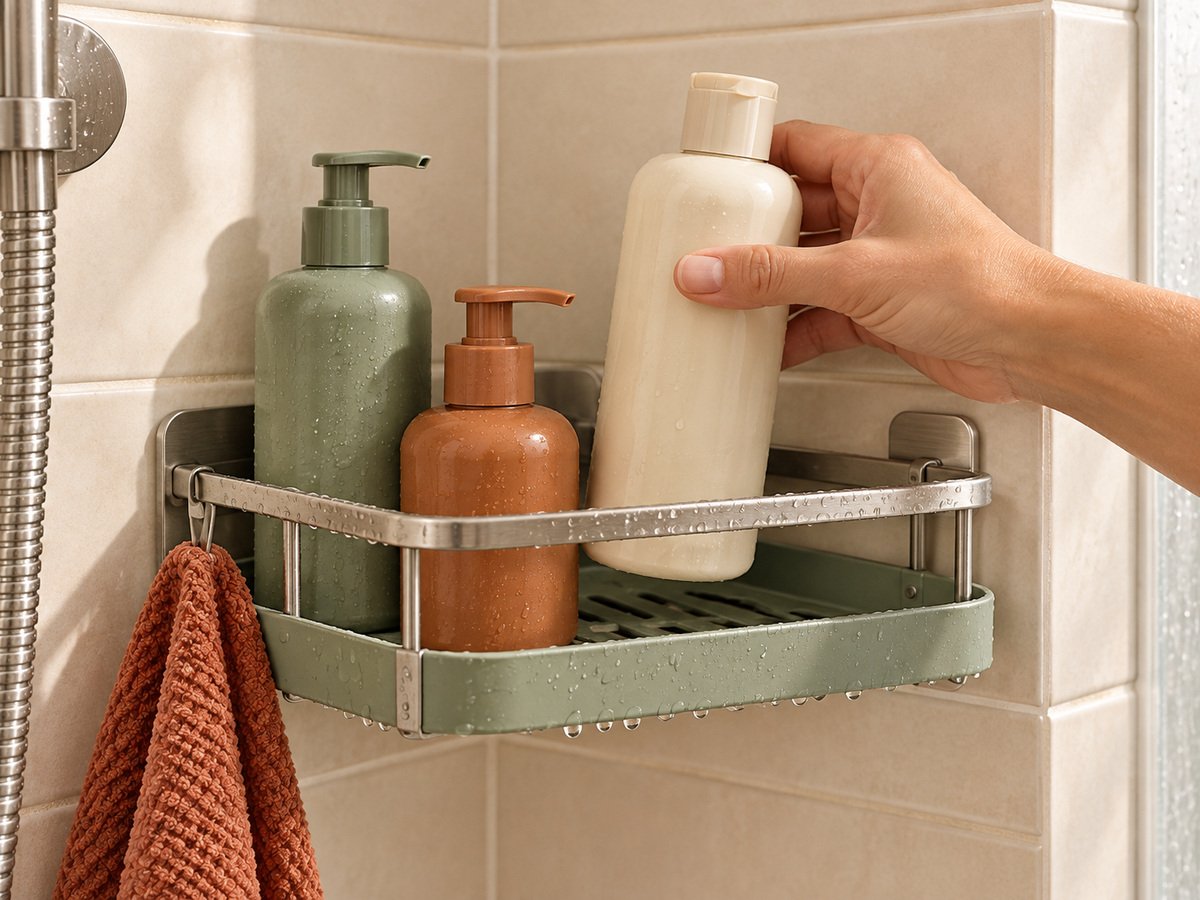
Choose the mounting family first
| Type | Best match | Measure | Main failure |
|---|---|---|---|
| Hanging adjustable | Compatible fixed showerhead neck | Neck, hose, controls and bottle height | Swinging or interfering with handheld hose |
| Tension pole | Sound floor-to-ceiling corner | Exact compressed height and corner | Poor contact or obstructed ceiling |
| Press-fit corner | Manufacturer-approved smooth wall | Tile plane and grout interruptions | Using it on an excluded surface |
| Adhesive shelf | Listed, clean, smooth substrate | Mount area and cure instructions | Moisture or texture defeating adhesion |
Documented examples
Simplehuman describes adjustable hanging caddies with movable shelves, support above and below, stainless steel and anodized aluminum. Its tension model uses a spring-loaded pole and adjustable shelves. OXO’s Press-Sure Corner Caddy manual explicitly excludes acrylic and fiberglass tub or shower walls; that kind of surface restriction must outweigh a marketplace photo.
Wet-zone checklist
- Every bottle fits below the next shelf and can be removed one-handed.
- Drainage openings remain clear.
- The caddy does not block controls, hose travel or grab bars.
- The exact mounting surface is allowed by the current instructions.
- The caddy can be removed or reached for cleaning.
Sources checked: Simplehuman shower-caddy families, its adjustable model documentation, and the OXO Press-Sure instructions.
Frequently asked questions
Do suction or adhesive caddies work on every tile?
No. Texture, grout, coatings and curvature matter. Use only the surfaces listed in the current instructions.
Is stainless steel automatically rustproof?
Material and finish claims belong to the manufacturer. Cleaning, scratches, mixed metals and exposure conditions can still affect performance.