Best laundry storage for small spaces, chosen by constraint
A cart stores supplies. A sorter separates loads. Shelves free the floor. A drying rack makes room for air-drying. Start with the job that keeps getting in your way, then choose the smallest solution that makes it easier. More capacity is not always the answer: a cart needs a clear pull-out route, shelves need comfortable reach, and a rack needs space while clothes are hanging. This comparison helps you weigh those everyday trade-offs before choosing a design.
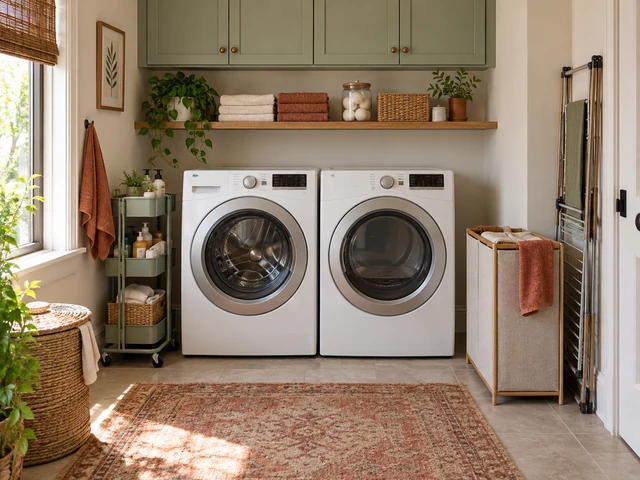
Choose by the job you need to fix
These are four different jobs, so there is no single overall winner. If your existing basket, shelf, or rack already handles the job comfortably, you may not need another organizer.
Compare the everyday trade-offs
Swipe across the table to compare all four columns.
| Choose this family | When it earns its space | Main compromise | Decisive check |
|---|---|---|---|
| Slim rolling cart | Daily supplies sit in a usable side gap. | Deep tiers are useful only if you can pull them out. | Extract it without moving a machine or trapping a connection. |
| Shallow wall shelves | You need storage while keeping the floor open. | Higher shelves are less convenient for heavy, frequent-use items. | Open the appliance fully and retrieve the item without leaning over it. |
| Divided hamper / sorter | You repeatedly separate the same types of load. | Several bags can take more floor space than one basket. | Remove and carry a full bag without unloading another section. |
| Folding drying rack | Regular air-drying needs a temporary place. | The working footprint matters more than its folded size. | Walk past hanging garments and still open the room's door. |
We compare product families by access, installation, and the work they remove from a laundry routine. These are planning recommendations, not rankings of tested models. Casa Ordenada has not physically tested the organizers; there are no active affiliate links, copied star ratings, or static prices.
Illustrations show typical layouts, not exact products or installation clearances. Use the instructions for your own appliance and organizer.
Match the organizer to your routine
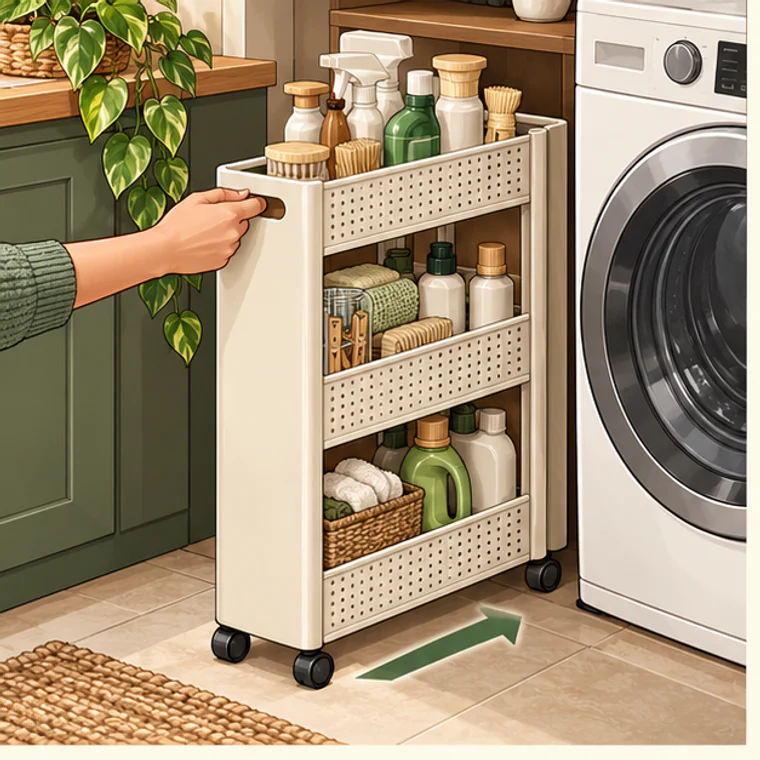
Slim rolling cart — keep daily supplies within reach
A cart is worth considering when detergent, brushes, or spare cloths disappear into a narrow gap. Pulling the tiers forward can make their contents easier to see than supplies stored at the back of a fixed shelf.
Read the arrow: it marks the cart's travel, not just its parking spot. The front of the cart needs a clear route into the room.
- Choose it when
- You can retrieve a daily item and return the cart without shifting the washer or another basket.
- Choose another route when
- The gap contains connections, or the cart would need a turn that the room cannot accommodate.
What makes one cart more usable?
Compare the complete outside width, including wheels and handle, then the tier openings against your tallest bottle. High sides can retain supplies but make short items harder to grab. A deep cart adds little useful storage if only its front section can come out.
Try reaching your everyday supplies
- Try this
- Trace the full pull-out route with removable tape, then use a tray holding your usual supplies to simulate reaching into a tier.
- If you find a problem
- If a basket blocks the route, or a rug or threshold interrupts it, a rolling cart may add another chore.
- Look for this instead
- Look for front-access drawers if they can open freely, or a lift-out caddy you can carry to the work area. Compare tier openings with your tallest bottle and check the actual cart's stability and wheel performance.
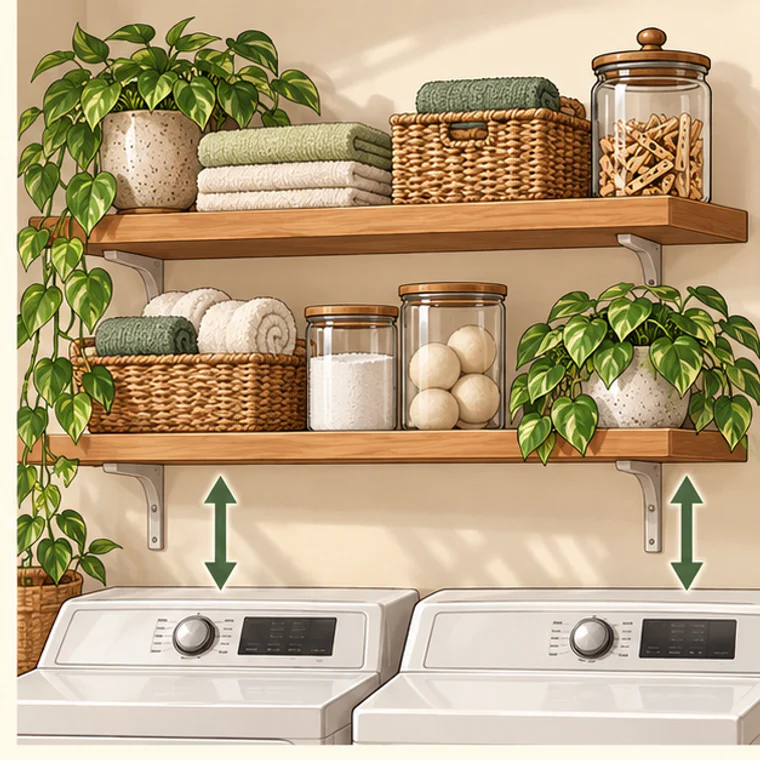
Shallow wall shelves — use height without losing working room
Wall shelves can hold folded textiles or small baskets while leaving the floor available for a hamper. Compared with a freestanding frame, they avoid floor uprights, but require suitable wall mounting and a usable reach.
Read the arrows: they identify the gap below the shelf. The lids are closed in this illustration; it does not prove that they can open completely.
- Choose them when
- The wall can support the specified installation and the shelf leaves the appliance's opening and controls accessible.
- Choose another route when
- Retrieval requires climbing, leaning across a machine, or opening a top-loader only partway.
Open shelves or a cabinet?
An open shelf keeps supplies visible and avoids cabinet-door clearance, but leaves contents exposed. A cabinet hides clutter and adds another opening movement. Keep frequent-use, manageable items within comfortable reach; reserve higher positions for suitable occasional storage rather than making every level part of the daily routine.
Try opening and retrieving together
- Try this
- With the appliance stopped, open its lid or door fully and map the proposed shelf and basket position. Check reach from the floor without climbing or leaning across the machine.
- If you find a problem
- If the opening overlaps the shelf, raising it may solve the collision but put supplies beyond comfortable reach.
- Look for this instead
- Look for shallower or adjustable shelves, or choose a different wall position. Keep daily-use items accessible; verify mounting, load limits and appliance clearances in the exact instructions.
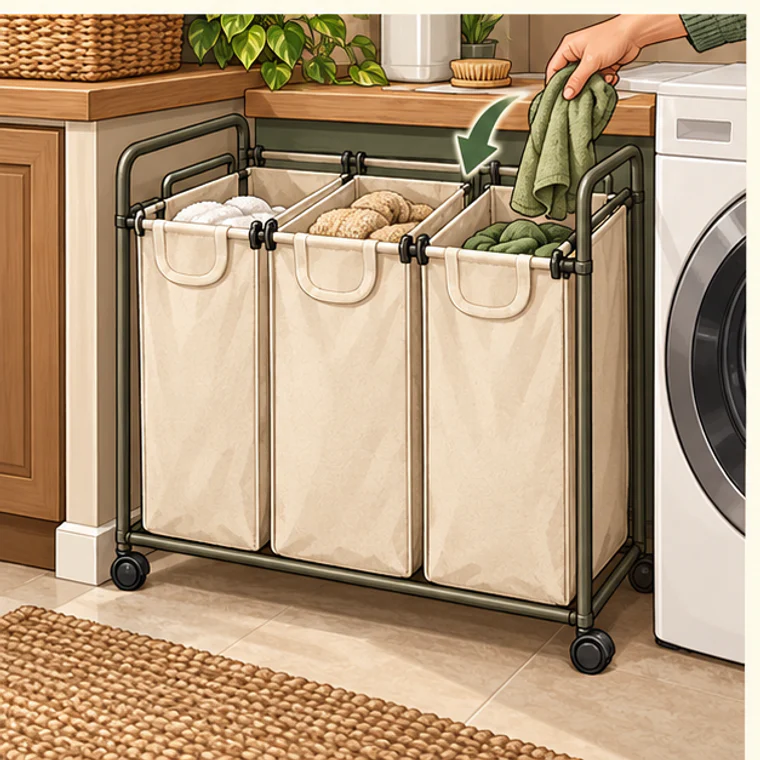
Divided hamper — separate loads before they reach the floor
A sorter makes sense when you repeatedly form the same groups, such as towels, everyday clothing, and items needing a separate wash. Putting each item in its group as it arrives can remove a sorting step on laundry day.
Read the arrow: it shows putting clothing into a bag. Getting a full bag back out is a separate movement you still need to plan.
- Choose it when
- The compartments match your actual loads and a removable bag can travel straight to the machine.
- Choose another route when
- You usually wash one mixed load or must move the whole frame to reach each bag. One basket may be simpler.
Count useful groups, not bags
A third compartment earns its footprint only if you use it. Similar-looking sorters can differ in how liners detach, whether handles are usable when full, and whether a top shelf obstructs removal. Documented capacity alone does not establish how comfortably you can carry the load.
Try moving one normal load
- Try this
- Carry your current full bag or basket from the proposed sorter position to the washer, including any stairs, turns and the place where you set it down.
- If you find a problem
- If the route includes stairs, moving the entire wheeled frame is not the useful feature. If a bag would hit a counter on removal, its release mechanism matters more than an extra compartment.
- Look for this instead
- Look for removable bags with usable carry handles; compare front removal versus lift-out access. Choose only the number of sections your routine actually uses.
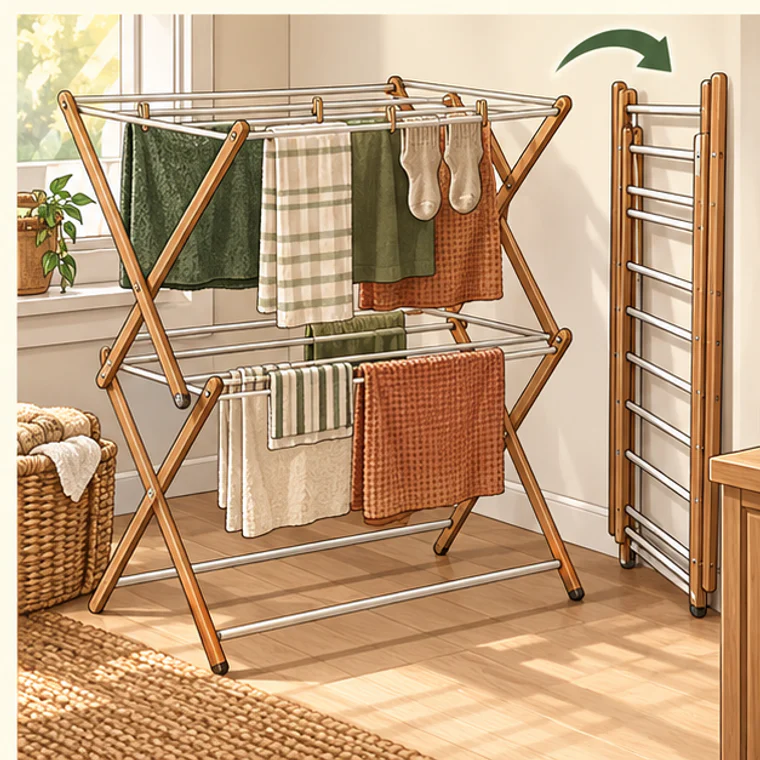
Folding drying rack — plan for the loaded footprint
A folding rack provides temporary drying space and can leave the floor clear afterward. A taller design may suit short garments; a wider design may provide a more useful span for towels or longer items. Choose against the clothes you actually air-dry.
Read the arrow: it connects the working and stored configurations. The folded depth tells you where it can live afterward, not how much room it needs while loaded.
- Choose it when
- You have an open, usable drying position and a separate place to store the closed rack.
- Choose another route when
- Hanging sleeves or towels would enter the doorway, cover controls, or obstruct the room's normal route.
Drying length is not garment clearance
Total rail length helps compare how much hanging space is provided, but says little about the gap between rails or the drop below them. Check your longest air-dried garment against the lowest usable rail. Follow the rack's instructions for loading and opening its supports.
Try the space with clothes in it
- Try this
- Mark the open footprint and hold a long garment where it would hang. Walk past with a basket and open the room door; include sleeves and fabric beyond the frame.
- If you find a problem
- If clothes enter the walkway or touch the floor, the bare frame fitting in the room is not enough.
- Look for this instead
- Look for a different rail height or layout. A vertical rack can suit shorter items; a wall-mounted option still needs room when extended and suitable mounting. Check folded storage separately before choosing.
From family choice to a shortlist
Use the comparison above to choose the job you need to solve, then follow that family\'s guide to compare designs. You do not need to complete a worksheet or buy all four types.
Keep one deciding feature in mind: front access for an obstructed cart route, comfortable reach for shelves, removable handled bags for stairs, or a usable loaded footprint for drying. Discard any candidate that repeats the problem you are trying to fix.
For equipment clearances, start with your own model's installation manual. Our reference for why model-specific spacing and vent access matter is Whirlpool's dryer venting specifications; it applies to the equipment covered by that document, not every laundry installation.
Map appliance openings, connections and service access →
Plan the laundry workflow →