Best narrow shoe cabinets for tight entryways
QIVOMIX’s two-flip-drawer cabinet is our best-documented enclosed option: it is 9.4 inches deep and includes a manufacturer-stated anti-tip device. YATINEY’s 9-tier tower uses only 10.2 inches of width but is deeper and keeps shoes visible.
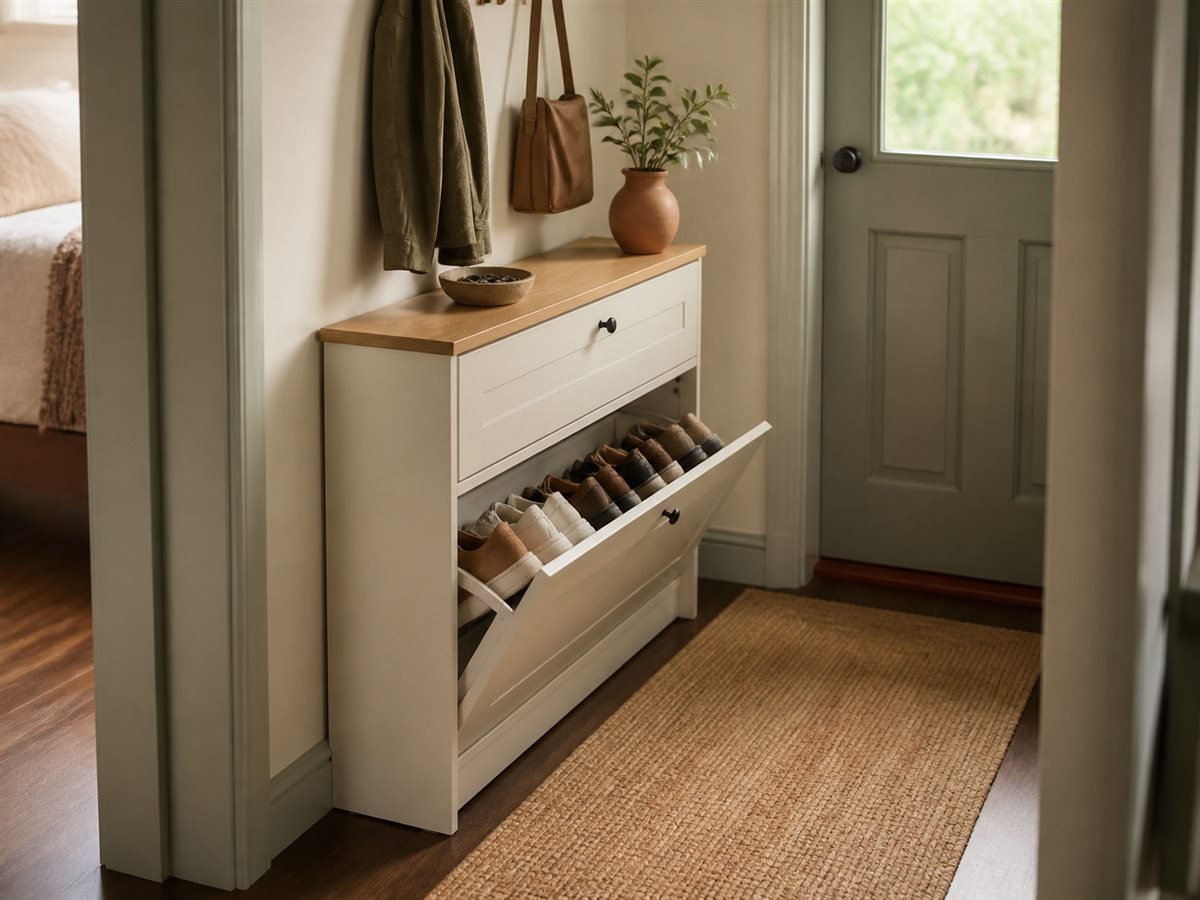
Editorial illustration; shoe fit and opening clearance depend on the exact model.
Quick comparison
| Option | Documented size | Access | Best for | Main trade-off |
|---|---|---|---|---|
| QIVOMIX two-flip-drawer cabinet | 9.4 D × 31.5 W × 38 H in | Two tilt-out drawers | Shallow enclosed entryway storage | Requires wall restraint; drawer projection |
| YATINEY 9-tier tower | 13.4 D × 10.2 W × 65.7 H in | Open vertical shelves | Very narrow wall width | Greater depth and height; visible contents |
How we compared
Closed depth and clearance 30%, verified footwear fit 20%, opening access 15%, stability/anchoring 20%, assembly 5%, and documentation 10%. The shortlist is intentionally short: options with unclear identity, instructions, or current availability did not become winners.
1. QIVOMIX two-flip-drawer cabinet — best enclosed option
The public product documentation lists a 9.4-inch depth, 31.5-inch width, and 38-inch height. QIVOMIX includes an anti-tip device and says it must be fixed to the wall. Adjustable internal dividers can help with different footwear, but the cabinet still needs to be checked with the largest pair.
Trade-offs: the two drawers project into the room. The front door, hallway, and user must all clear that open position. Engineered-wood construction also means assembly and wall restraint deserve more attention than the closed profile suggests.
2. YATINEY 9-tier tower — best when width is scarcer than depth
The observed variant uses only 10.2 inches of width and reaches 65.7 inches high. Its 13.4-inch depth is greater than the QIVOMIX cabinet, but open shelves avoid flip-drawer operating space.
Trade-offs: shoes remain visible and the tall, narrow profile makes stability instructions essential. It is a shoe rack rather than concealed furniture.
How to check shoe fit
- Measure the longest and widest shoes that will live there.
- Check the internal shelf or drawer dimensions—not just the cabinet body.
- Confirm whether dividers can be removed without compromising structure.
- Tape the closed footprint and full drawer projection on the floor.
- Open the entry door and walk through while the drawer is open.
- Confirm the wall and supplied anti-tip method are usable.
If the storage is for mixed supplies rather than shoes, see slim storage cabinets. For the complete room check, use the small-space measurement guide.
Frequently asked questions
These answers use our documented review method and treat advertised capacity as a variable, not a guarantee.
Can I rely on the advertised number of shoe pairs?
Use it only as an estimate. Capacity changes with shoe size, width, heel height, boots, and internal dividers. Internal dimensions and the footwear you actually own are more useful than a headline pair count.
How much depth does a tilt-out cabinet need?
Measure both its closed depth and the full projection of the open drawer, including handles. The entry door, baseboard, and walking path must remain usable while the compartment is open.