How to organize a small laundry room by workflow
A small laundry room works better when each load has a clear next step. Storage should support collection, sorting, washing, drying, and returning clothes rather than give every empty surface another container. Start with the interruption that happens most often: moving baskets to reach detergent, re-sorting clothes, or walking around a drying rack. This guide helps assign places to those tasks, keep daily tools separate from reserve stock, and decide which organizer would genuinely remove work.
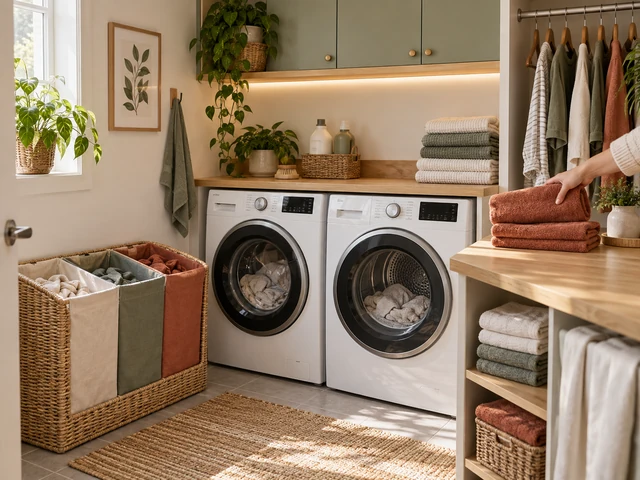
Plan the room in four steps
Use the steps to identify what changes your routine. No form or printable checklist is required, and an unresolved installation condition is not a pass.
We analyze layouts and product families, not personally tested models. There are no active affiliate links, copied ratings, or static prices. Compare any eventual product with its current instructions and your own appliance documentation.
Illustrations are conceptual layouts, not exact products, scale drawings, or installation instructions. Arrows highlight movements or areas to check, not specified clearances. Decorative containers are not recommendations to repackage laundry products.
Turn observations into decisions
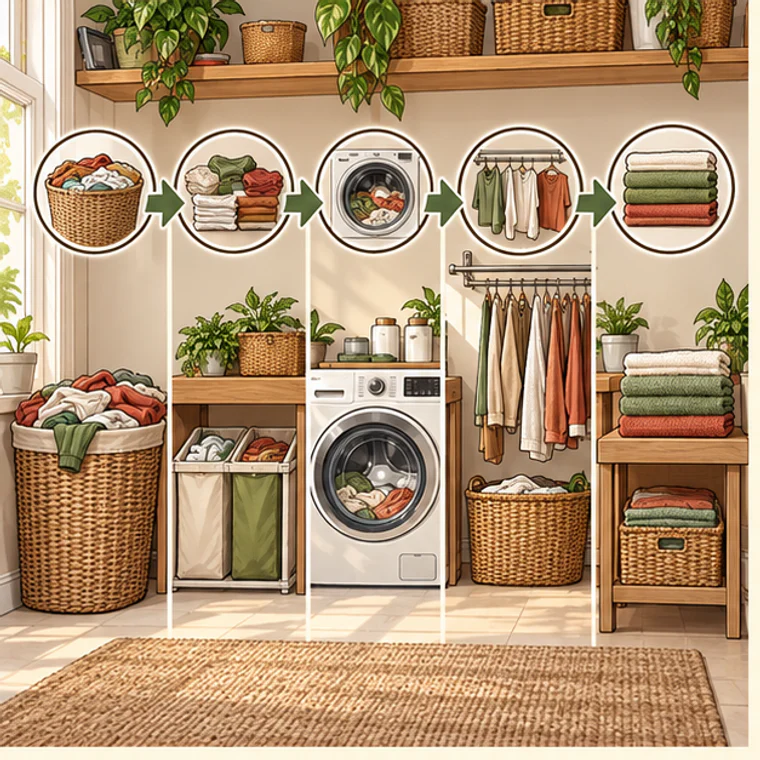
1. Map the load route — give dirty and clean clothes different destinations
Follow one typical load from collection to its return to the closet. Note where you sort it, where the empty basket waits, and where clean clothes land before folding. The useful plan separates these stages so a surface holding clean clothes does not become the next place for unsorted laundry.
Read the scene: The sequence of room zones represents tasks, not a requirement to buy a separate organizer for every stage.
- Change this first
- The transfer or repeated sorting step that interrupts your normal load.
- Keep it simple when
- Your present basket already carries the load and has a clear place while the machine runs.
Choose a collection point that matches the route
A divided hamper is useful if you repeatedly separate the same groups. If you sort only on laundry day, one basket and a temporary sorting surface may be enough. For a shared laundry outside the home, portable bags can matter more than a wheeled frame that never leaves the room.
Trace a real load
- Try this
- Notice each place you put the basket down and each transfer between containers.
- What the result reveals
- Repeated transfers or mixed clean and dirty piles reveal a missing destination, not necessarily insufficient capacity.
- What to change or look for
- Assign that destination first; compare removable bags or a sorter only if it removes the specific step.
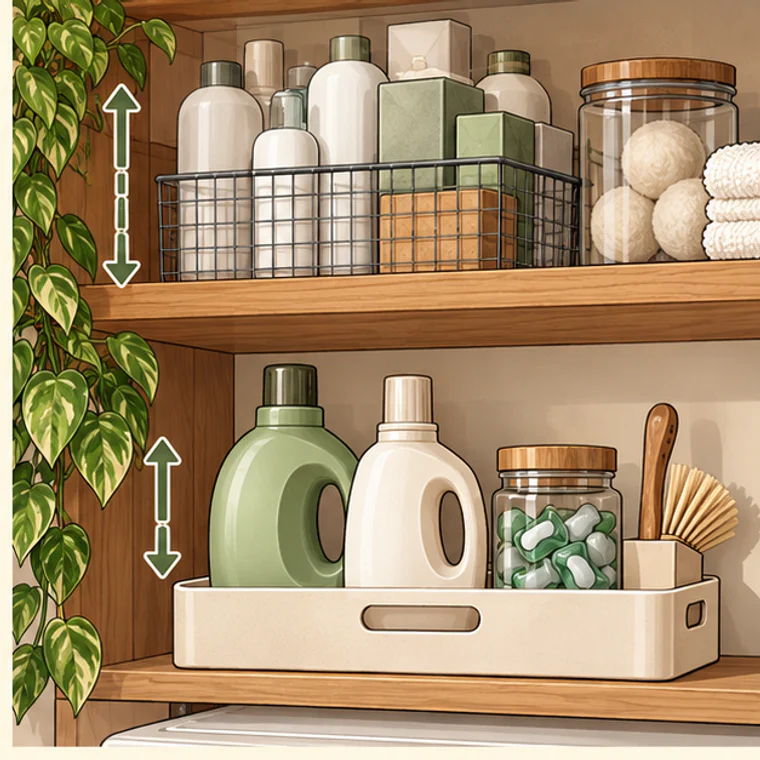
2. Separate daily supplies from backstock — shorten the ordinary reach
Keep the small set you use for a normal load in a reachable location, and reserve another position for replacement stock. A cart, shallow shelf, or handled kit can serve the daily task. Filling that same position with every spare bottle makes retrieval harder and encourages buying a larger organizer than you need.
Read the scene: The different storage levels illustrate daily access and reserve stock as separate jobs.
- Change this first
- Move rarely used stock out of the path to the products and tools used on each load.
- Keep it simple when
- A small existing shelf or kit already makes the daily supplies accessible.
Preserve packaging and appropriate secure storage
Keep laundry products in their original labeled packaging. Laundry packets need secure storage out of children's sight and reach; an open tray or an ordinary cabinet is not a substitute for suitable protection. Illustrations are layout examples, not recommendations to decant detergents into decorative containers.
Retrieve your most-used item
- Try this
- Try the current routine without first moving spare stock or another basket.
- What the result reveals
- If reserve products obstruct it, reorganizing the contents may solve the problem before new furniture is needed.
- What to change or look for
- Shortlist a shallow shelf or accessible kit only after separating the daily set from backstock.
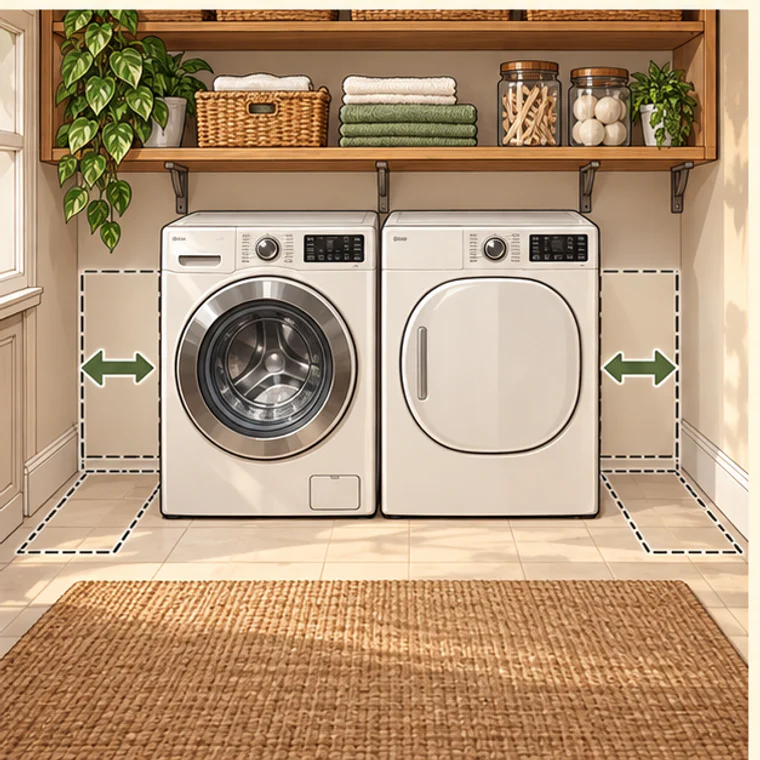
3. Keep service zones empty — do not organize away access
A connection route or appliance opening is not a spare storage zone. Keep the layout from obscuring controls, shutoff access, hoses, or the relevant vent route. Avoid letting a temporary basket turn into permanent furniture in a place that should remain accessible.
Read the scene: The clear service area illustrates an intentional empty zone, not an unfinished corner to decorate.
- Change this first
- Remove the proposed storage location from any area reserved by your equipment instructions.
- Keep it simple when
- Leaving that area empty already preserves the installation and access conditions.
Plan storage around the equipment, not the reverse
Use the exact appliance instructions when deciding what remains clear. Do not shift a machine, compress a hose, or alter a vent just to accommodate an organizer. If the current layout creates uncertainty about those conditions, seek suitable help rather than treating another storage product as the remedy.
Look at the room after a normal load
- Try this
- Notice whether baskets, spare packs, or the drying rack migrate into the reserved space.
- What the result reveals
- If the same obstruction returns, the temporary item needs another home; the service zone should not absorb it.
- What to change or look for
- Create a reachable parking position elsewhere and keep this zone out of the storage shortlist.
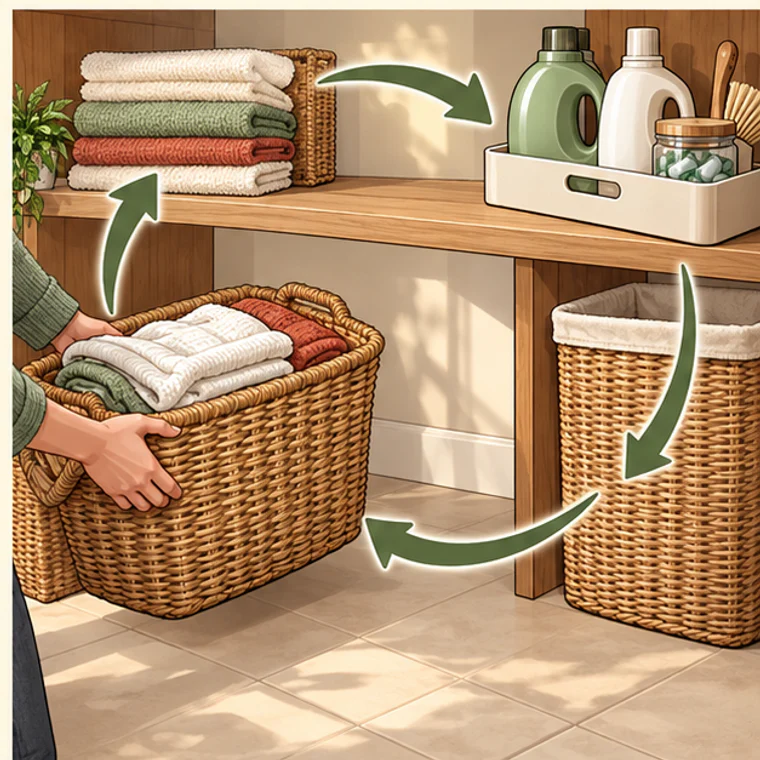
4. Reset the room — put away what the next load does not need
The room needs a repeatable finish, not an elaborate cleaning checklist. Give the empty basket, folded rack, and tools a reachable return position. Decide where dry clothes go next so a folding surface does not stay occupied until the next wash.
Read the scene: The reset scene illustrates the room ready for its next load; fewer items left out can be more useful than extra storage.
- Change this first
- The item that repeatedly has no home after the task is finished.
- Keep it simple when
- The room returns to a usable state without moving several containers.
Choose storage for the closed state too
A drying rack needs a folded home that remains accessible on wash day. A portable kit needs a place you can return it one-handed without unloading it. Avoid locating either behind backstock. If the routine depends on a temporary folding surface, reserve a clear destination for the folded clothes rather than buying more bins to hold them indefinitely.
Finish one load completely
- Try this
- Return the basket, tools, and rack to their planned places and clear the folding area.
- What the result reveals
- An item left out because its home is inaccessible will continue to occupy the working room.
- What to change or look for
- Change that return position or choose a simpler fold-and-store design before adding capacity.
Questions before your next step
Do I need a sorter, cart, shelf, and rack?
No. Start with the repeated interruption. If an existing basket or shelf handles the task, another organizer may add work instead of removing it.
What if the room also serves another purpose?
Use temporary working positions with reachable return locations. A portable kit and fold-flat rack can be useful, but only when their setup and storage do not block the other use of the room.
Is decanting detergent part of an organized room?
No. Keep laundry products in their original labeled packaging and use appropriate secure storage. A coordinated appearance should not remove product identification or safety information.
References and the next decision
For equipment fit and installation, start with your exact model's manual. Whirlpool's dryer venting specifications explain why the equipment concerned needs its own installation and venting requirements; this document is not a universal clearance guide.
For laundry packets, the CPSC safety alert recommends original sealed packaging and locked storage out of children's sight and reach.
Choose the one interruption you want to remove and try the revised placement with what you already own. If a product is still needed, compare the relevant family below. Keep the deciding feature specific: independent bag removal, easier retrieval, or a rack that can be put away without blocking the next load.