How to organize a small pantry without overfilling it
The best small pantry system reduces searching and restocking friction. It does not require every food to match or every shelf to be completely full.
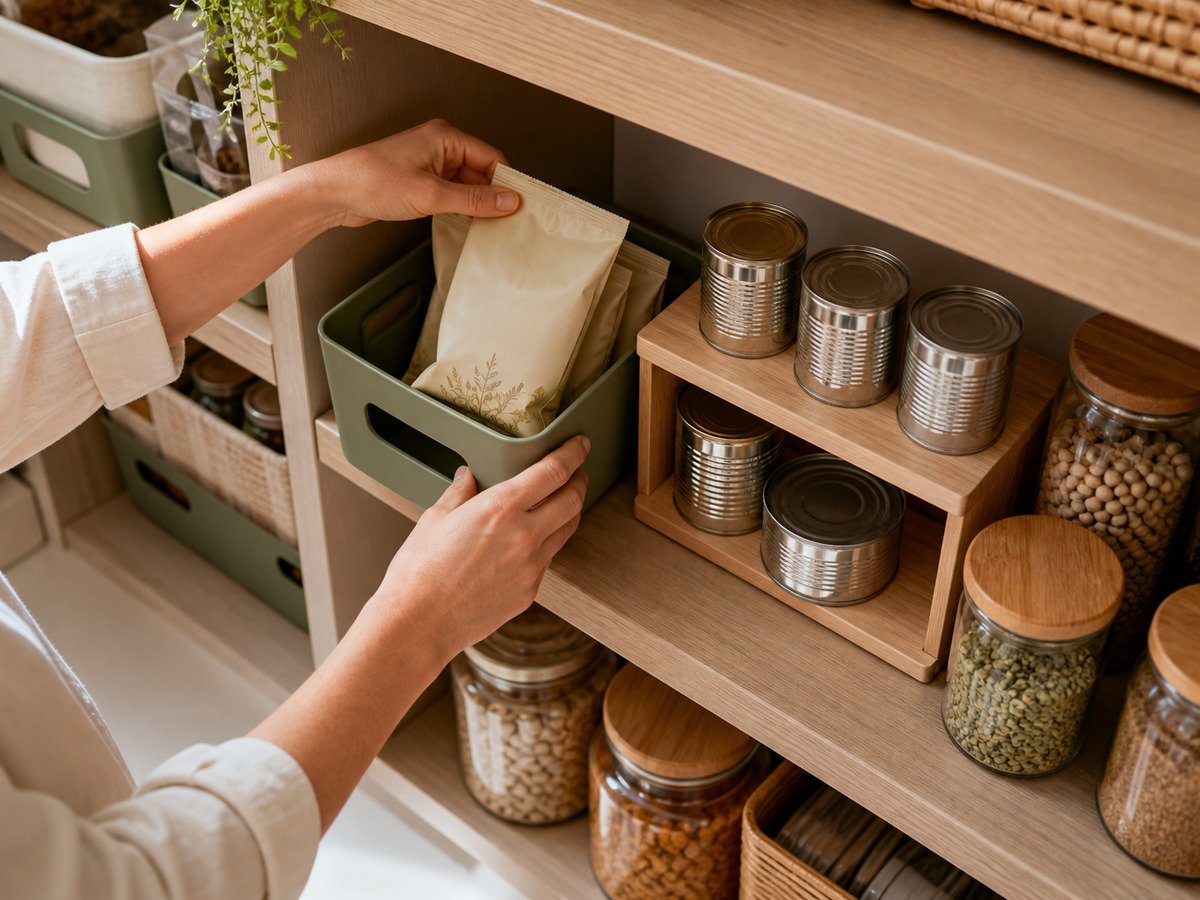
1. Organize the food flow before the containers
Remove expired items, combine safe duplicates, and identify what enters the pantry every week. The goal is not to decant everything; it is to make the most-used foods visible, reachable, and easy to return. Keep original labels or transfer allergen, date, and preparation information when you decant.
2. Put frequency at the center
Reserve eye-to-waist height for daily foods. Heavy items belong on stable lower shelves. Light backstock can move higher. Group breakfast, baking, snacks, canned foods, and meal components according to how your household cooks—not according to a photograph.
Daily reach
One movement, clear label, no unstable stack.
Weekly support
Grouped by task in bins or on an open shelf.
Backstock
Visible quantity, dated, and separated from active stock.
3. Give deep shelves a retrieval strategy
Use a turntable for small bottles that would otherwise disappear in a corner, a pull-out bin for a category you retrieve together, and tiered storage for cans whose labels need to remain visible. Avoid placing unrelated items in a deep opaque bin: it hides inventory and adds a second search.
4. Choose the lowest-maintenance system that works
Leave breathing room for restocking. If every purchase requires rearranging five containers, the system is too dense. Review one zone when you make a shopping list, wipe food-contact surfaces according to the manufacturer, and store shelf-stable food in a cool, dry area away from heat and excess humidity.
Choose only the helper you need
A shelf riser improves label visibility; a turntable improves corner access; a door rack adds shallow capacity; a container controls loose dry food. They are not interchangeable.
Food-storage sources
Our safety boundary follows the USDA guidance on shelf-stable food and the FDA consumer overview of food-contact substances. Product-specific instructions still control.