Best bathroom organizers for small spaces, chosen by constraint
A small bathroom needs easier access, not an organizer on every available surface. Start with the daily failure: products lost behind plumbing, bottles sitting in water, missing dry backstock space, or furniture crowding the room. Each family below solves a different problem and introduces a different limit. Compare the useful zone, mounting conditions, and movements before considering models. The dedicated guides take you into exact dimensions and documentation once a family makes sense. One compatible intervention that simplifies the routine is more valuable than a matching set that makes cleaning or maintenance harder.
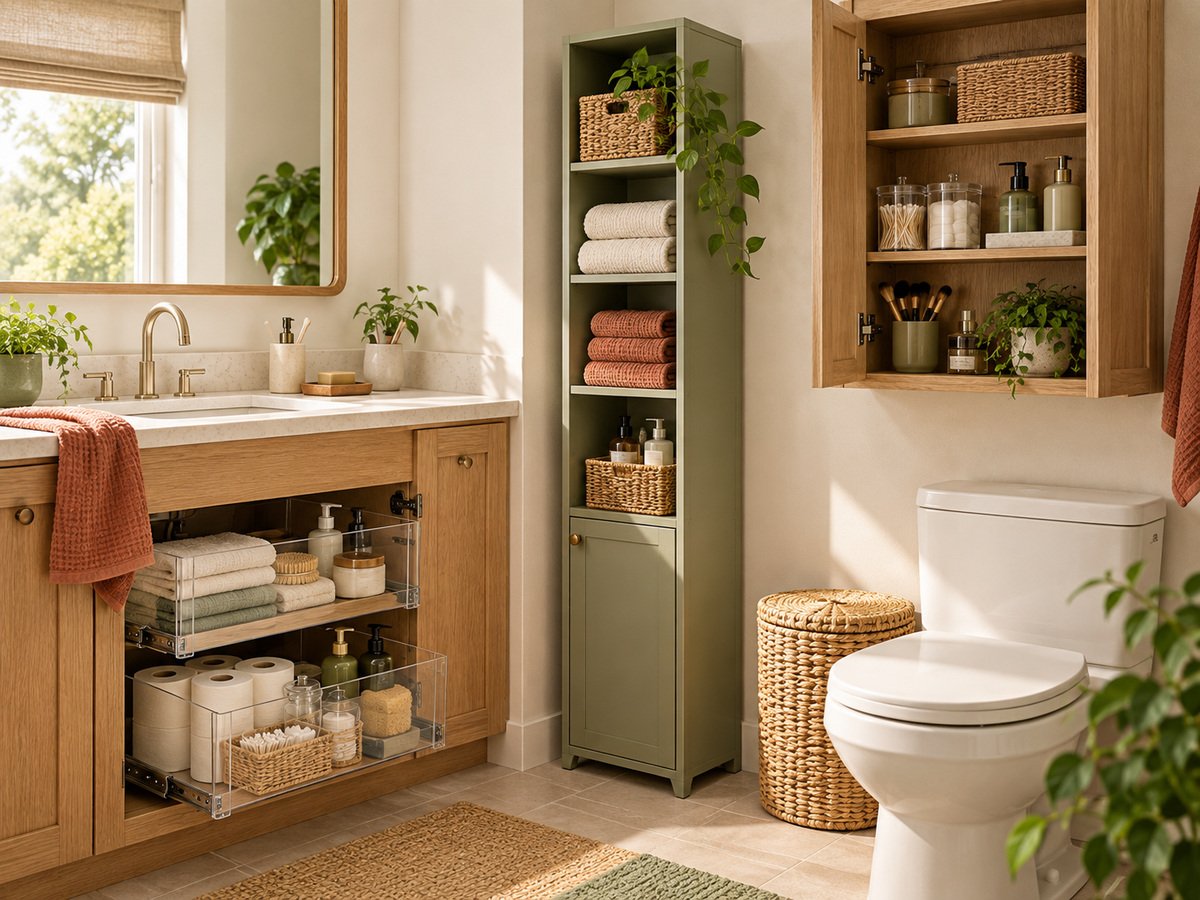
Compare the useful layouts
Start with the case that matches your routine. The checks explain what changes the choice; they are not installation approvals or a reason to buy every option.
These recommendations combine documented specifications with practical planning inferences. Casa Ordenada has not physically tested these organizers. Named models are documentary examples, not a market-wide ranking; decisive dimensions and instructions must be rechecked for the exact current variant. There are no active affiliate links, copied star ratings or static prices.
The illustrations explain typical layouts and movements. They are not exact product renderings, scaled installation drawings or proof of tested performance. Use the current appliance, fixture and organizer instructions for your own space.
Best means the smallest solution that removes a repeated friction
A small bathroom rarely improves when every available surface receives an organizer. The strongest first purchase solves one daily failure: inaccessible vanity items, unused vertical space, bottles on the shower floor, or storage furniture blocking circulation.
Use frequency to choose the first zone
Count the friction rather than the products. A bottle retrieved twice a day deserves easier access before a backup towel used monthly. If the same item is moved to reach something behind it, that is a retrieval problem. If the user must step around furniture, that is a footprint problem. If surfaces remain wet, that is a drainage problem.
Use the dedicated guide for the exact product decision
This page chooses the family. The linked guides compare exact dimensions, mounting requirements, and product trade-offs. Keeping these layers separate avoids presenting four unrelated products as universal “winners.”
| Repeated friction | Start with | Measure | Do not buy when | Detailed guide |
|---|---|---|---|---|
| Items disappear behind plumbing | Pull-out or removable caddy | Pipe map, opening, full travel | Valves or leaks become hidden | Under-sink options |
| The toilet wall is unused | Over-toilet unit | Tank, lid lift, opening, depth | Service or walking space closes | Over-toilet options |
| Bottles crowd the shower floor | Drainable shower caddy | Surface, controls, bottle height | The mount is not approved | Shower caddies |
| No floor depth remains | Shallow wall cabinet | Wall, body depth, door swing | Mounting or reach is unsafe | Small cabinets |
Compare the layouts in use
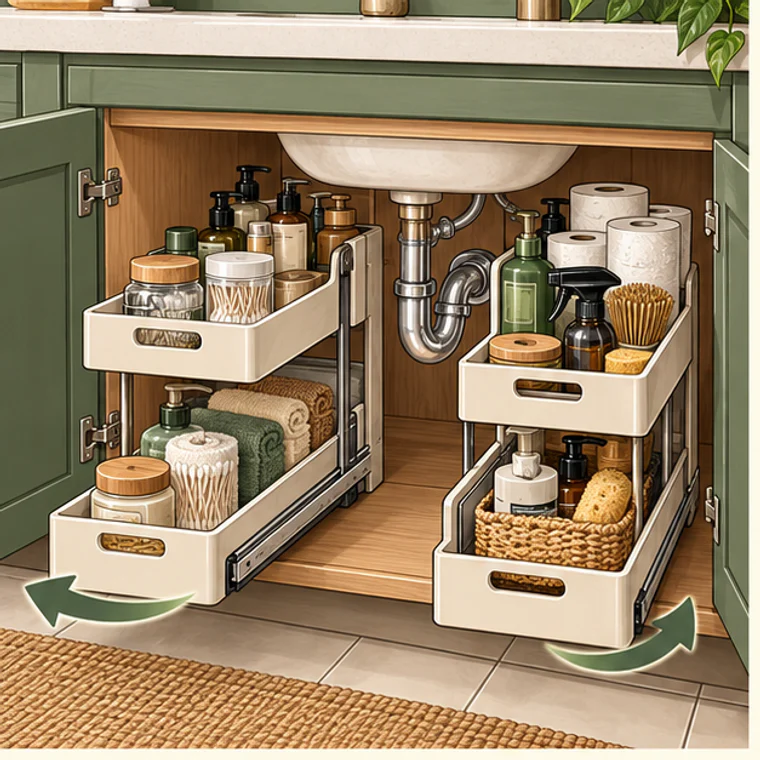
Pull-out caddy — Retrieve a clear vanity lane
Choose a pull-out only when the pipe map leaves a straight side lane. The mechanism should reduce repeated unloading without covering valves or preventing a leak inspection.
A removable handled bin is often the better fallback when plumbing is irregular because the entire category can leave the cabinet for cleaning.
Read the scene: The drawers travel beside the central plumbing. A clear side lane must leave the valves and inspection areas accessible.
- Useful when
- The pipe map leaves a straight side lane for daily supplies.
- Reconsider when
- The mechanism hides valves or prevents floor inspection.
Check the working layout
- Try this
- Use a filled removable category to rehearse retrieval and returning it without touching the plumbing.
- What it reveals
- A straight pull-out is not always better than a handled bin around irregular pipes.
- What to change or look for
- Choose by clear opening, travel and valve access; keep liquids contained in a removable suitable tray.
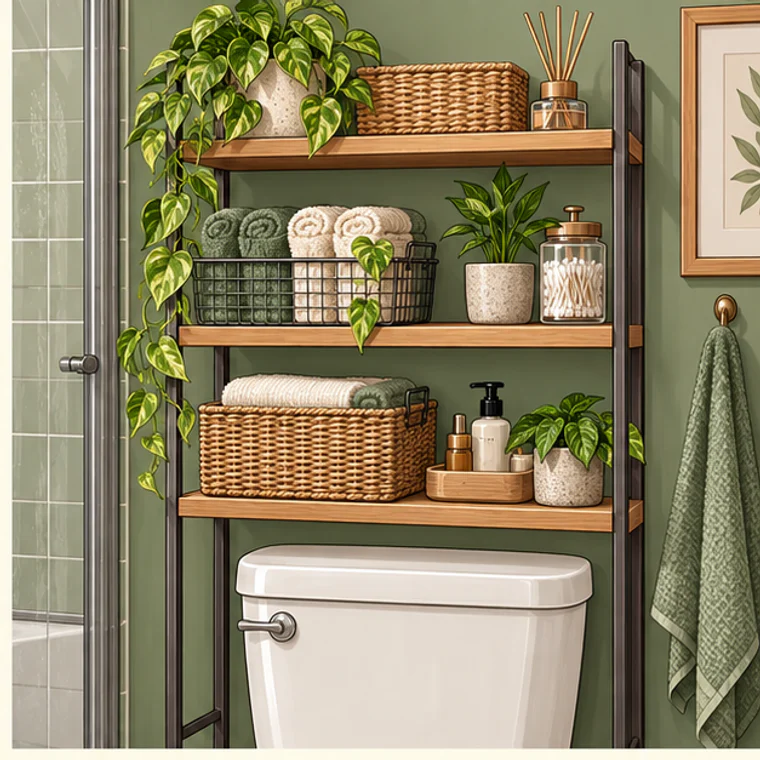
Over-toilet storage — Use genuinely free height
Choose this family after measuring the toilet service envelope and deciding whether open or enclosed storage suits the room. Open racks remove door motion; cabinets hide clutter but add another moving part.
The useful unit is the one that remains restrained, cleanable, and out of the sitting and standing path.
- Keep heavier objects low.
- Protect tank-lid removal and shutoff access.
- Reject any exact variant without a clear opening diagram.
Read the scene: The open shelves use height above a service fixture. Protect the tank opening, lid lift and user path rather than fill every tier.
- Useful when
- The tank and user have adequate clearance and restraint is feasible.
- Reconsider when
- The unit makes tank service, cleaning or standing up awkward.
Check the working layout
- Try this
- Outline the frame, then rehearse lifting the tank lid and approaching the toilet normally.
- What it reveals
- Available wall height is not the same as a clear service envelope.
- What to change or look for
- Require a clear opening diagram and exact restraint instructions before comparing shelf count.
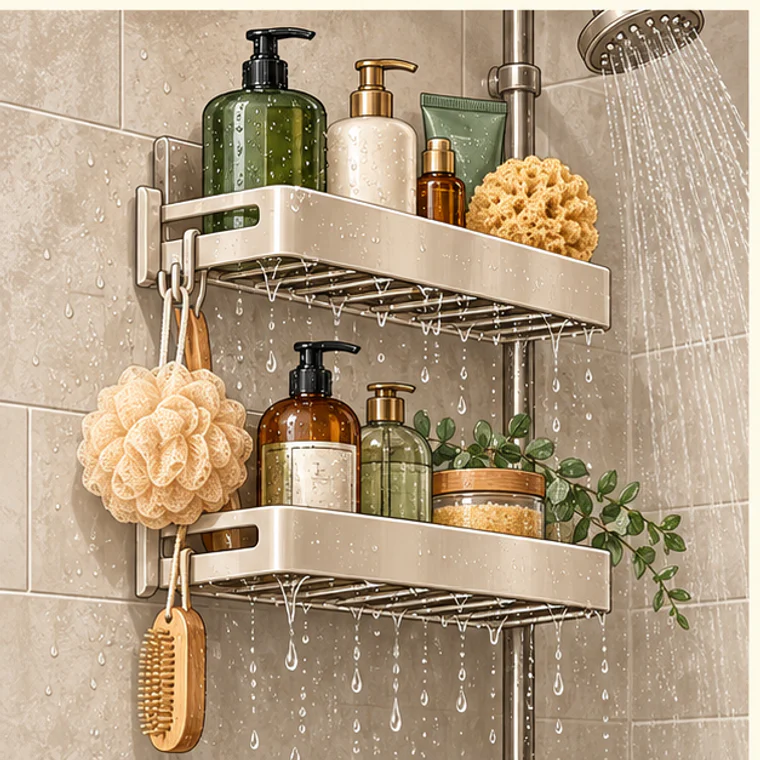
Shower caddy — Keep wet products drainable
Start with the mounting surface or fixture: hanging neck, tension pole, press-fit corner, or adhesive shelf. Only then compare shelf spacing, hooks, and capacity.
The caddy should leave controls, hose travel, grab bars, and cleaning access unobstructed.
- Use only documented compatible surfaces.
- Leave drainage openings uncovered.
- Avoid storing more bottles than can be removed one-handed.
Read the scene: Water passes through the open shelf structure. The benefit is reachable products with drainage and a compatible mount, not extra bottle capacity alone.
- Useful when
- A documented compatible mount places daily bottles within reach.
- Reconsider when
- It obstructs controls, hose movement, drainage or grab bars.
Check the working layout
- Try this
- Rehearse taking the tallest pump bottle while leaving hose and controls usable.
- What it reveals
- A shelf that holds bottles may still interfere with the shower's primary functions.
- What to change or look for
- Choose mounting compatibility first, then shelf spacing and removable cleaning access.
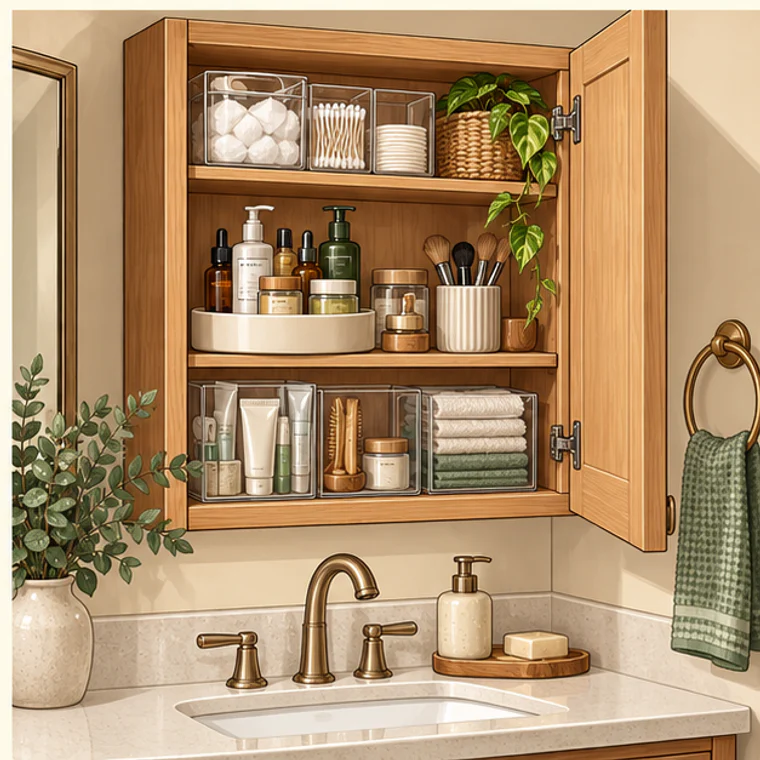
Shallow wall cabinet — Preserve floor depth
A wall cabinet can create closed storage without narrowing the floor, but transfers the burden to wall construction, hardware, height, and door swing.
Daily items belong within comfortable reach; high compartments are better for light, infrequent backstock.
- Check mirrors, lights, outlets, switches, and towel bars.
- Use the exact manufacturer mounting instructions.
- Do not assume bathroom staging means water resistance.
Read the scene: The door opens above the basin without a floor-standing body. Saving floor space transfers the decision to mounting, reach and door projection.
- Useful when
- Closed dry storage is needed and the wall and permissions are suitable.
- Reconsider when
- The door strikes fixtures or routine items sit beyond comfortable reach.
Check the working layout
- Try this
- Trace the body and complete door swing at its proposed height while standing in the usual position.
- What it reveals
- Zero floor footprint does not remove projection, mounting or reach constraints.
- What to change or look for
- Verify wall hardware, component list and care directions; keep damp items in a suitable drainable zone.
Frequently asked questions
What should I buy first for a small bathroom?
The smallest compatible organizer that removes the most frequent friction. Measure that exact zone before choosing a product.
Are matching organizers more useful?
Not automatically. Matching can improve appearance, but different zones need different moisture, access, and mounting behavior.
Are adhesive organizers renter-safe?
Only when the lease permits them and the exact product lists the surface and removal method. “Renter-safe” is not a universal material property.
Can one organizer serve daily and backup items?
It can, but daily items should remain easiest to reach and backup quantity should stay visible. Do not let reserve stock block the active zone.
Make the next decision
Plan the access and movement → Explore all bathroom guides → How we review →