Best storage furniture for small spaces, chosen by constraint
There is no universal winner: choose a storage ottoman for hidden, dual-purpose volume; a narrow shoe cabinet for entryway depth; a slim cabinet for fixed vertical storage; an over-toilet unit for bathroom height; or a rolling cart when supplies must move.
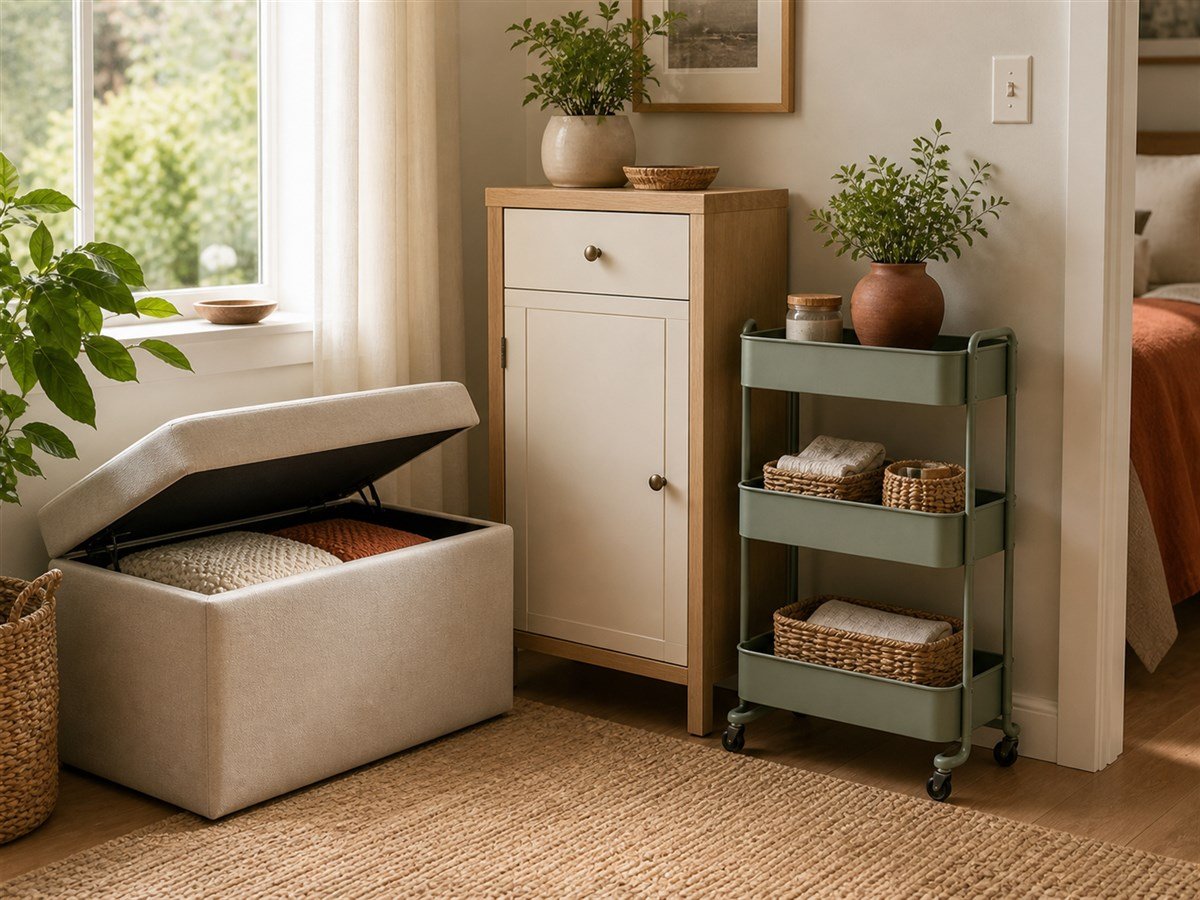
Quick picks
Storage ottoman
Adds concealed volume and may provide a documented seat, footrest, tray, or bench function in one footprint.
Compare →Narrow shoe cabinet
Tilt-out drawers reduce closed depth, but shoe fit, opening projection, and anchoring decide whether it works.
Compare →Slim cabinet
Uses height in a narrow footprint while containing small supplies behind doors or drawers.
Compare →Over-the-toilet unit
Uses otherwise empty height, provided the frame clears the toilet, plumbing, lid, and wall fixtures.
Compare →Slim rolling cart
Moves supplies to the task and back into a gap; it is usually a lower-ticket support solution rather than the main furniture investment.
Compare →Which family solves which problem?
| Family | Footprint advantage | Operating cost in space | Safety/fit question |
|---|---|---|---|
| Storage ottoman | One object can store and serve another authorized function | Lid or removable top needs handling space | Is sitting or tray use explicitly permitted? |
| Narrow shoe cabinet | Commonly under about a foot deep in the observed shortlist | Tilt drawer projects into the entry | Does the footwear fit, and must it be anchored? |
| Slim cabinet | Turns a narrow gap into vertical storage | Door/drawer and handle projection | Does the baseboard prevent flush placement? |
| Over-toilet storage | Uses vertical bathroom space | Frame surrounds a service fixture | Can the toilet and valve remain fully accessible? |
| Rolling cart | Can disappear into a very narrow gap | Needs a route and turning/handle room | Are wheels, retention edges, and loads documented? |
How we chose the families
Storage-to-footprint fit 30%, operating clearance 20%, usefulness/multifunction 15%, stability and anchoring 15%, moveability 10%, and quality of documentation 10%. These weights describe suitability for small spaces, not décor quality.
Our recommendation order
- Remove or relocate anything that does not need storage furniture.
- Choose the single family that solves the named bottleneck.
- Measure its closed and open footprint.
- Compare documented candidates within that family.
- Recheck manual, restraint, and exact variant before purchase.
Frequently asked questions
These answers apply our constraint-based review method before any product shortlist is built.
What is the best storage furniture for the smallest room?
There is no universal type. Start with the bottleneck: hidden volume may favor an ottoman, a narrow entry may favor shoe storage, an unused gap may favor a slim cabinet or cart, and a bathroom may favor vertical storage.
Should I always choose the tallest option to maximize storage?
No. Extra height can add capacity, but it can also increase anchoring demands, reduce reachability, conflict with fixtures, and make a narrow footprint less forgiving. Usable access and safe installation matter more than height alone.
Evidence base: this family comparison is supported by the 40-product US-market sample documented internally on August 17, 2026, manufacturer specifications, and CPSC furniture safety guidance. It is not a market-wide sales ranking.