Best under-sink bathroom organizers, chosen by pipe fit
Under-sink storage begins with the plumbing that must remain accessible. A deep clear lane can suit a pull-out, a clear circle can suit a turntable, and a shallow rectangle may work with a small drawer frame. Irregular plumbing may make a removable handled bin the simpler choice. Compare how each layout retrieves the intended contents, not how completely it fills the cabinet. This guide separates the documented body from its working envelope and keeps valves, pipe joints, and the cabinet floor visible. Choose one usable category without making leaks or cleaning harder to notice.
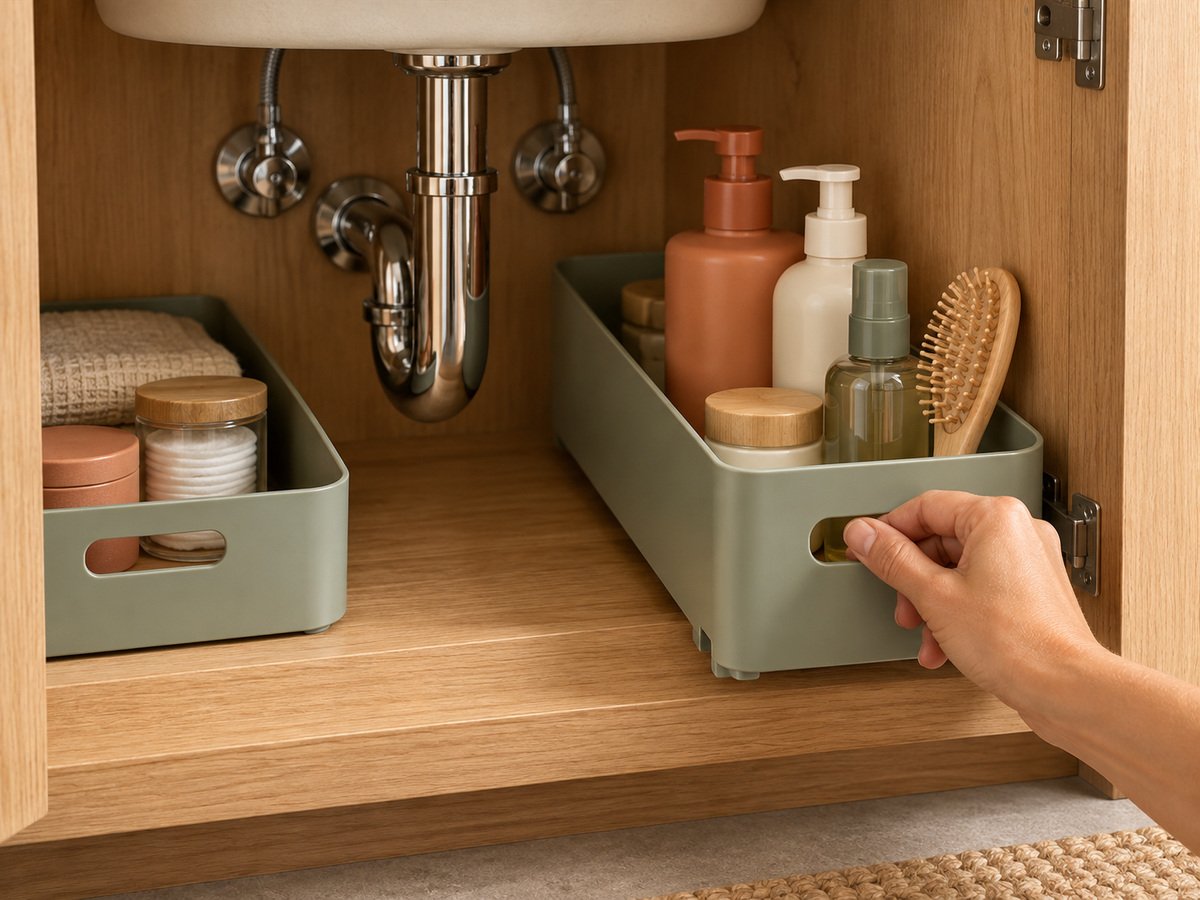
Compare the useful layouts
Start with the case that matches your routine. The checks explain what changes the choice; they are not installation approvals or a reason to buy every option.
These recommendations combine documented specifications with practical planning inferences. Casa Ordenada has not physically tested these organizers. Named models are documentary examples, not a market-wide ranking; decisive dimensions and instructions must be rechecked for the exact current variant. There are no active affiliate links, copied star ratings or static prices.
The illustrations explain typical layouts and movements. They are not exact product renderings, scaled installation drawings or proof of tested performance. Use the current appliance, fixture and organizer instructions for your own space.
Divide the cabinet into plumbing and storage zones
Draw the P-trap, supply lines, shutoff valves, and any disposal or filter before shopping. Then measure the clear door opening—not just the wider cabinet interior. The organizer can use only the remaining rectangles while preserving a hand path to both valves and a visible cabinet floor.
Retrieval changes the required depth
The YouCopia RollOut body is documented at 16.4 inches deep, but the complete basket position reaches 21.3 inches. That is an additional 4.9 inches of operating depth—about 30% beyond the body depth. A cabinet can contain it while closed and still fail when the basket reaches the door frame or the user cannot stand in front of it.
Rotation needs a clear circle
A 12-inch SinkSuite turntable needs a full 12-inch sweep plus fingertip room. It can bring small bottles forward around a central pipe zone, but its circular footprint leaves corner space unused and tall bottles near the edge can enlarge the effective sweep.
| Option | Documented geometry | Best pipe map | Operating check | Main limit |
|---|---|---|---|---|
| YouCopia RollOut 8-inch | 7.7 W × 5.3 H × 16.4 D in; 21.3 D extended | One clear side lane | 4.9 inches of extra travel | Basket and user clearance |
| YouCopia SinkSuite | 12-inch diameter | Clear circular zone | Complete rotation | Corner loss and edge-item sweep |
| Cabinet mesh drawers | Variant dependent | Stable shallow rectangle | Drawer and frame travel | Pipe and door alignment |
Compare the layouts in use
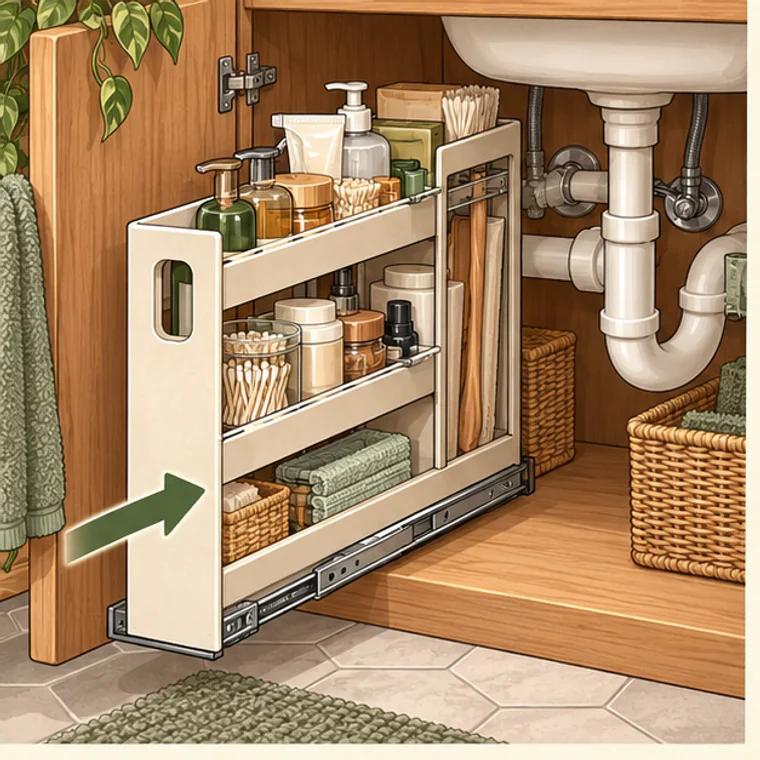
YouCopia RollOut — One uninterrupted side lane
Choose it when one side of the plumbing forms a clear lane at least as wide as the unit and the cabinet has the depth to extend the basket. The lift-and-roll action can retrieve bottles without moving every item in front.
Skip it when the door opening narrows the lane, a valve sits in the basket path, or the bathroom does not provide standing room for the extended position.
- Measure the narrowest opening at hinges.
- Protect direct access to the shutoff valve.
- Keep leak-prone liquids in a removable tray.
Read the scene: The arrow follows the basket forward beside the pipes. Body depth and fully extended depth are different, and the valve path must stay clear.
- Useful when
- The clear opening and full travel avoid plumbing.
- Reconsider when
- The extended basket occupies a valve path or needed standing space.
Check the working layout
- Try this
- Trace the documented 21.3-inch extended depth from the proposed installation line.
- What it reveals
- The 16.4-inch body needs an additional 4.9 inches of operating depth.
- What to change or look for
- Compare the fully extended drawing and user position; choose a removable category if the lane is irregular.
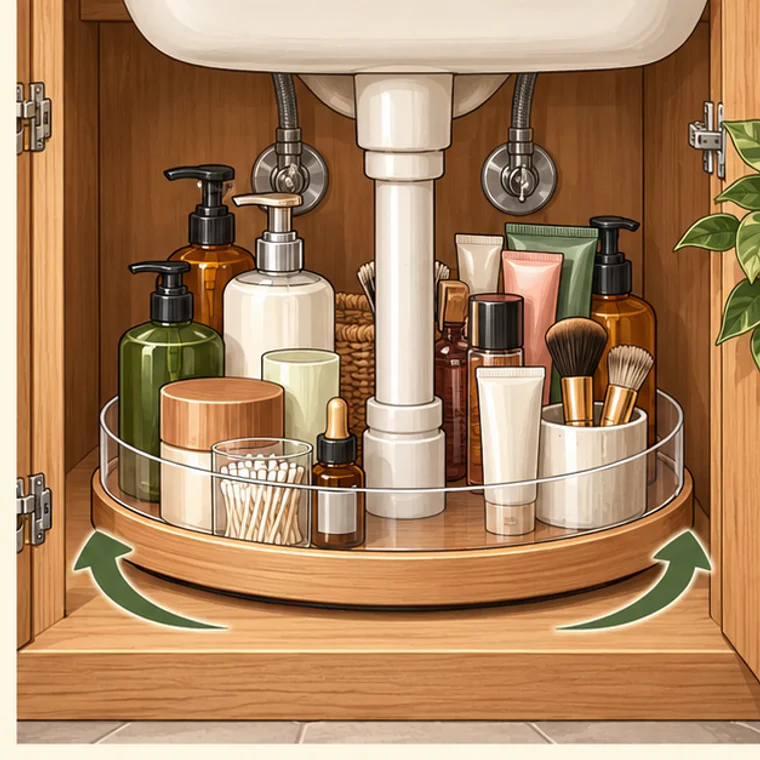
SinkSuite — A clear circular zone
Rotation can bring small daily items forward without a long pull-out path. The 12-inch diameter is easy to understand, but the cabinet must clear the widest bottle at every angle.
Skip it when pipes divide the circle, tall bottles become unstable near the edge, or the vanity corners are more valuable than central retrieval.
- Load heavier bottles nearer the center.
- Keep labels visible rather than packing the rim.
- Test rotation with the cabinet door partly constrained by the room.
Read the scene: The circle turns small bottles beneath the plumbing. Every loaded angle needs clearance; an empty base fitting once is not enough.
- Useful when
- Small stable bottles can rotate around an unobstructed circle.
- Reconsider when
- Pipes divide the sweep or wide edge bottles enlarge it into an obstacle.
Check the working layout
- Try this
- Trace a loaded 12-inch circle with the widest intended bottle at the edge and the door at its normal angle.
- What it reveals
- A rotating base may fit while the contents or your fingers do not clear the pipe map.
- What to change or look for
- Move wider loads inward or choose rectangular removable storage; keep labels identifiable.
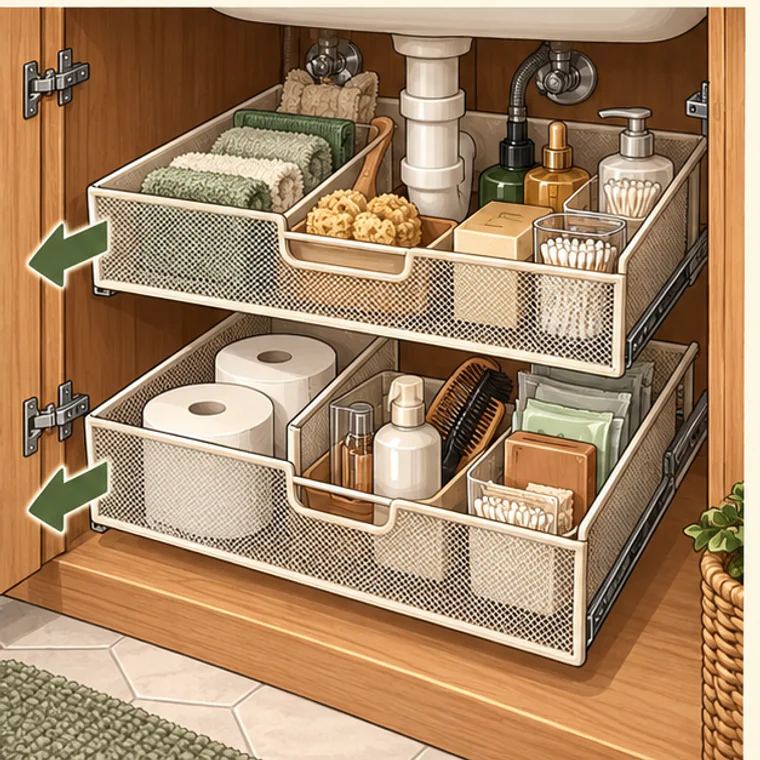
Mesh drawers — A shallow rectangular zone
A mesh drawer can use a shallow rectangle efficiently and allows air and leak visibility. It becomes a good choice only after selecting an exact frame whose width, height, drawer travel, and supports avoid every pipe.
Because variants differ, a generic family recommendation cannot substitute for the exact component drawing.
- Verify frame stability on the cabinet floor.
- Check the drawer with the tallest stored bottle.
- Avoid a frame that bridges or presses against supply lines.
Read the scene: The two drawers move through a rectangular lane. Compare the exact frame, tallest stored item and extended travel with the pipe map.
- Useful when
- The exact frame avoids plumbing and permits independent drawer access.
- Reconsider when
- Supports press against lines or the drawer catches the opening.
Check the working layout
- Try this
- Match the frame and extended drawer diagram to a pipe map, including the tallest bottle.
- What it reveals
- Generic family dimensions cannot establish that a particular frame will fit.
- What to change or look for
- Select an exact stable component with a documented travel envelope and an inspectable cabinet floor.
Frequently asked questions
Should an organizer fill the entire vanity?
No. Preserve valve access, visible plumbing, and enough open floor to notice and clean a leak.
Is a pull-out always better than a removable bin?
No. Pull-outs need a straight travel lane. A removable caddy can work better around irregular plumbing or a narrow opening.
What should stay out from under the sink?
Avoid anything damaged by a possible leak, and follow label guidance for medicines, chemicals, and products that require child-resistant storage.
How often should I empty the cabinet?
Inspect the floor, pipes, and valves on a regular household cleaning cycle and immediately after any moisture, odor, or staining appears.
Make the next decision
Plan the access and movement → Explore all bathroom guides → How we review →