Best pantry organizers for small spaces, chosen by access problem
A small pantry improves when one repeated access problem disappears, not when every shelf gains a container. Hidden labels, lost corner bottles, and a category that must travel to the counter need different solutions. This guide compares the space each family uses and the task it should make easier. Start with the zone you use most, test one intervention through a normal grocery cycle, and keep the no-organizer option when products already remain visible and reachable. The linked comparisons help you choose exact models after you have identified the family that suits the problem.
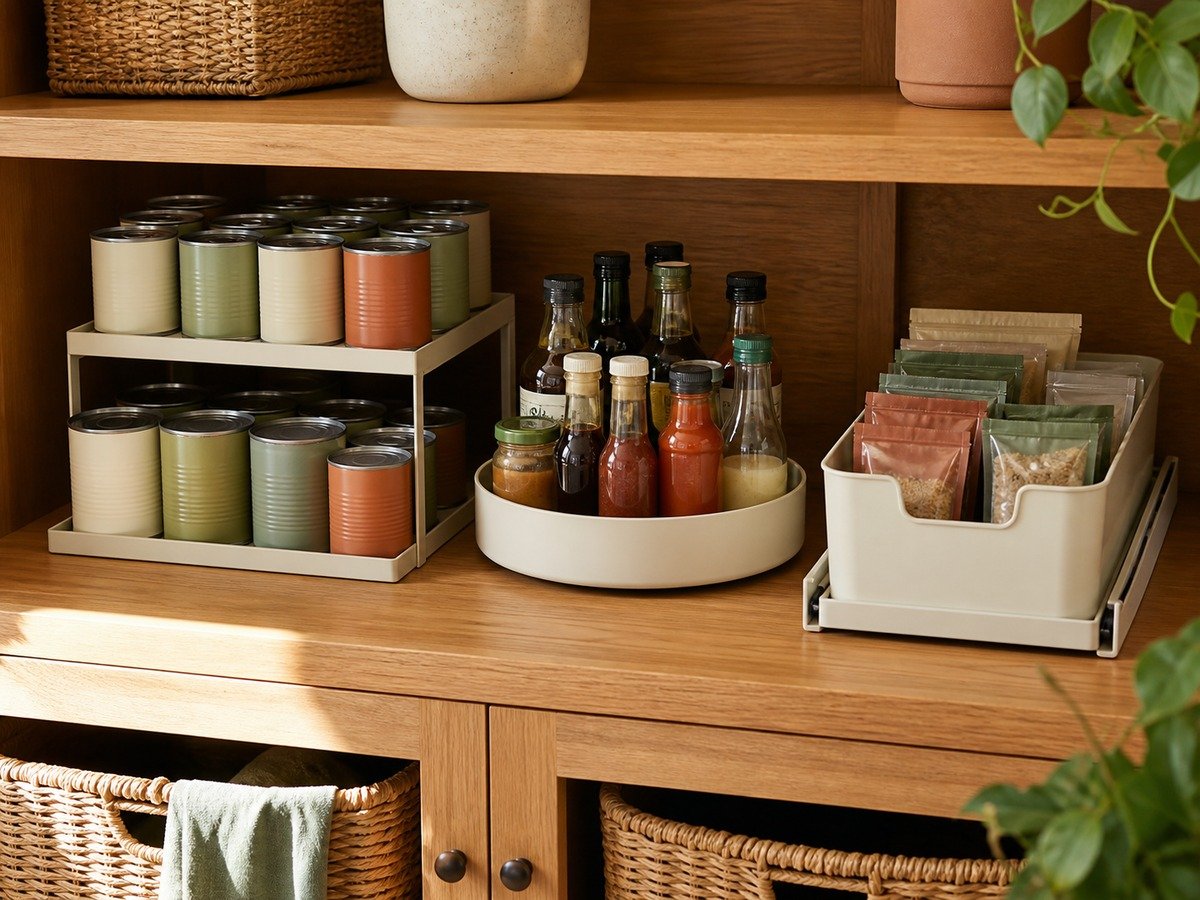
Compare the useful layouts
Start with the case that matches your routine. The checks explain what changes the choice; they are not installation approvals or a reason to buy every option.
These recommendations combine documented specifications with practical planning inferences. Casa Ordenada has not physically tested these organizers. Named models are documentary examples, not a market-wide ranking; decisive dimensions and instructions must be rechecked for the exact current variant. There are no active affiliate links, copied star ratings or static prices.
The illustrations explain typical layouts and movements. They are not exact product renderings, scaled installation drawings or proof of tested performance. Use the current appliance, fixture and organizer instructions for your own space.
Choose by access failure, then compare exact products
Pantry organizers do not create volume. They exchange one kind of space for better visibility, retrieval, or stacking. A shelf riser consumes vertical clearance; a turntable trades square corners for rotation; a bin adds a pull path; a door rack adds moving load.
Measure the operation, not only the shelf
Record opening width, usable depth, shelf spacing, hinge intrusion, and the height needed to lift the tallest item. For moving organizers, add the full rotation, pull, or door swing. Buy one test unit before standardizing a pantry with different shelf dimensions.
Use a success test
After one week, the organizer should reduce searching, make stock quantity easier to read, and allow every item to return without rearranging another category. If it only makes the shelf look coordinated, it has not solved the access problem.
| Failure | Organizer | Space cost | Measure first | Dedicated comparison |
|---|---|---|---|---|
| Labels disappear in rows | Tiered organizer | Vertical headroom | Tier rise and removal height | Can organizers |
| Small bottles disappear in a corner | Turntable | Unused square corners | Diameter and edge-item sweep | Turntables |
| A whole category is retrieved together | Pull-out bin | Hand and travel clearance | Opening and full extension | Exact bin documentation |
| No shelf area remains | Door rack | Moving door load | Projection and loaded swing | Over-the-door pantry organizers |
| Loose dry food will not stack | Food container | Decanting and cleaning | Package volume and lid | Storage containers |
Compare the layouts in use
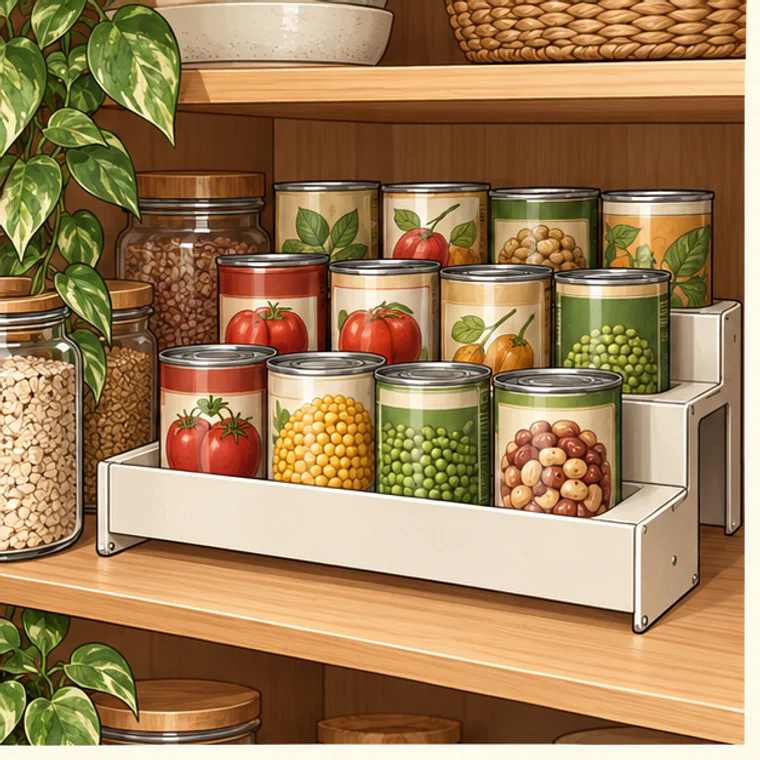
Tiered organizer — Bring hidden labels into view
Use steps when the same-size cans or short jars form multiple invisible rows. The organizer succeeds when every active label can be identified and the rear item can be lifted out.
Skip it when shelf spacing is low or the surface is excluded by the current product instructions.
- Measure rear-row total height.
- Keep enough hand space above the tallest can.
- Do not treat a stated load as permission to overload the shelf.
Read the scene: The raised rear cans illustrate label visibility. The decision also depends on removing the back can without unloading the front row.
- Useful when
- Similar short cans form several hidden rows.
- Reconsider when
- The raised rear row cannot be removed under the shelf above.
Check the working layout
- Try this
- Try identifying and removing a rear can without first clearing the front.
- What it reveals
- The benefit is visibility plus retrieval, not merely a stepped display.
- What to change or look for
- Compare rear rise, hand clearance and the exact allowed shelf surface.
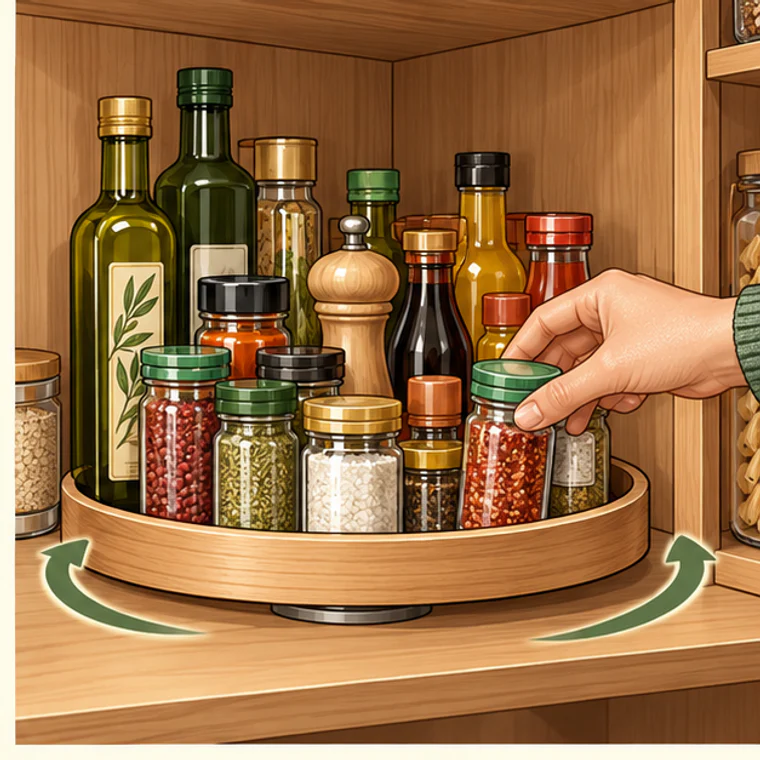
Turntable — Bring the corner forward
Rotation changes retrieval direction: the back comes forward. It works best for stable bottles and jars that remain inside the rim and visible throughout the sweep.
Skip it for mixed tall and heavy items or when a hinge clips the edge of the rotating load.
- Measure full diameter plus fingertip room.
- Load heavier items nearer the center.
- Choose bins or dividers only when categories need separation.
Read the scene: The hand and curved arrow bring rear bottles forward. The useful space is the loaded sweep that clears the cabinet, not just the empty tray.
- Useful when
- Stable small bottles disappear behind one another.
- Reconsider when
- The loaded sweep hits a hinge or tall edge items are unstable.
Check the working layout
- Try this
- Arrange the widest bottle at the edge of a paper template and trace a complete turn.
- What it reveals
- The effective moving circle can be larger than the published tray diameter.
- What to change or look for
- Choose a smaller open platform or bin-based layout only when separation is needed.
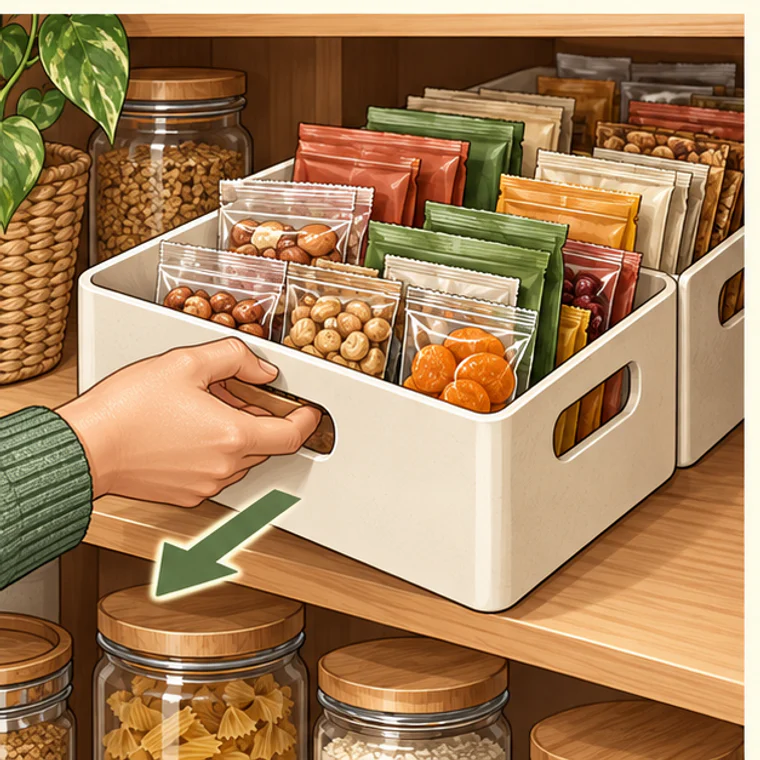
Pull-out bin — Move one task together
A handled bin can turn a deep shelf into a removable drawer for baking supplies, snacks, or packets. Clear sides help inventory; opaque walls can recreate the hidden-back problem inside the bin.
Skip it when the opening narrows at hinges or the filled weight makes one-handed retrieval awkward.
- Measure the narrowest opening.
- Allow hand clearance above and beside the handle.
- Test the bin with a realistic filled weight.
Read the scene: Both hands move one grouped category off the shelf. Judge the filled weight, handle access and return path together.
- Useful when
- Baking, snacks or another category is retrieved as a group.
- Reconsider when
- The filled bin is awkward to lift or the opening traps its handle.
Check the working layout
- Try this
- Use a box with the intended filled category and rehearse moving it to the counter and returning it.
- What it reveals
- A removable category saves work only when its weight and handles suit the actual journey.
- What to change or look for
- Compare internal fit, clear opening and a usable grip; divide an overly heavy category.
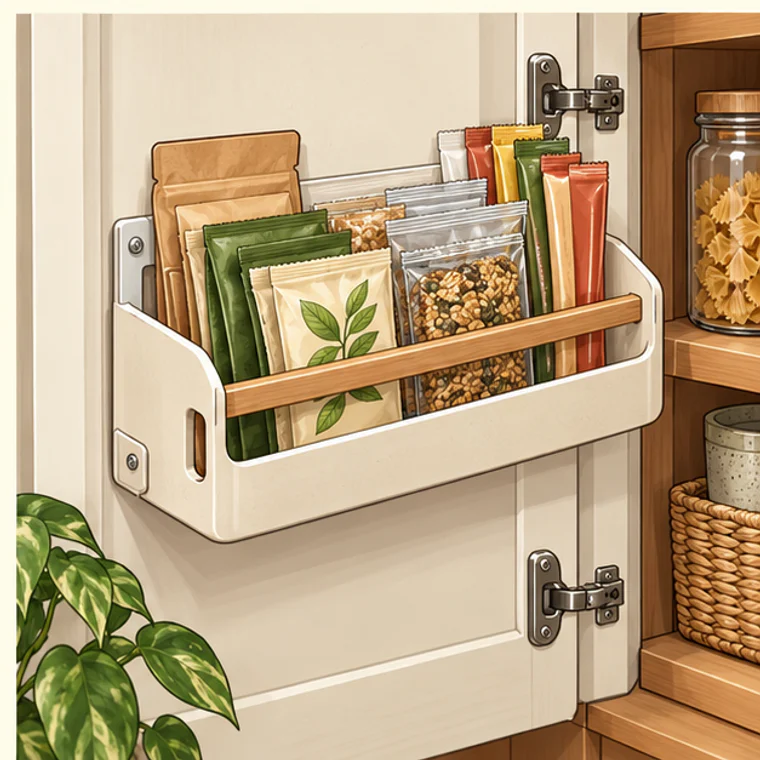
Door rack — Use genuinely free vertical space
A door rack adds shallow vertical storage without consuming a shelf, but the door becomes a moving storage surface. Hooks, frame, hinges, handle, interior shelves, and latch must all cooperate.
Use it for lighter shallow packages rather than heavy glass backstock.
- Measure top gap and door thickness.
- Compare basket projection with interior shelf setback.
- Test closing and latching under realistic load.
Read the scene: The basket sits on a surface that swings beside fixed shelves. Unused door area is useful only when the loaded door still closes normally.
- Useful when
- Light shallow packages have no useful shelf position.
- Reconsider when
- Hooks, loaded swing or stabilization conflict with the door.
Check the working layout
- Try this
- Trace basket projection at each shelf height while opening and closing the door.
- What it reveals
- Free door area does not necessarily mean a free moving envelope.
- What to change or look for
- Compare the exact mount and basket setback before choosing capacity or basket count.
Frequently asked questions
Should I buy matching pantry organizers?
Only after one unit proves it solves the named access problem. Different shelves often need different dimensions and retrieval methods.
Which organizer should I buy first?
Start with the most frequent problem: hidden labels, lost corner bottles, a category that must leave together, or genuinely unused door space.
Do organizers create more capacity?
They reorganize existing volume. Some improve vertical use, but every organizer also occupies material thickness, clearance, or motion space.
When should I use no organizer at all?
When items already remain visible, reachable, stable, and easy to return. Empty shelf space is useful restocking capacity.
Make the next decision
Plan the access and movement → Explore all pantry guides → How we review →