How to measure pantry shelves
before choosing organizers
A pantry organizer must fit through the opening, sit inside the smallest usable rectangle, and move without hitting hinges, doors, lips, or nearby items.
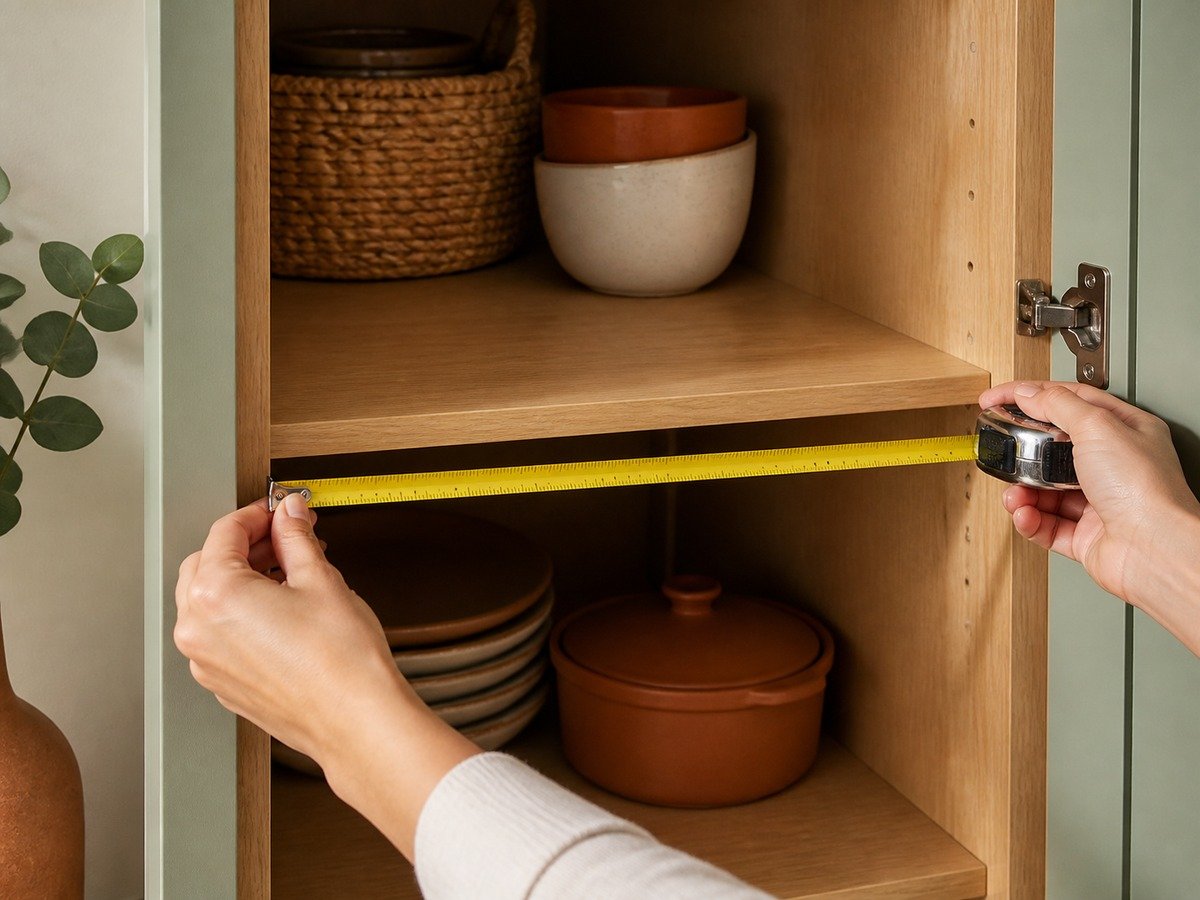
1. Measure the usable rectangle, not the cabinet opening
Record the narrowest clear width between shelf supports, hinges, trim, pipes, or bowed walls. Then measure usable depth from the front edge to the first obstruction. A shelf may look deep enough while a door hinge, center stile, or lip prevents a bin from entering straight.
Measure at the front, middle, and back. Keep the smallest value. For a pull-out or turntable, also record the clear opening through which the product must pass.
2. Map vertical gaps shelf by shelf
Measure from the top surface of one shelf to the underside of the shelf above it. Repeat for every level: fixed shelves are rarely identical. If shelves are adjustable, record the peg spacing and the highest position that still allows you to remove an item comfortably.
3. Add the operating envelope
A turntable needs finger clearance at its rim. A pull-out bin needs room to travel past the door and handle. An over-door rack must clear interior shelves throughout the full swing. Measure products both closed and in their most open position, then protect the aisle you need to stand and reach.
| Record | Why it matters | Common miss |
|---|---|---|
| Smallest clear width | Controls whether the organizer enters and sits flat | Measuring wall-to-wall behind a narrower opening |
| Usable depth | Prevents overhang and door collision | Ignoring the back lip or hinge |
| Vertical clearance | Determines stack and access | Counting the shelf thickness as space |
| Door swing | Protects rack and interior shelf clearance | Testing only with the door half open |
| Largest package | Checks real container volume | Comparing product quarts with food weight |
4. Create a buy/no-buy line for each candidate
Write the exact model and variant, its documented assembled dimensions, the clearance it needs, and the smallest measurement you recorded. Mark “pass” only when every hard constraint fits. Package dimensions are not assembled dimensions, and marketplace listings may mix variants.
Next decision
Once the measurements are stable, compare families rather than buying a matching set by appearance.