Best storage ottomans for small spaces and
double-duty rooms
A storage ottoman can replace two objects, but only when retrieving what is inside does not interrupt the room. A folding bench suits a changing layout, a tray-top cube can support a small living-room corner, and a longer bench needs a clear wall or bed-end position. This comparison uses documented sizes and functions, not untested comfort claims. Plan where the lid goes, how a filled compartment will be handled, and whether sitting or tray use is explicitly permitted. The final choice should simplify an actual routine rather than merely hide more things.
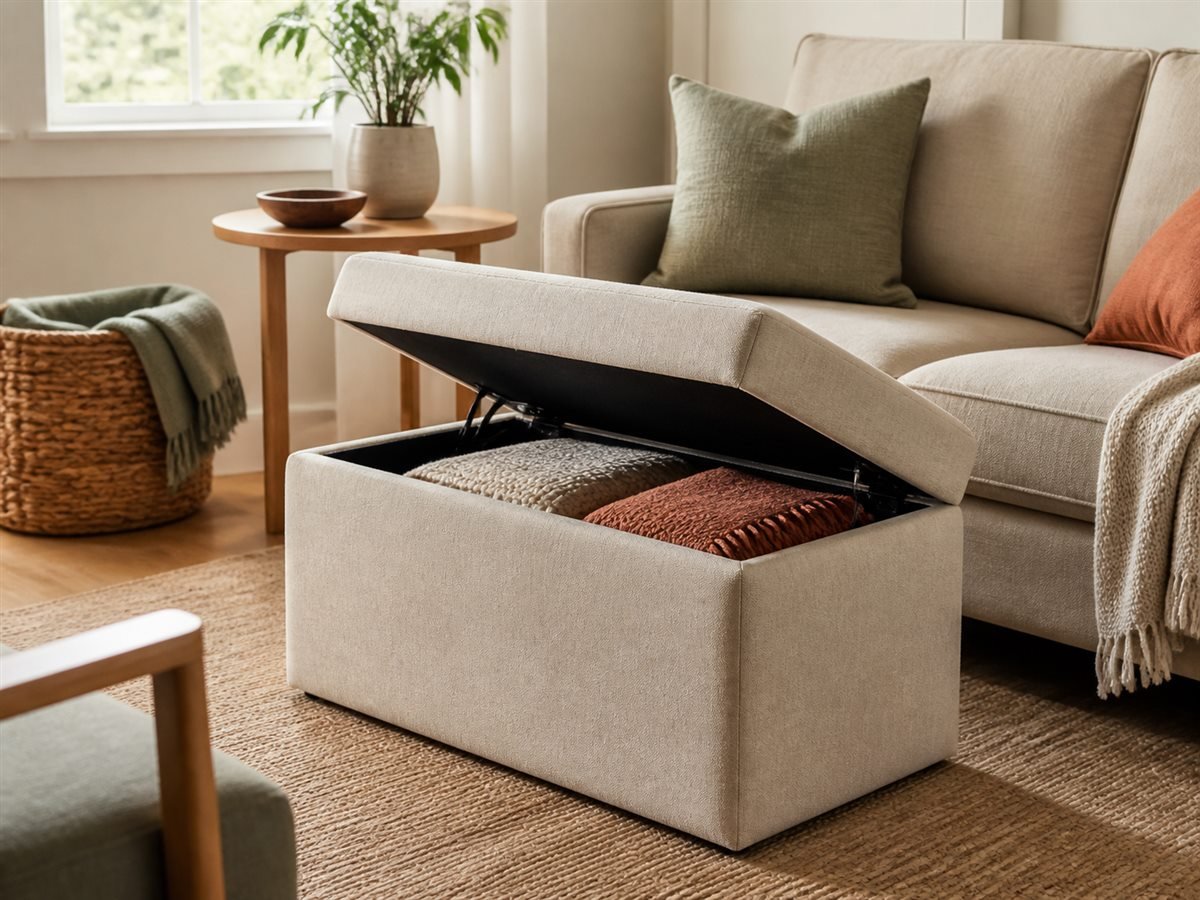
Compare the useful layouts
Start with the case that matches your routine. The checks explain what changes the choice; they are not installation approvals or a reason to buy every option.
These recommendations combine documented specifications with practical planning inferences. Casa Ordenada has not physically tested these organizers. Named models are documentary examples, not a market-wide ranking; decisive dimensions and instructions must be rechecked for the exact current variant. There are no active affiliate links, copied star ratings or static prices.
The illustrations explain typical layouts and movements. They are not exact product renderings, scaled installation drawings or proof of tested performance. Use the current appliance, fixture and organizer instructions for your own space.
| Option | Documented size | Format | Best for | Verify |
|---|---|---|---|---|
| SONGMICS MAZIE 30-inch | 30 W × 15 D × 15 H in | Folding bench; 22.4 gal stated volume | Seasonal flexibility | Current seating/load instructions |
| HomePop tray-top cube | 17.5 W × 17.5 D × 17.5 H in | Compact cube with tray top | Small living-room corner | Top handling and authorized uses |
| Royal Windsor storage bench | 43.31 W × 15.75 D × 15.75 H in | Long upholstered bench | End of bed or long wall | Full lid opening and safety directions |
Compare the layouts in use
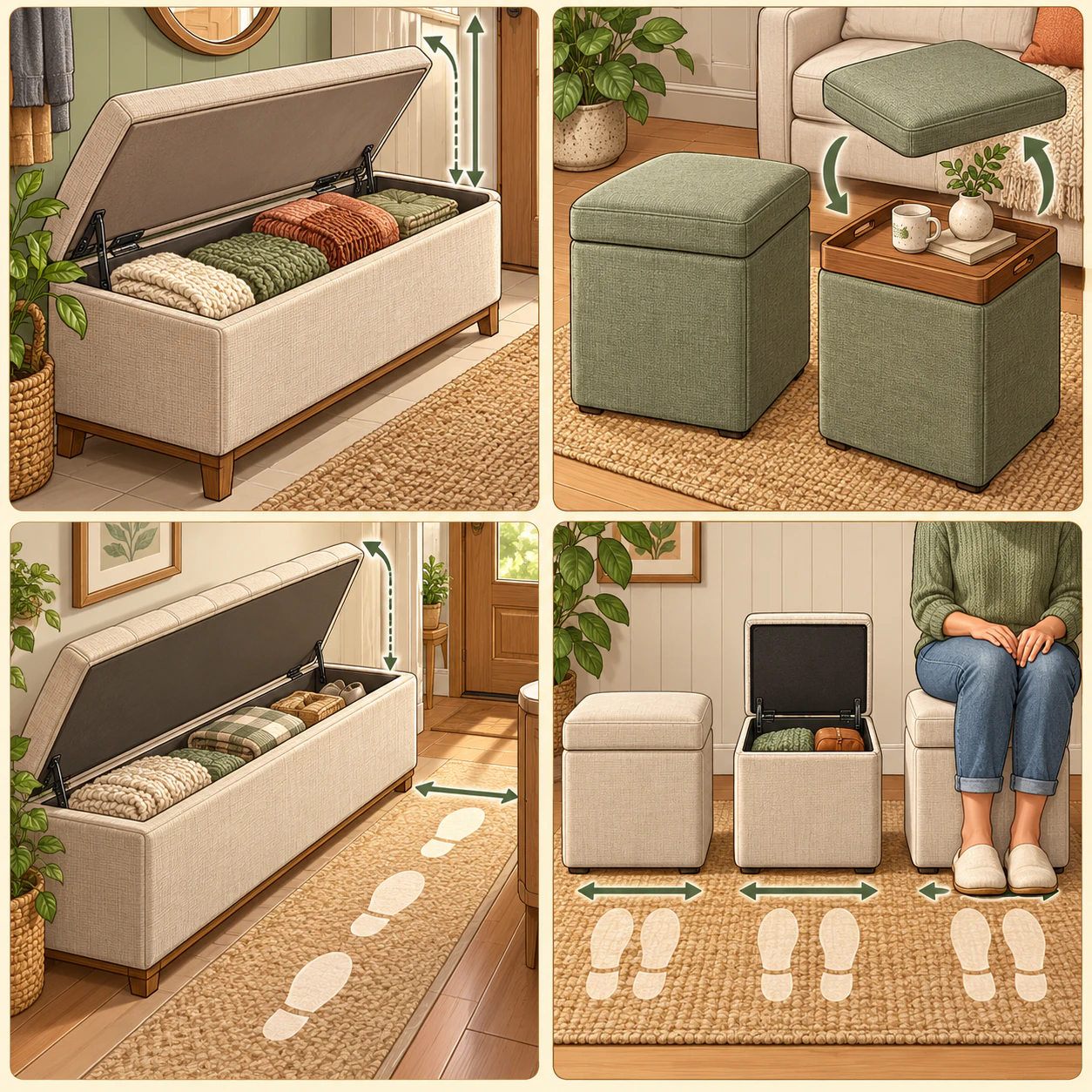
SONGMICS MAZIE — Folding flexibility
SONGMICS documents a 30 × 15 × 15-inch assembled size, MDF structure, foam padding, linen-look fabric, 22.4-gallon volume, and a manufacturer-stated static load. The body folds when not needed, which is valuable in a room that changes function.
Trade-offs: folding construction is not the same as rigid furniture. Do not add casters or change the structure unless the manufacturer authorizes it. A static load claim is not a comfort or durability result.
Check before buying: where the lid will go, whether stored items exceed the practical lift weight, and the current instructions for sitting.
Read the scene: The raised lid highlights storage access. The scene does not prove folding mechanics, seating comfort or an exact model's authorized uses.
- Useful when
- The room changes function and storage can be emptied before folding.
- Reconsider when
- You need a rigid permanent seat or assume a static load proves comfort.
Check the working layout
- Try this
- Choose the real stored category and rehearse removing it before the bench is folded away.
- What it reveals
- Foldability adds flexibility only when emptying and finding a home for the lid remain practical.
- What to change or look for
- Follow the exact permitted uses; do not add casters or change the construction without authorization.
HomePop — Compact tray-top format
The observed 17.5-inch cube uses far less width than a bench and adds a tray-top format, useful where a separate side table would consume another footprint.
Trade-offs: the near-square footprint is deeper than an ultra-slim bench. Confirm how the top reverses or lifts, where it rests while open, and what uses the manufacturer permits.
Read the scene: The reversible top changes the cube's function. Plan a safe place for the tray and its contents when opening the storage.
- Useful when
- A small corner needs hidden storage and a permitted hard-surface function.
- Reconsider when
- The tray will usually hold objects that make the storage inaccessible.
Check the working layout
- Try this
- Simulate lifting or reversing the top while the items normally on it have a safe temporary place.
- What it reveals
- A dual-purpose top can create extra handling before every retrieval.
- What to change or look for
- Use it for less frequent stored items, or choose independent top and storage access.
Royal Windsor — A clear long-wall position
At a documented 43.31 inches wide and 15.75 inches deep/high in the observed listing, this is the largest finalist. It fits better at the end of a bed or along a clear wall than in a tight circulation pinch point.
Trade-offs: larger width increases stored volume but reduces layout flexibility. Confirm lid motion, hinge behavior, and any restraint or use limits in current documentation.
Read the scene: The long body, lid arc and footsteps share the same room. More hidden volume can reduce flexibility in a narrow route.
- Useful when
- A longer body fits without becoming a circulation pinch point.
- Reconsider when
- The lid meets a wall, bed or nearby furniture before opening fully.
Check the working layout
- Try this
- Trace the documented 43.31-inch width and lid operation where the bench will actually stand.
- What it reveals
- A large hidden compartment is not useful when reaching the back requires awkward leaning or moving furniture.
- What to change or look for
- Check the hinge instructions, complete opening and authorized uses before committing to the longer body.
Plan the closed, open and in-use states
Need a different family? Return to storage furniture by constraint or use the full-motion measurement guide.
Read the scene: The closed, open and seated arrangements need different working space. The arrows compare those states, not a universal clearance allowance.
- Useful when
- One footprint can genuinely support the intended routine.
- Reconsider when
- An open lid or displaced tray blocks the normal passage.
Measure the ottoman in use
- Tape the closed footprint on the floor.
- Trace the lid’s open position or reserve a place for a removable top.
- Open nearby doors and pull out adjacent drawers.
- Sit or walk in the normal path without stepping around the tape.
- Confirm the manufacturer explicitly permits every intended second use.
Check the working layout
- Try this
- Open adjacent doors and drawers while a lid-sized template occupies its removal or hinged position.
- What it reveals
- The problem may be simultaneous use rather than lack of storage volume.
- What to change or look for
- Choose a smaller body, a different opening direction or another family if the functions compete.
Frequently asked questions
Can every storage ottoman be used as a seat?
No. Sitting is appropriate only when the manufacturer explicitly permits it and provides the relevant load guidance. A storage box with upholstery should not be treated as seating based on appearance alone.
How should I measure space for an opening lid?
Record the closed footprint, then add the lid movement and the room needed for your hands and stored items. Also check nearby walls, tables, beds, and walking paths that could prevent full opening.
Make the next decision
Plan the access and movement → Explore all small-space guides → How we review →