Best pantry storage containers, chosen by package fit
A matching set is not the starting point for useful pantry containers. Start with the foods you repeatedly buy, the package quantity you need to store, and how you will scoop, pour, wash, and relabel them. Mixed volumes, modular sets, and narrow tall containers each solve a different shelf problem. Compare the documented examples here, then test one package before standardizing. A small visual improvement is not worth recurring overflow bags or awkward lids. Preserve the food's required label information and follow its storage guidance; decanting does not automatically extend shelf life.
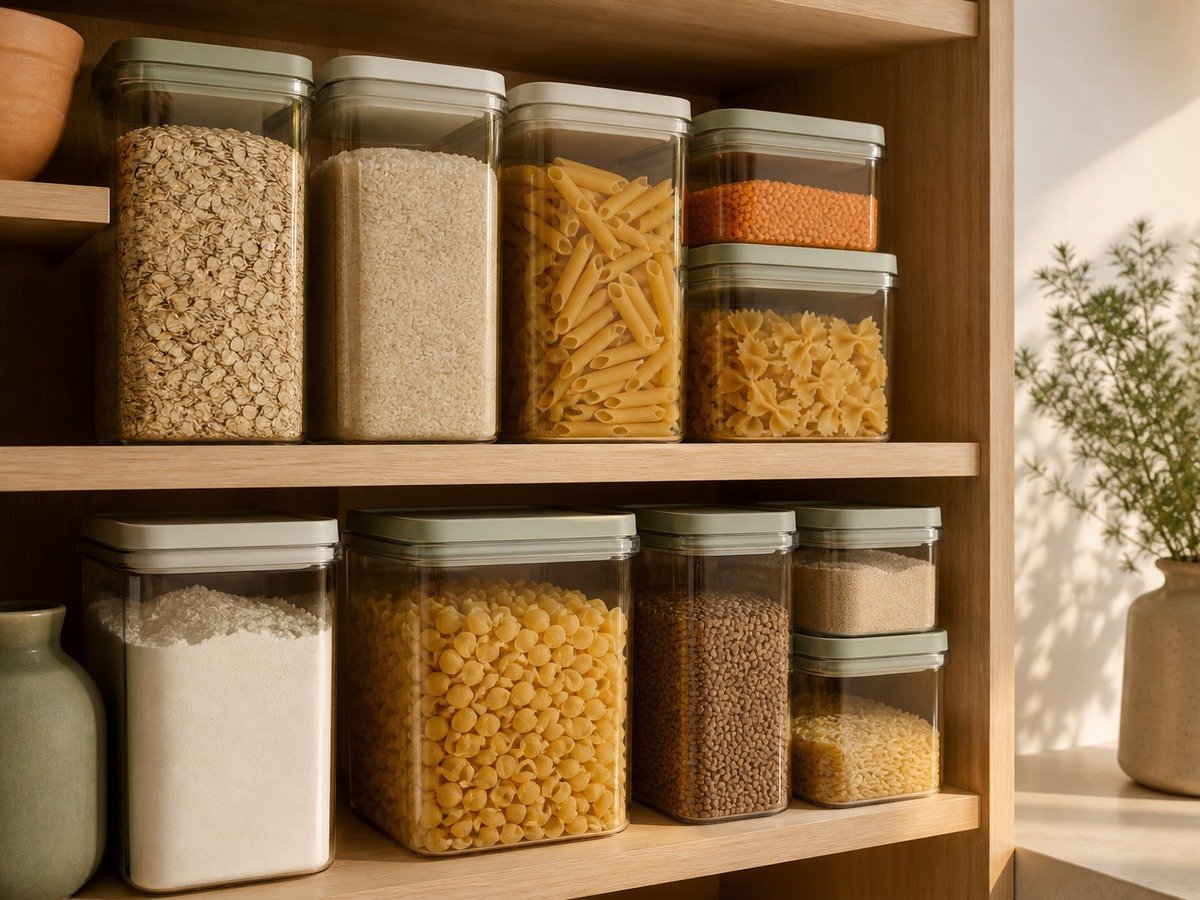
Compare the useful layouts
Start with the case that matches your routine. The checks explain what changes the choice; they are not installation approvals or a reason to buy every option.
These recommendations combine documented specifications with practical planning inferences. Casa Ordenada has not physically tested these organizers. Named models are documentary examples, not a market-wide ranking; decisive dimensions and instructions must be rechecked for the exact current variant. There are no active affiliate links, copied star ratings or static prices.
The illustrations explain typical layouts and movements. They are not exact product renderings, scaled installation drawings or proof of tested performance. Use the current appliance, fixture and organizer instructions for your own space.
Manufacturer sources
Dimensions and use statements were checked against Rubbermaid Brilliance Pantry, the OXO POP 5-piece set, and IKEA 365+ dry-food storage. Verify the current US variant before purchase.
| Documented option | Set or size | Closure | Best for | Main trade-off |
|---|---|---|---|---|
| Rubbermaid Brilliance Pantry set | 3.2, 7.8, 12, and 16 cup containers | Manufacturer states airtight | Mixed dry-food volumes in one line | Package fit varies by food density |
| OXO POP 5-piece set | 2.1, 1.5, two 0.9, and 0.3 qt | Push-button seal | Modular small-to-medium staples | Button needs cleaning and headroom |
| IKEA 365+ 2 qt | 7 L × 3 W × 12 H in | Tight-fitting lid | Narrow, tall shelf zones | Height can block removal |
Compare the layouts in use
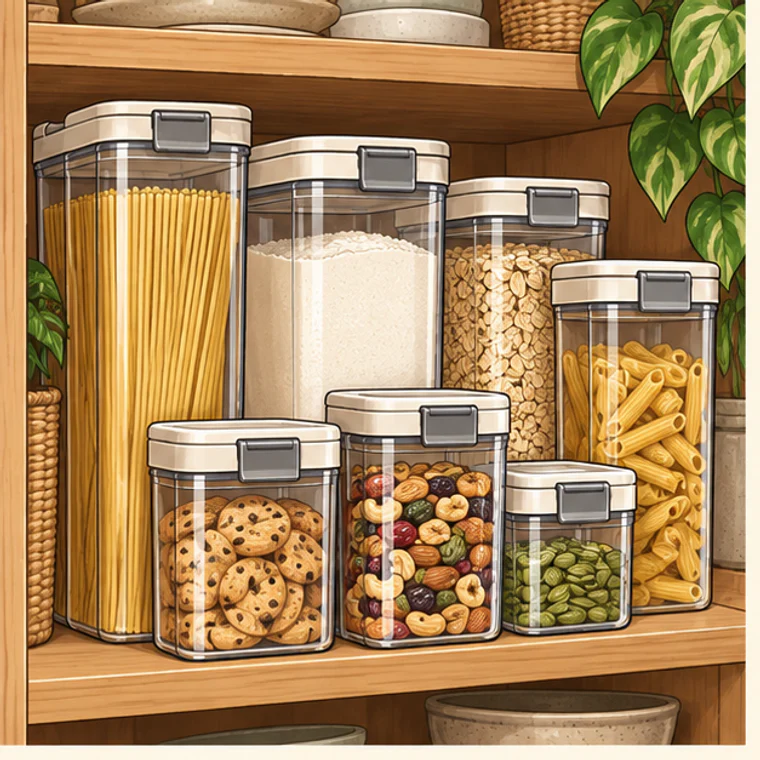
Rubbermaid Brilliance — Mixed recurring quantities
The four documented capacities cover several package sizes, and Rubbermaid states an airtight seal for this line. The useful question is not the number of pieces: test whether your largest recurring package fits with enough headspace to close the lid.
Read the scene: Different heights and volumes fit different staples. A set is useful when those sizes match recurring packages, not merely because the pieces look coordinated.
- Useful when
- Different staples genuinely need the documented range of volumes.
- Reconsider when
- A set leaves several unused pieces and still cannot take the main package.
Check the working layout
- Try this
- Test the largest recurring package in one candidate volume with lid-closing headspace.
- What it reveals
- Piece count can disguise a poor match between set sizes and your buying pattern.
- What to change or look for
- Buy around repeated quantities rather than a matching look; confirm care and food-use instructions for the variant.
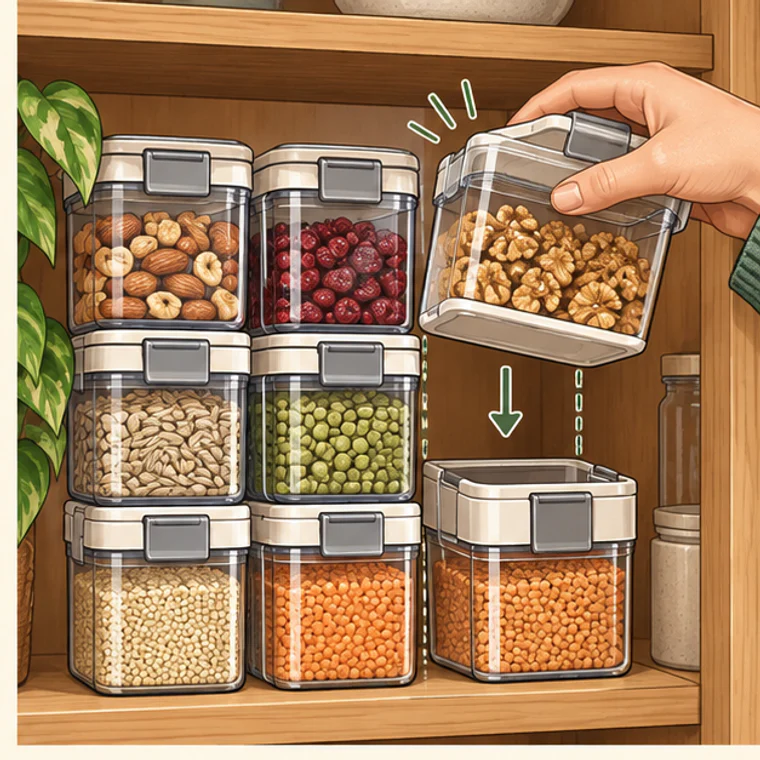
OXO POP — Modular small and medium staples
The varied footprints can build a compact group for staples and smaller ingredients. Leave vertical room to operate and remove the lid, and follow the current cleaning instructions for the lid mechanism.
Read the scene: The lifted lid and stacked containers show the access cost of a compact group. Daily staples should not require unloading the stack.
- Useful when
- Separate quantities fit the set and repeated lid use remains simple.
- Reconsider when
- Cleaning the mechanism or unstacking adds more work than the layout saves.
Check the working layout
- Try this
- Rehearse lid operation and removal at the proposed shelf height, including any container stacked above.
- What it reveals
- A compact stack can be inconvenient when the bottom staple is used every day.
- What to change or look for
- Keep daily containers independently accessible; compare current lid disassembly and cleaning directions.
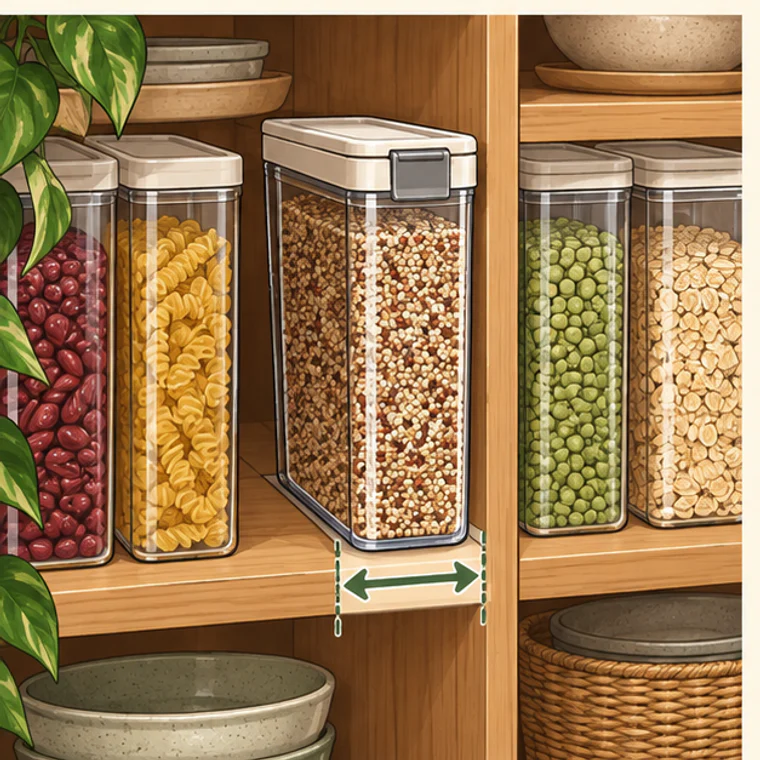
IKEA 365+ — Narrow, tall rows
The documented three-inch width can make efficient rows, but the twelve-inch height is restrictive on short shelves. Verify that the container enters through the opening and can be lifted out without tipping.
Read the scene: The floor-width arrow highlights the slim row, while the tall bodies use headroom. Check removal height as well as the narrow footprint.
- Useful when
- A shallow-width lane has enough height to remove the container.
- Reconsider when
- The 12-inch body fits but cannot be lifted or tilted safely through the opening.
Check the working layout
- Try this
- Mock up the documented 7-by-3-by-12-inch body and remove it with adjacent containers in place.
- What it reveals
- Slim width trades horizontal space for a taller removal envelope.
- What to change or look for
- Choose a shorter format when shelf spacing controls access; do not infer fit from volume alone.
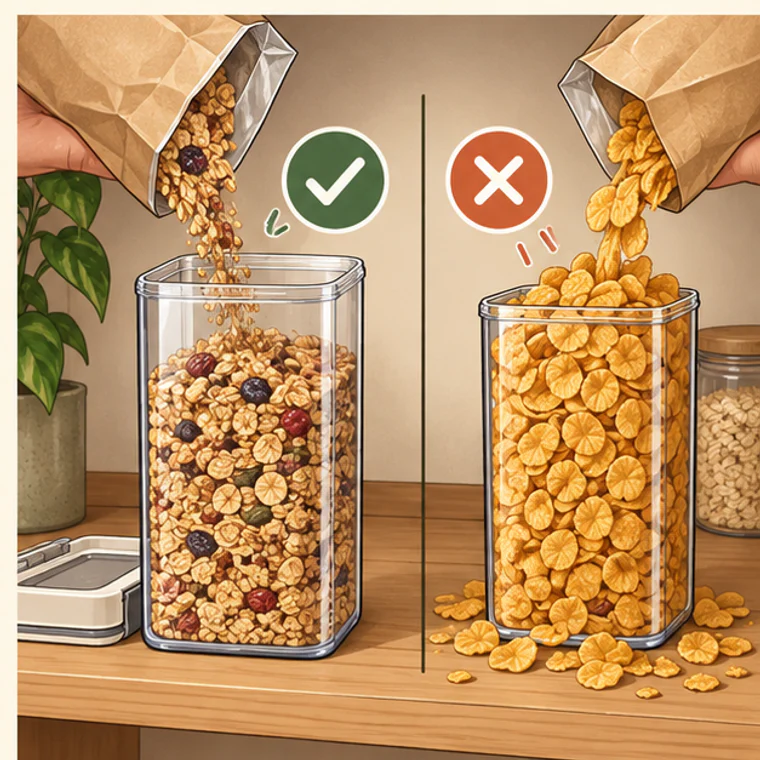
Test the package and restocking cycle
Quarts, liters, cups, and ounces may describe different things. A container volume does not guarantee that a named weight of flour, cereal, or rice will fit because density and package headspace vary. Measure or test one package before buying a matching set.
Read the scene: The two pours contrast package fit and overflow. A container needs to handle the normal restocking quantity without creating an unplanned second bag.
- Useful when
- Decanting solves a real stacking, access or closure problem.
- Reconsider when
- Refilling produces a second half-empty bag with no assigned home.
Check the working layout
- Try this
- Simulate a new purchase arriving before the container is empty, and plan where the remainder and its label belong.
- What it reveals
- The system must handle overlap between old stock and the next package, not just a fresh full container.
- What to change or look for
- Keep required dates, allergens and preparation details; choose original packaging when the added maintenance has no benefit.
Food-use boundary: use containers only as the manufacturer directs. Preserve allergen, date, and preparation information. Casa Ordenada does not claim that decanting extends shelf life.
Frequently asked questions
How do I know whether a food package will fit?
Compare volume rather than weight, then test one recurring package because food density and required headspace vary.
Do pantry containers make food last longer?
Casa Ordenada does not make that general claim. Use each container and store the food according to the manufacturer and food-label instructions.
Make the next decision
Plan the access and movement → Explore all pantry guides → How we review →