Best drying racks for small spaces, measured open and folded
The most compact drying rack is not necessarily the one that folds smallest. It needs to hold the clothes you actually air-dry without taking over the doorway, and it needs a reachable place when the load is finished. Wall-mounted, winged, and over-door designs distribute that space differently. This comparison helps you choose a working position first, then check garment drop, loading access, installation, and folded storage before committing to a design.
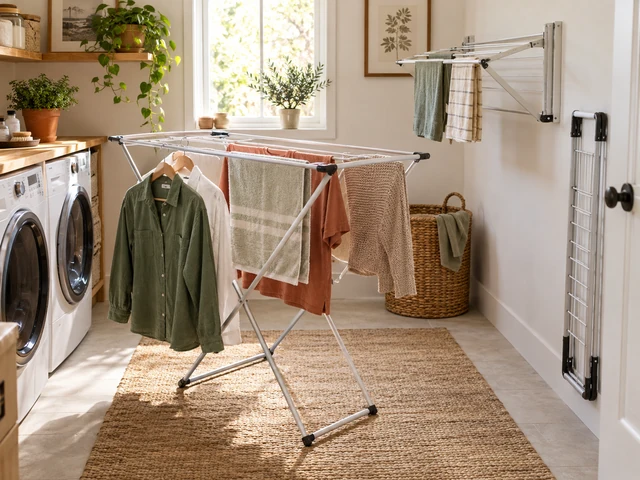
Choose the design that solves your problem
The first three sections compare organizer designs. The final section checks the working space or routine; it is not another product recommendation.
Compare the practical trade-offs
Swipe across the table to compare all four columns.
| Design | Useful when | Main compromise | Deciding feature |
|---|---|---|---|
| Wall-mounted accordion rack | A repeatable drying position with suitable mounting | Uses room depth when extended | Access to the rear rail and loaded garment drop |
| Freestanding winged rack | A temporary drying position without wall mounting | Wings and clothes enlarge the footprint | Walkway with a representative long garment |
| Over-door rack | An occasional small load on a compatible door | Can interfere with door motion | Hook fit, closing, handle access, and hanging drop |
We analyze layouts and product families, not personally tested models. There are no active affiliate links, copied ratings, or static prices. Compare any eventual product with its current instructions and your own appliance documentation.
Illustrations are conceptual layouts, not exact products, scale drawings, or installation instructions. Arrows highlight movements or areas to check, not specified clearances. Decorative containers are not recommendations to repackage laundry products.
See the differences in daily use
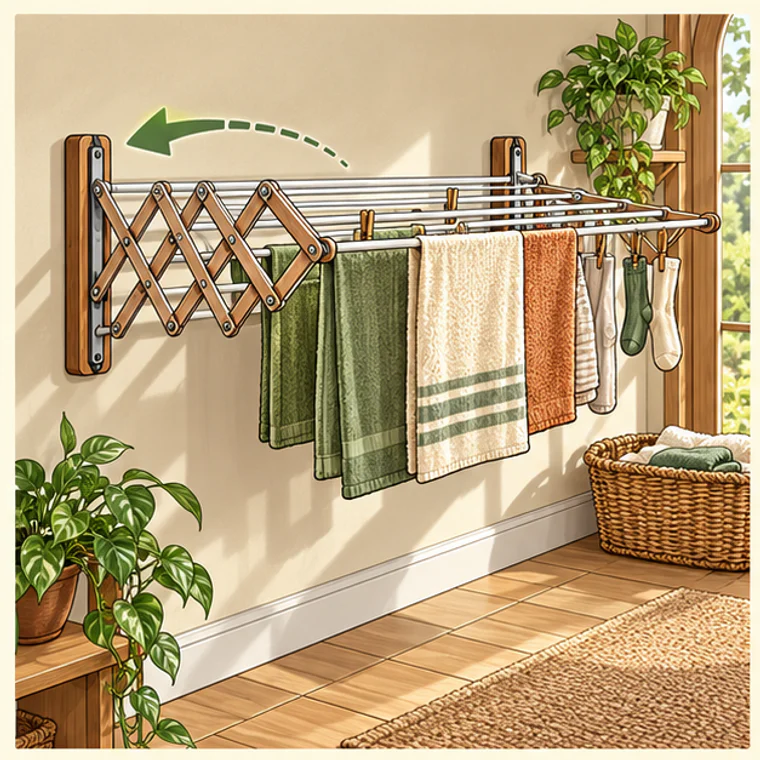
Wall-mounted accordion rack — free the floor, reserve the depth
An extending wall rack can leave the floor clear when closed and bring rails within reach while in use. Its working depth still enters the room, so it is not a zero-footprint solution. It makes most sense for a regular drying position rather than somewhere you only occasionally clear.
Read the scene: The extending rails show that the wall position has both a closed state and a working state.
- Choose it when
- You have a suitable mounting surface and can reach the extended rails without leaning over an appliance.
- Choose another route when
- The rack would extend into a doorway, or wall mounting and its required fixings are not possible.
Compare reach and loading, not only folded depth
Check the mounting and loading instructions for the exact design. Rail spacing and usable hanging drop matter for your garments, while the wall and fixings must suit the specified load. Avoid selecting a position solely because it looks unused above a washer; a top-loading lid and comfortable access still need room.
Plan with your longest garment
- Try this
- Hold a representative garment at the proposed rail position and consider how you would load the rear rail.
- What the result reveals
- A reachable empty rack may become awkward once the front rail is occupied.
- What to change or look for
- Look for a lower, unobstructed mounting position or a freestanding design.
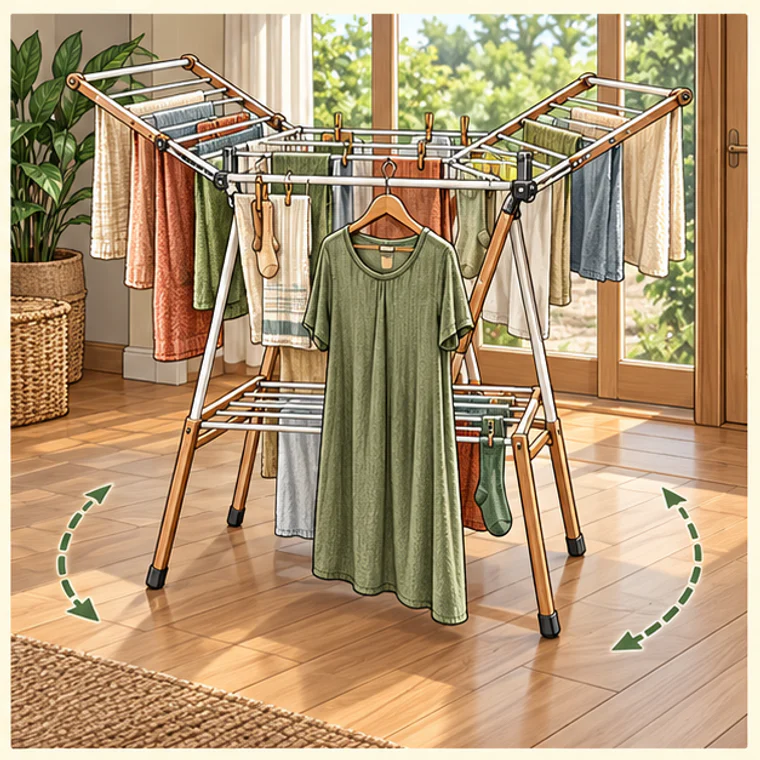
Freestanding winged rack — flexible position, larger working footprint
A fold-flat floor rack lets you move the drying position and avoid permanent wall mounting. Raised wings can provide different hanging heights, but they also enlarge the working footprint. Sleeves, towels, and an open wing may extend beyond the outline of the base.
Read the scene: The spread wings illustrate why the base dimensions alone do not describe the space used by a drying load.
- Choose it when
- You can temporarily reserve a drying position and still move a basket through the room.
- Choose another route when
- Every load would require blocking a door or relocating the rack several times.
Match the rail arrangement to your usual load
Count the types of garment you air-dry, rather than assuming a claimed drying length equals a number of loads. Long items need enough drop; many short items benefit from accessible rail spacing. A vertical drying tower is another layout to compare, but its loading reach, stability, and usable drop also need checking.
Walk around a loaded outline
- Try this
- Mark the fully opened frame and include the fabric that would hang beyond it. Pass with your basket.
- What the result reveals
- If you have to turn sideways or move the rack, the open footprint is the deciding limitation.
- What to change or look for
- Compare a different rail layout or drying position before choosing more advertised capacity.
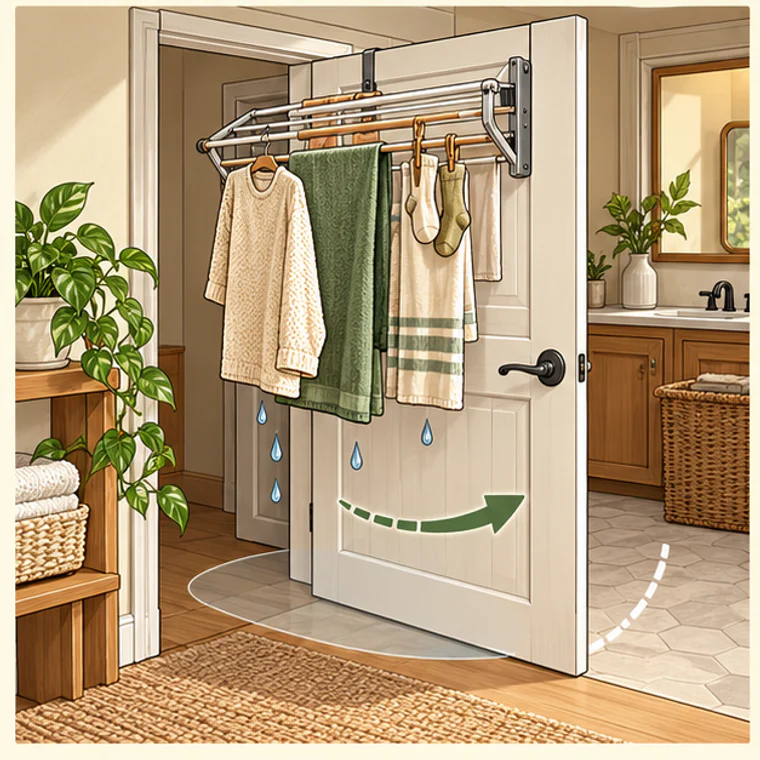
Compact over-door rack — useful for a small, occasional load
An over-door design can create hanging space without a freestanding base. It suits a limited number of smaller items when the door and rack are compatible. It is a poor substitute for a full-size rack if clothes would stop the door from closing or drape across the handle.
Read the scene: The hanging position highlights the interaction with the door, not just the amount of rail space.
- Choose it when
- The specified hooks fit the door and its normal motion remains usable with garments hanging.
- Choose another route when
- The door is part of an essential route, the hooks interfere with closing, or long clothing cannot hang freely.
Check the door conditions before the rail count
Compare the hook dimensions, permitted loading, and the rack's instructions with your actual door. Do not force a door shut against a bracket. Consider where the rack lives after drying too: a small model that is awkward to remove or store can still clutter a frequently used door.
Check use from both sides
- Try this
- Without adding an unsuitable load, examine the door's opening, handle access, and planned garment drop.
- What the result reveals
- If using the rack would remove the door's normal function, the hanging location is unsuitable.
- What to change or look for
- Choose another door only if compatible, or switch to a fold-flat or properly mounted rack.
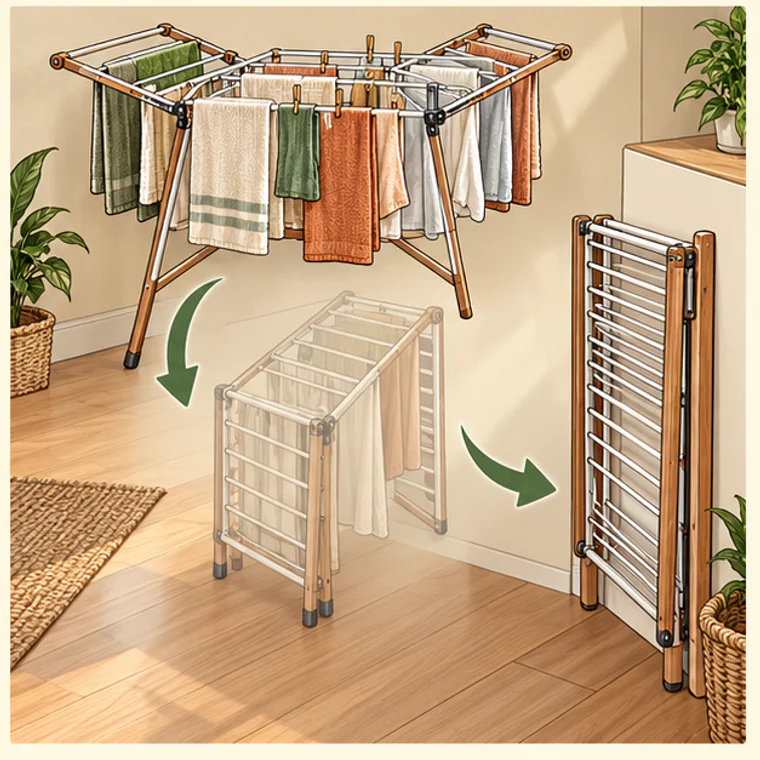
Open, loaded, and folded — three different space requirements
A rack can pass an empty-frame check and still fail in daily use. Wet sleeves hang beyond the rails, a long item may brush the floor, and a folded rack may not fit in the place you expected. Compare all three states before treating a compact description as proof of suitability.
Read the scene: The different rack positions are a prompt to compare working space and storage space separately.
- Keep a candidate when
- You can load the rails, move through the room, and return the folded rack to a reachable place.
- Discard it when
- Its only workable position depends on blocking access or leaving it unfolded permanently.
Give the folded rack a home before buying
Measure folded thickness as well as height and width, including parts that project. A reachable vertical slot can be practical, but it must not trap a connection or obstruct a door. Loading limits and fabric care instructions remain separate checks; this layout comparison does not predict drying time.
Rehearse the whole cycle
- Try this
- Plan where you will set it up, hang a representative long item, walk past, and put it away.
- What the result reveals
- If the last step has no workable location, the room will keep the rack even when it is not drying.
- What to change or look for
- Prioritize a simpler folding mechanism or a different storage position instead of additional rails.
Questions before your next step
Does more drying length mean faster drying?
Not by itself. Total rail length does not describe spacing, garment overlap, room conditions, or your fabric care requirements. Use it to compare hanging space, not to promise a drying time.
When is a vertical tower worth comparing?
When you mainly dry shorter items and cannot reserve a wide footprint. Check access to each level, the drop beneath the rails, and the manufacturer's loading and stability instructions.
Can a wall-mounted rack go above any washer?
No. The mounting surface, rack instructions, appliance opening, and your reach all matter. A photograph of a front-loading machine does not establish suitability above a top-loading one.
References and the next decision
The Brabantia drying-rack guide provides manufacturer examples of floor, tower, wall, and hanging designs. We use it to distinguish layouts, not to recommend a tested model or repeat capacity and drying-time claims. For a shortlisted rack, check that exact model's open and folded dimensions, loading limits, and mounting instructions.
Choose the drying position and garment type first. Then compare the rack's open, loaded, and folded states, together with its loading and mounting instructions. A design that adds rails but blocks the room is not an improvement; a simpler rack with a usable return position may be the more practical choice.