Closet drawers vs. shelves: which uses your space better?
Choose shelves for visibility, adjustability, and low operating clearance. Choose drawers for contained small items and visual calm—only when the drawer can open fully through the closet doorway.
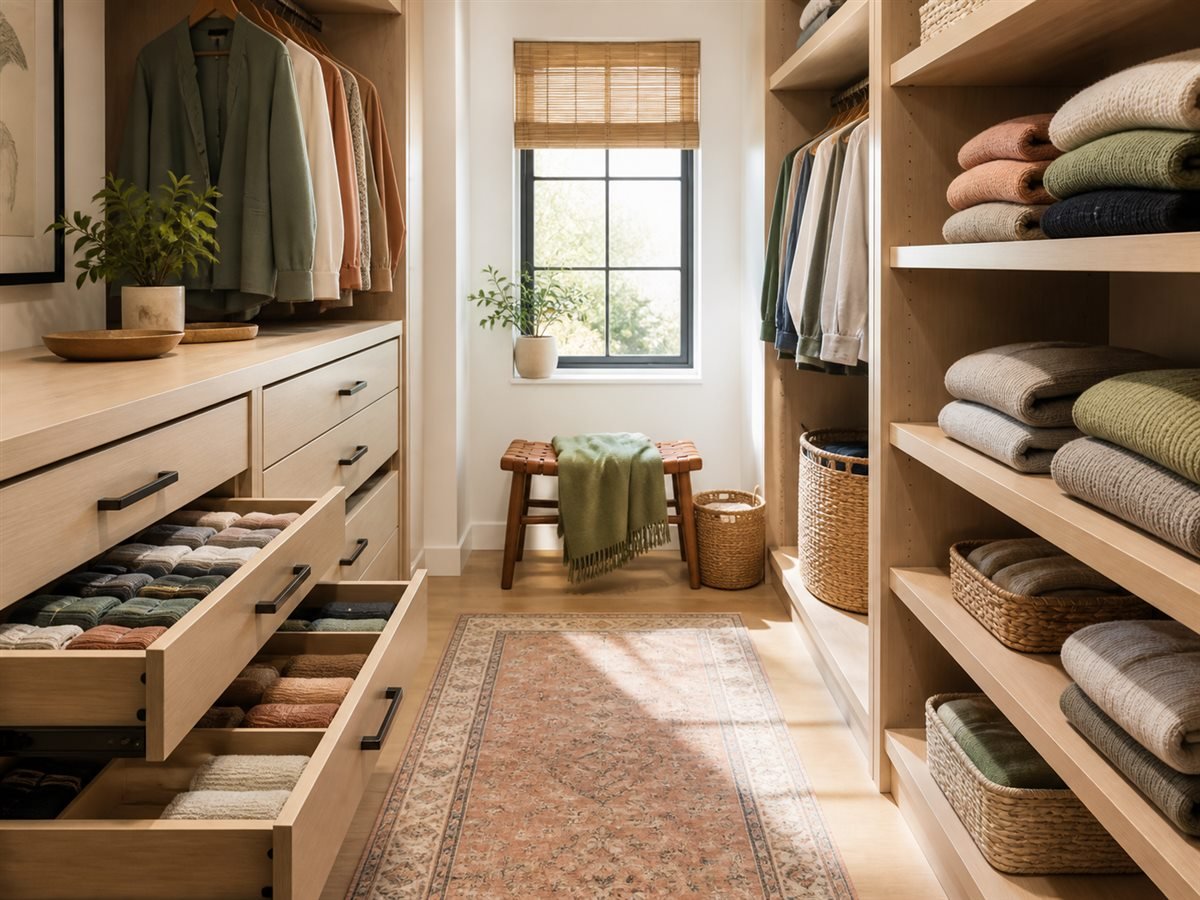
Editorial illustration of the operating-clearance trade-off; it is not a tested installation.
Quick verdict
Shelves: better for flexible folded storage and awkward openings. Drawers: better for small items and concealed storage when frontal clearance is generous. A mixed layout is usually more resilient than choosing one exclusively.
Direct comparison
| Criterion | Shelves | Drawers |
|---|---|---|
| See contents at a glance | Strong, unless stacks or bins are too deep | Requires opening each drawer |
| Contain small items | Needs bins or dividers | Built-in containment |
| Frontal clearance | Low | Body depth + pull-out space + access |
| Adjustability | Often easier with track systems | Usually a fixed module |
| Dust and visual calm | Open unless contained | More concealed |
| Cost and complexity | Usually fewer moving parts | Slides, box construction, and installation add complexity |
When shelves are the safer choice
Use shelves when a sliding door, narrow opening, or deep return prevents a drawer from operating. Adjustable shelves also adapt when folded categories change. The trade-off is stack control: shallow stacks and contained bins keep items from disappearing at the back.
When drawers earn their footprint
Drawers work well for underwear, socks, accessories, workout clothes, and other small categories that spread across open shelves. They also reduce visible clutter. But measure the cabinet body, handle projection, and the full extension needed to see the back. A drawer that opens only halfway wastes usable volume.
Calculate operating depth
For planning, treat the required depth as the cabinet depth plus the manufacturer’s documented open projection, then add the space a person needs to stand and use it. Do not guess the projection from a closed product photo. If the manufacturer does not document it, measure an assembled display or choose a more transparent option.
Three mixed layouts
- Daily basics: two or three drawers at waist height, adjustable shelves above, shoes below.
- Mostly folded clothing: shallow shelves with one narrow drawer module for small items.
- Narrow reach-in: shelves or pull-out bins centered in the clear opening; avoid drawers behind side returns.
Decision checklist
- Measure the clear opening and returns.
- Trace the full drawer pull-out area with painter’s tape.
- List which categories truly need concealment.
- Check whether adjustable shelves can solve the same problem with bins.
- Verify the exact module’s assembled dimensions and anchoring instructions.
Still planning the overall system? Start with the measurement guide and then choose the structural type. For a non-structural reset, see small closet organization ideas.
Frequently asked questions
These answers apply our fit-first review method to the operating-clearance trade-off.
Which option needs more clearance in front of the closet?
Drawers need enough unobstructed space to extend and allow the user to stand in front of them. Shelves do not project while opening, although deep shelves can make items at the back harder to reach.
Are drawers or shelves better for folded clothes?
Drawers contain small stacks and reduce visual clutter. Shelves make categories visible and can adjust more easily. The better choice depends on stack depth, reach height, drawer projection, and whether the closet opening blocks access.