Best can organizers and shelf risers for visible pantry rows
A riser is useful when it makes the back row both identifiable and removable. Steps lift labels above one another; a flat insert creates another level inside a tall gap. Those are different solutions, and both consume headroom. Compare the documented layouts here, then test the tallest rear item and the hand movement needed to remove it. A visible can that cannot be lifted out is still difficult to use. Choose one shelf and one real category first, and check the exact surface restrictions before extending the same organizer throughout the pantry.
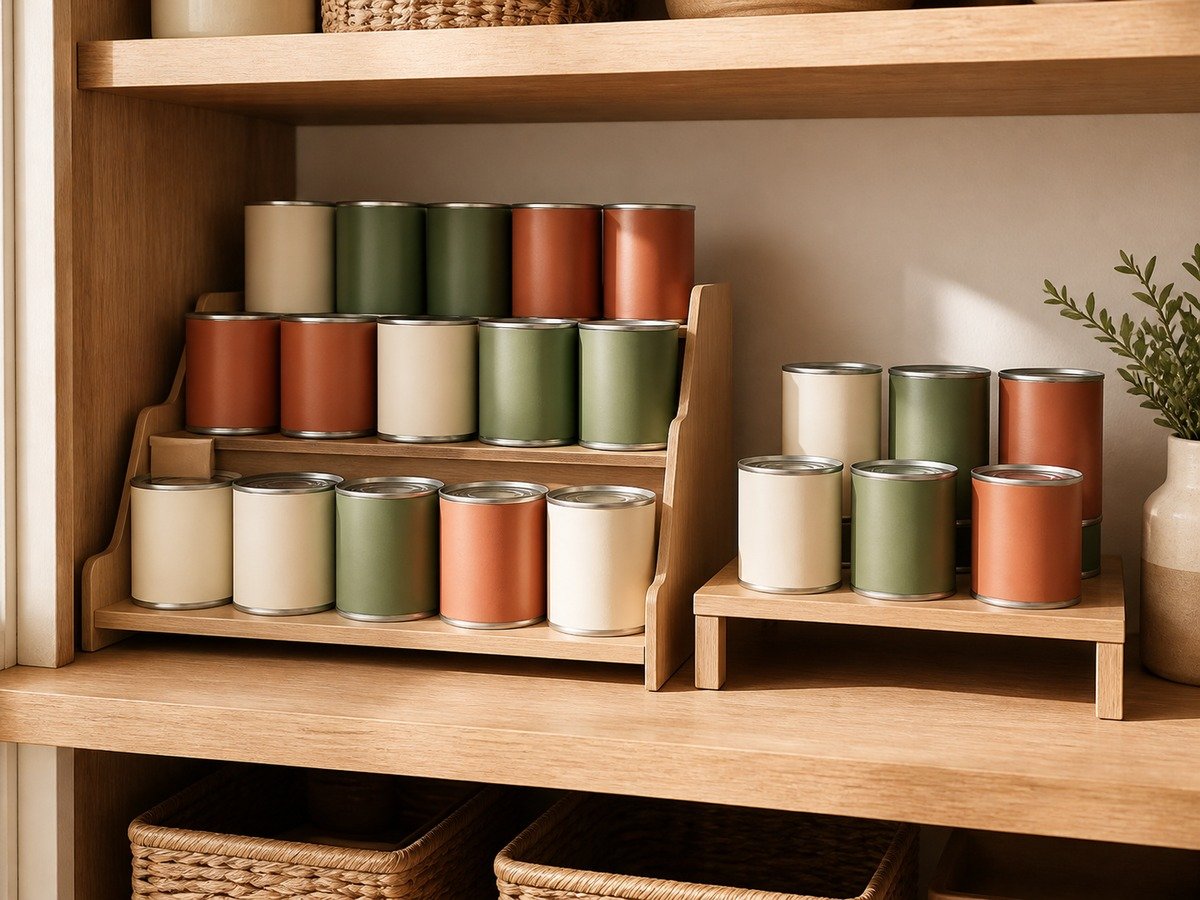
Compare the useful layouts
Start with the case that matches your routine. The checks explain what changes the choice; they are not installation approvals or a reason to buy every option.
These recommendations combine documented specifications with practical planning inferences. Casa Ordenada has not physically tested these organizers. Named models are documentary examples, not a market-wide ranking; decisive dimensions and instructions must be rechecked for the exact current variant. There are no active affiliate links, copied star ratings or static prices.
The illustrations explain typical layouts and movements. They are not exact product renderings, scaled installation drawings or proof of tested performance. Use the current appliance, fixture and organizer instructions for your own space.
Visibility is useful only when the rear item can be removed
Steps raise labels; shelf inserts divide vertical space. Both consume clearance. Measure organizer height plus the tallest rear item, then add the hand path needed to lift it over the row in front.
Steps solve label occlusion
YouCopia ShelfSteps expands from 4.8 to 12.6 inches deep and reaches 6.5 inches high. The manufacturer also says the compared model is not intended for wire shelves. That surface exclusion is a purchase blocker even if the dimensions fit.
Adjustable and fixed inserts solve vertical gaps
UpSpace uses adjustable shelf heights inside a 16-by-9-inch footprint. IKEA VARIERA creates one extra level in roughly a 12⅝-by-11-inch body. Neither creates stepped label visibility; they are best when the failure is empty height above short packages.
| Option | Documented dimensions | Access change | Best category | Purchase blocker |
|---|---|---|---|---|
| YouCopia ShelfSteps | 13.4 W × 4.8–12.6 D × 6.5 H in | Three visible rows | Cans and short jars | Wire shelf or low rear headroom |
| YouCopia UpSpace | 16 W × 9 D × 7.7 H in | Adjustable added levels | Mixed packages | Narrow opening or wasted width |
| IKEA VARIERA | 12⅝ W × 11 D × 6¼ H in | One additional level | Plates, jars, backstock | Lower level loses hand access |
Compare the layouts in use
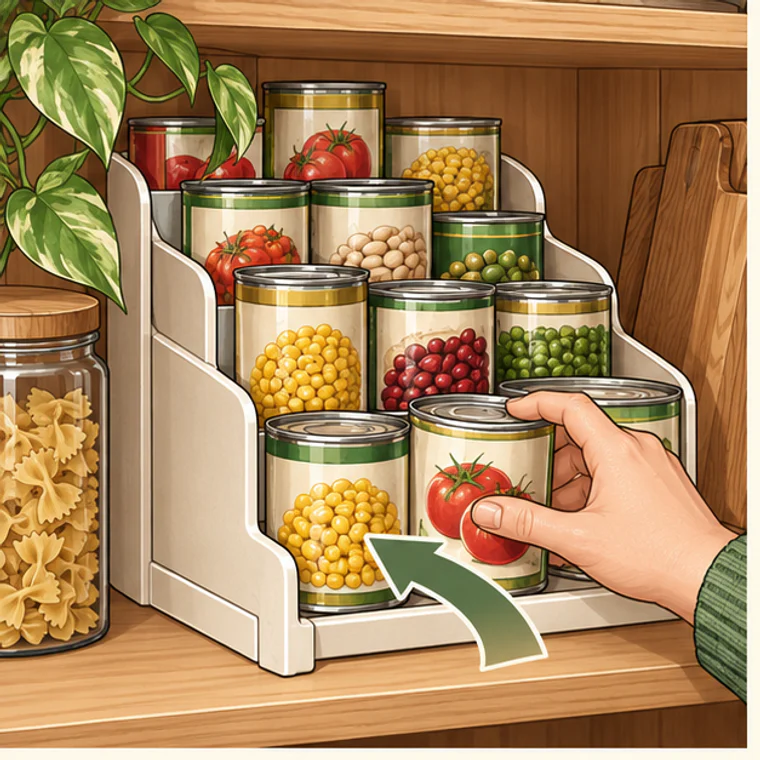
ShelfSteps — Reveal short labels
Three levels directly address the can-behind-can problem. The expandable depth helps adapt to shelf geometry, while the 6.5-inch organizer height must be added to the rear can and removal path.
The documented wire-shelf exclusion means surface compatibility outweighs the otherwise useful dimensions.
- Do not transfer the 30-pound claim to the pantry shelf itself.
Read the scene: The rising rows reveal labels, and the hand shows removal. A readable rear can still needs enough height to clear the row in front.
- Useful when
- Repeated short cans or jars form hidden rows.
- Reconsider when
- The surface is excluded or the rear row has too little removal height.
Check the working layout
- Try this
- Place the tallest can at the proposed rear level and rehearse lifting it over the front row.
- What it reveals
- Readable labels are not enough when the front row still has to be unloaded.
- What to change or look for
- Choose less rise, lower contents or another retrieval direction; the compared model excludes wire shelves.
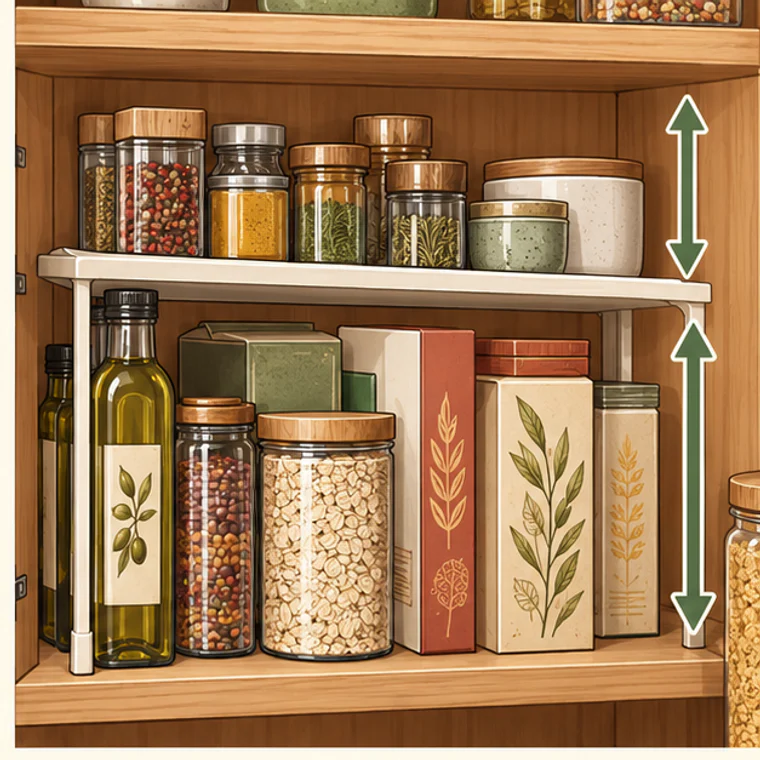
UpSpace — Match mixed package heights
Adjustable shelf heights make more sense than fixed steps when packets, jars, and short boxes share a zone. Its 16-inch width uses a broad opening efficiently but can waste space in a narrow cabinet.
Plan the package mix before choosing shelf positions.
- Measure the clear opening, not the inner wall.
- Leave hand access to both levels.
- Avoid unstable stacks on the upper platform.
Read the scene: The vertical arrows separate the clear openings above and below an added level. Set them for real packages and hand access, not equal-looking gaps.
- Useful when
- Different package heights need adjustable levels.
- Reconsider when
- The 16-inch width cannot pass the opening or creates unused narrow strips.
Check the working layout
- Try this
- Assign real packages to each proposed level and retrieve the rear one while the front stays in place.
- What it reveals
- Adjustment helps only when both levels retain usable openings and a hand path.
- What to change or look for
- Set levels for the actual categories, not equal-looking spacing, and verify the current shelf load instructions.
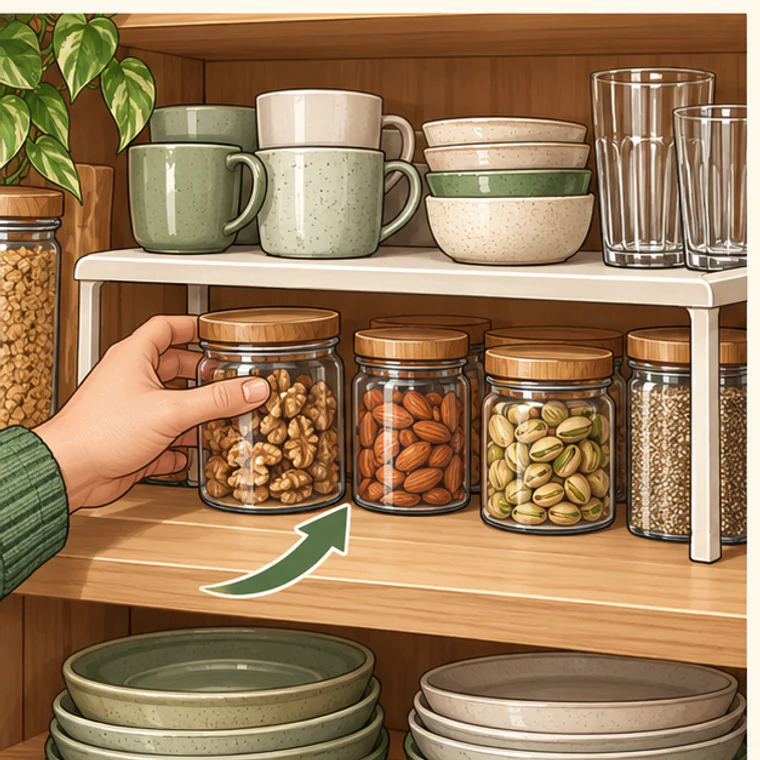
VARIERA — One stable second level
The steel insert divides one tall gap without forcing a stepped display. It works when upper and lower categories can remain independently reachable.
The lower level can become a dark hidden zone if labels face away or the front edge is crowded.
- Use for stable, similarly sized items.
- Preserve lower-level light and hand access.
- Check the exact shelf surface and care instructions.
Read the scene: The hand reaches into the lower level. A shelf insert helps only if that new zone remains visible and independently accessible.
- Useful when
- Short stable objects leave an otherwise unused vertical gap.
- Reconsider when
- The lower zone becomes too dark or tight to read and retrieve its contents.
Check the working layout
- Try this
- Put the least visible lower item behind the proposed front row and try taking it out normally.
- What it reveals
- A second level can create a hidden zone rather than improve the shelf.
- What to change or look for
- Use shallow rows and outward-facing labels; choose another layout if the lower hand path remains blocked.
Frequently asked questions
Do can organizers create more shelf volume?
No. They exchange vertical clearance for visibility and retrieval.
Can ShelfSteps sit on wire shelving?
The compared manufacturer documentation says it is not intended for wire shelves.
How do I compare a riser with stacking cans directly?
Compare label visibility, removal effort, stability, shelf load, and the time needed to restore the row after each use.
Should every can be visible?
Every active category should be identifiable. Backstock can sit elsewhere when its quantity remains easy to check.
Make the next decision
Plan the access and movement → Explore all pantry guides → How we review →