Best wall-mounted closet systems for
adjustable storage
A wall-mounted system is useful when it improves access and keeps the floor available, not merely because it has adjustable shelving. Reconfigurable rails, continuous hanging, and fixed direct-mount layouts solve different problems. Compare them before choosing a kit, then verify its components and mounting instructions. The fourth illustrated case explains an installation boundary, not another product to buy: uncertainty about the wall must be resolved before shortlisting the first three arrangements. Included hardware alone cannot establish suitability for your particular wall or loaded layout.
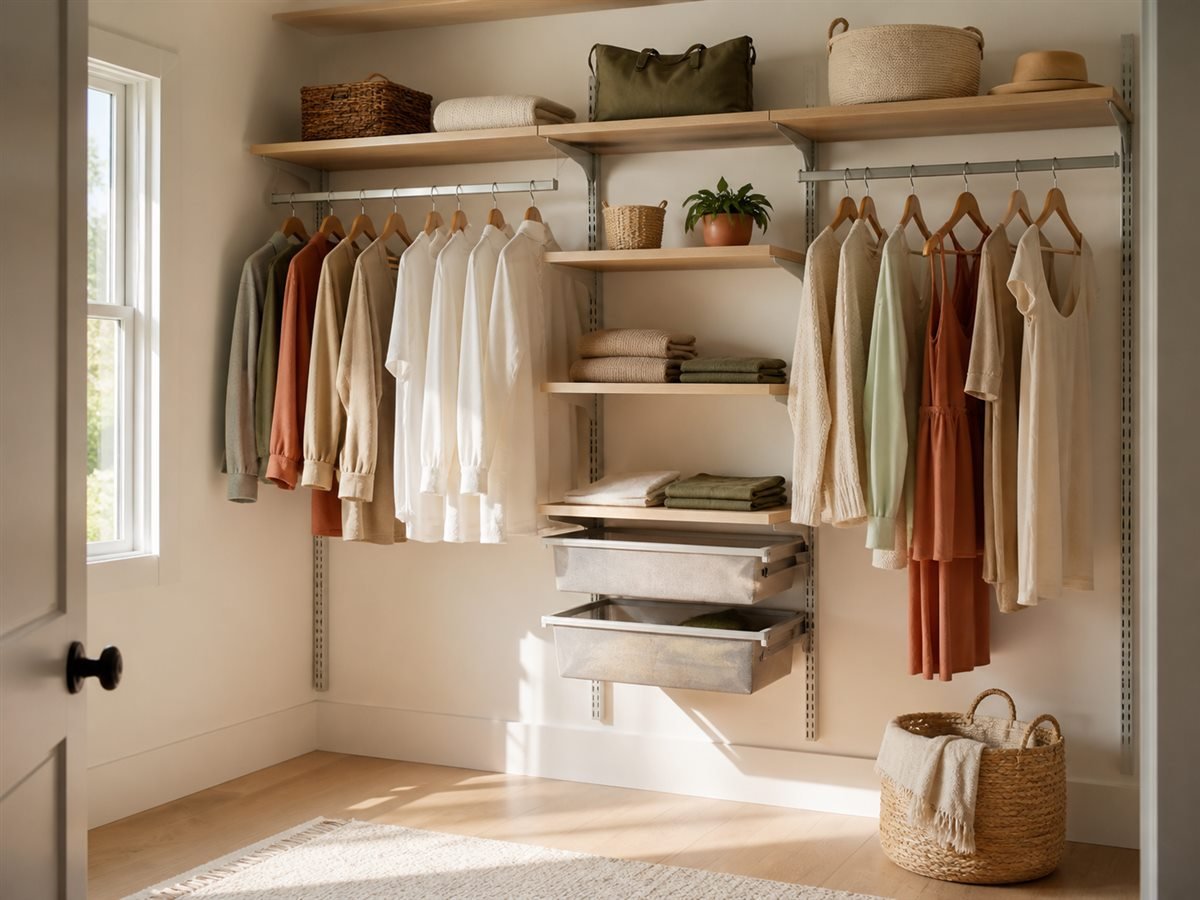
Find the layout that solves your problem
Use the examples to narrow a decision, not to buy every organizer shown. Each case explains its benefit, a reason to reconsider, and a practical way to test the idea with what you already own.
Quick comparison
| System | Fit / depth | Adjustability | Installation note | Best for |
|---|---|---|---|---|
| Rubbermaid Configurations | Multiple kit widths; 4–8 ft kit requires at least 14 in depth | Shelves and rods reconfigure | Top rails/uprights; hardware included | Flexible layouts |
| Rubbermaid FastTrack FreeSlide | 4–8 ft closet; 12-in-deep shelving | Adjustable kit | Hardware included; manual available | Continuous hanger movement |
| Rubbermaid Direct Mount | 6.5–8 ft model observed | Fixed after direct mounting | Supports attach at multiple points | Straightforward fixed storage |
We compare access, storage mix, and installation conditions. Named systems are documentary examples, not a universal ranking or a record of hands-on testing. Manufacturer-stated dimensions refer to the specified variant; load claims are not independent test results. There are no active affiliate links, copied star ratings, or static prices.
Illustrations explain typical situations, not the exact appearance, dimensions, hardware, or safe installation of the named products. Use the current instructions and labeled diagram for your selected variant.
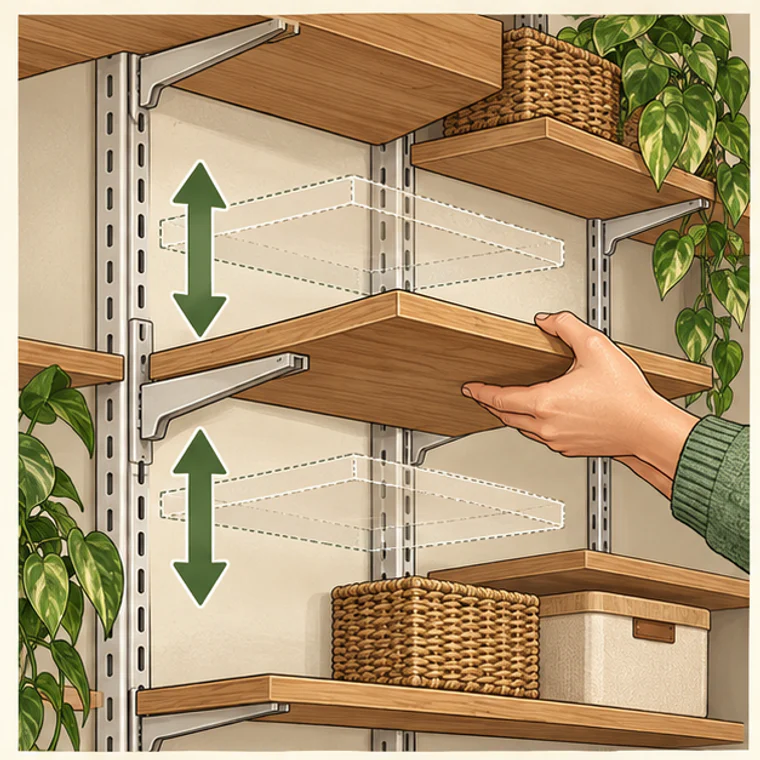
Reconfigurable rails — change the storage mix later
The uprights support different positions. The practical range depends on compatible parts, not simply the number of holes.
Documented example — Rubbermaid Configurations: Configurations uses overlapping rails, adjustable shelves, and telescoping rods. The official 4–8 ft kit says it fits walk-in or reach-in closets in that width range with at least 14 inches of depth and requires no cutting. After installation, shelves and rods can be repositioned without tools.
- Useful when
- Users or clothing lengths are likely to change.
- Reconsider when
- You assume accessories from unrelated series will fit.
Rubbermaid Configurations — best for reconfiguration
Trade-offs: “hardware included” does not remove the need to identify the wall and follow the manual. Wire shelves may need containers for small items.
Try it before choosing
- Try this
- Draw long-hang and double-hang arrangements with the actual parts list.
- What it reveals
- One version may require brackets or rods not supplied in the kit.
- What to change or look for
- Check compatible add-ons and whether repositioning involves unloading or disassembly.
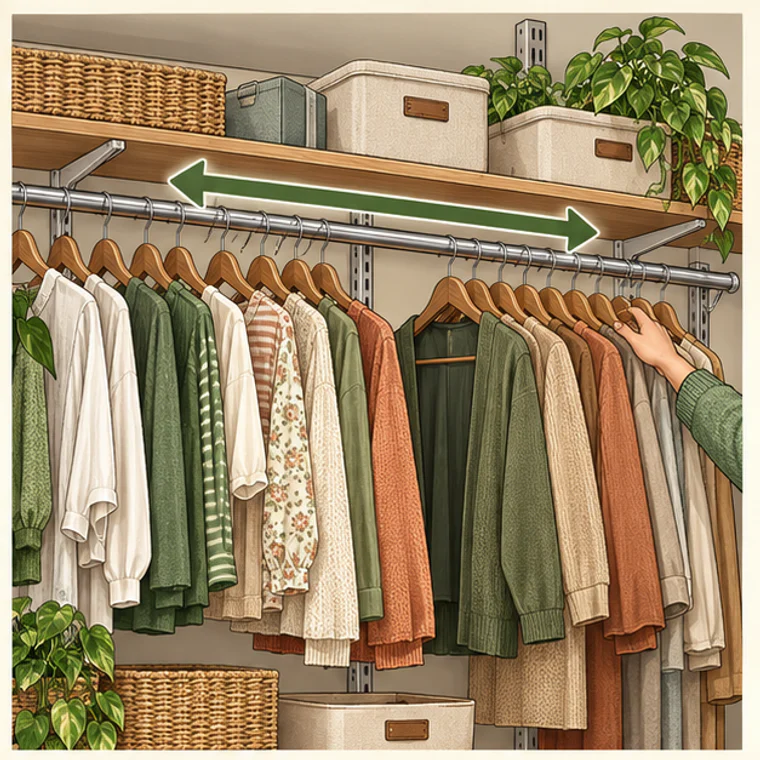
Continuous hanging — avoid interrupted hanger travel
The long rail explains end-to-end movement when sliding clothes to see a category. A door panel can still hide the useful area.
Documented example — Rubbermaid FastTrack FreeSlide: The manufacturer describes 12-inch-deep FreeSlide shelving with an integrated hanging function that lets hangers move end to end. The documented kit targets 4–8 ft closets and includes hardware.
- Useful when
- You mainly hang clothes and move groups along the rod.
- Reconsider when
- Folded categories need more separate bays.
Rubbermaid FastTrack FreeSlide — best for continuous hanging
Trade-offs: the published capacity and dimensions must be read for the exact package and configuration. It provides a more specific wire-shelf arrangement than a fully customized component system.
Try it before choosing
- Try this
- Slide a week's clothes along your existing rod with each door panel open.
- What it reveals
- The opening may hide the section a continuous rod would improve.
- What to change or look for
- Match the run to the accessible opening and leave separation between categories.
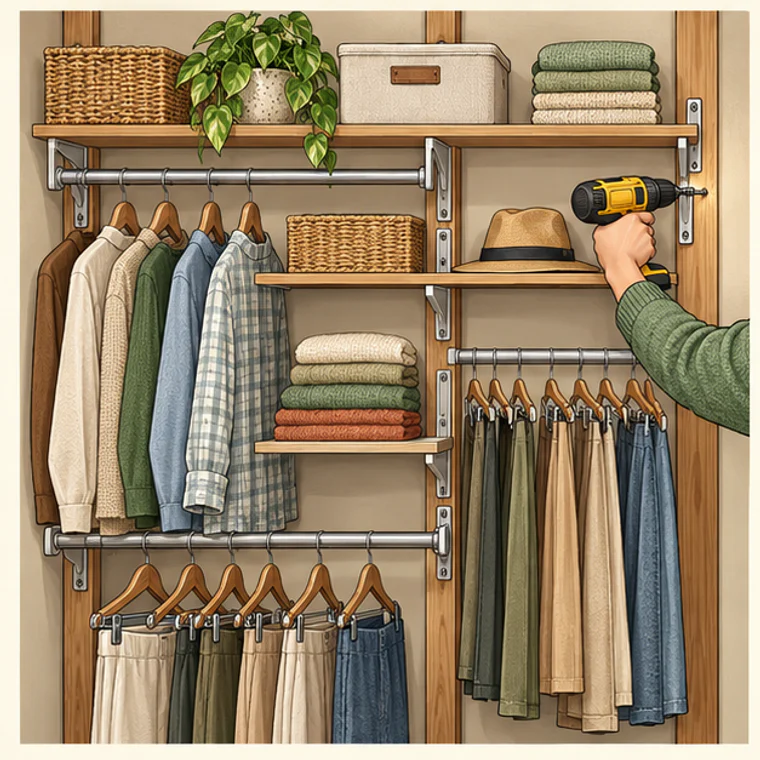
Direct mounting — settle the zones before installation
Fixed shelving can serve a stable wardrobe without adjustments you do not use. Future changes may require new mounting work.
Documented example — Rubbermaid Direct Mount: The direct-mount kit attaches shelving with supports rather than hanging adjustable uprights from a track. The observed 6.5–8 ft version includes shelves, rods, brackets, and hardware.
- Useful when
- Hanging lengths and shelf groups are settled.
- Reconsider when
- Users and rod heights will change frequently.
Rubbermaid Direct Mount — best when the layout can stay fixed
Trade-offs: future layout changes can require new mounting points or cutting. The lower initial complexity is only an advantage when the planned zones are already settled.
Try it before choosing
- Try this
- Sort current and seasonal clothes before finalizing the arrangement.
- What it reveals
- Returning long garments can invalidate a layout planned only for shirts.
- What to change or look for
- Verify the support and cutting requirements; use adjustable rails where change matters.
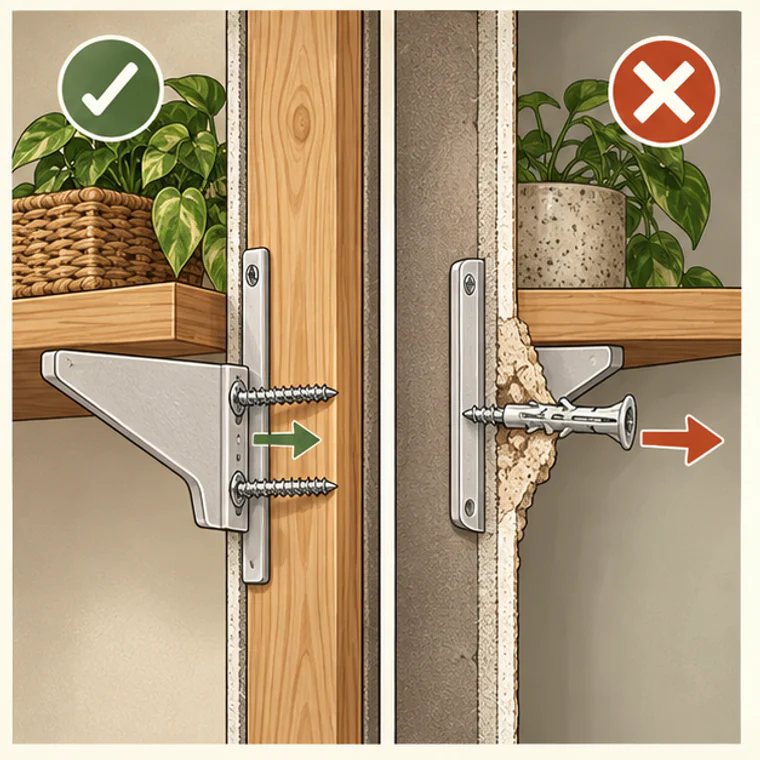
Wall compatibility — resolve installation before shortlisting
The support details explain a condition shared by all three designs. This is a mounting question, not another organizer recommendation.
- Useful when
- The exact manual and wall conditions establish a suitable installation.
- Reconsider when
- Substrate, fastening positions, or permission remain uncertain.
Before choosing any wall-mounted system
- Finish the measurement guide.
- Identify wall material and stud locations without guessing around wiring or plumbing.
- Download the current manual for the exact model and width.
- Confirm the hardware list and what, if anything, is not included.
- Plan rods and shelves around garment length and the door opening.
- Confirm permission if the home is rented.
If these conditions are not a good fit, compare freestanding systems instead.
Try it before choosing
- Try this
- Compare the manual's required mounting positions with your wall plan without drilling.
- What it reveals
- An obstruction or unknown substrate remains unresolved even if the kit width fits.
- What to change or look for
- Ask the manufacturer or a qualified installer about the exact condition; do not substitute universal anchors.
Frequently asked questions
These answers use our documented review method; the wall and current installation manual always control.
Can a wall-mounted closet system be installed on drywall?
That depends on the system, wall construction, stud locations, supplied or required hardware, and declared loads. Do not substitute a universal anchor recommendation for the fastening instructions provided for the exact kit.
Are track-based systems easier to reconfigure?
They are often designed to reposition compatible shelves, rods, or brackets along installed standards. Reconfiguration is still limited by the product family, component compatibility, wall layout, and the original installation.
Does included hardware guarantee wall compatibility?
No. The parts list does not establish compatibility with every wall or loaded layout. Use the exact installation instructions and obtain qualified help if substrate, concealed services, or fastening positions are uncertain.