Best freestanding closet systems for renters and flexible rooms
Freestanding systems can organize an open wall without turning it into a built-in closet, but still need a sensible footprint and a layout matching your clothes. Expandable frames, divided wardrobes, shoe bays, and corner arrangements solve different problems. Use these illustrated cases to identify the configuration worth investigating, then check the documented size and current assembly instructions for the exact variant. Freestanding describes how the structure is supported; it does not mean restraint requirements can be ignored or that a loaded frame is designed to move.
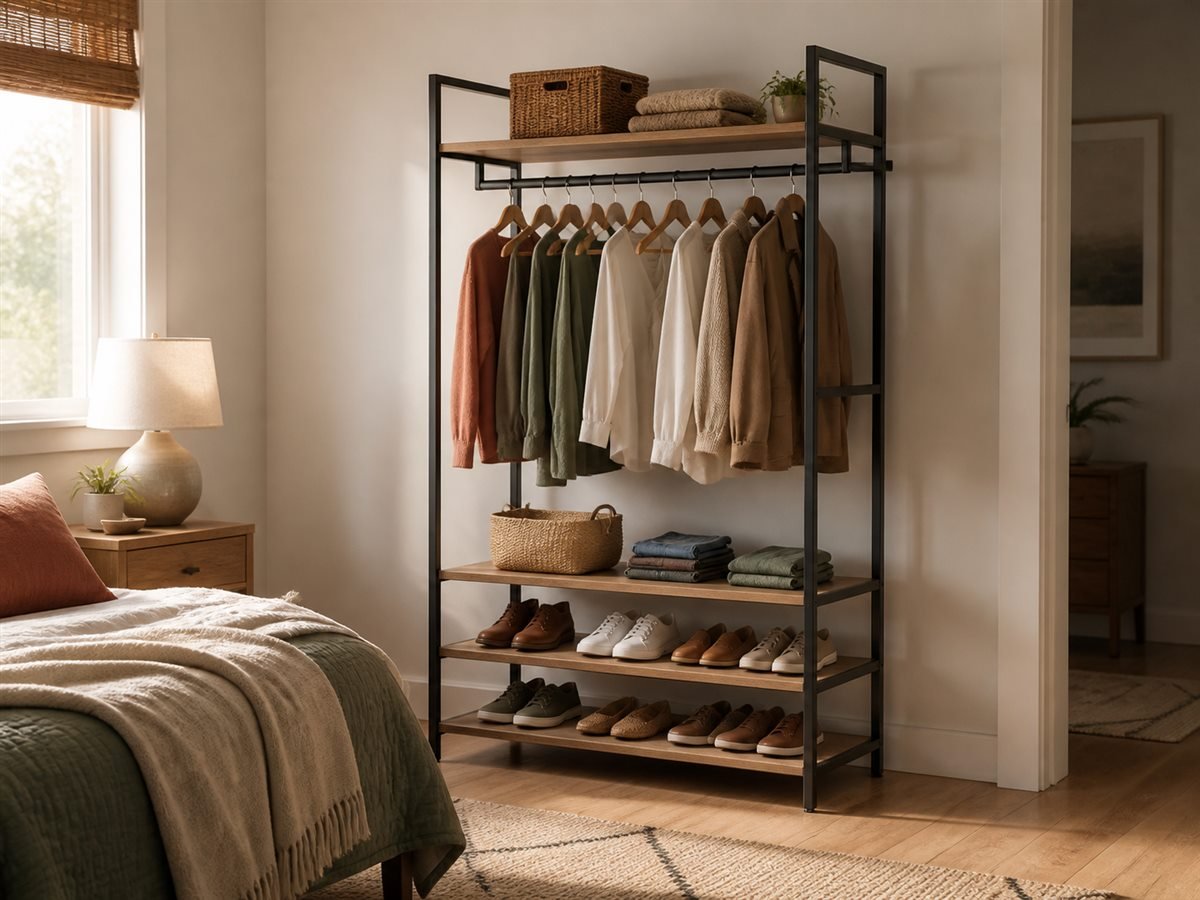
Find the layout that solves your problem
Use the examples to narrow a decision, not to buy every organizer shown. Each case explains its benefit, a reason to reconsider, and a practical way to test the idea with what you already own.
Quick comparison
| Model | Assembled size | Layout | Manufacturer-stated total load | Best for |
|---|---|---|---|---|
| VIPEK X20 | 39–56 W × 15.7 D × 76.4 H in | 2 rods, 2 shelves | 760 lb | Narrow/adaptable width |
| VIPEK V5 | 68.9 W × 15.7 D × 76.4 H in | 4 rods, 8 shelves | 890 lb | Balanced open wardrobe |
| VIPEK S3 | 68.9 W × 15.7 D × 76.4 H in | 3 rods, 6 wire + 6 shoe shelves | 1,060 lb | Shoe-heavy wardrobe |
| VIPEK V40 | 76 W × 15.7 D × 76.4 H in | 4 rods, 6 shelves | 1,110 lb | Large straight or corner layout |
We compare access, storage mix, and installation conditions. Named systems are documentary examples, not a universal ranking or a record of hands-on testing. Manufacturer-stated dimensions refer to the specified variant; load claims are not independent test results. There are no active affiliate links, copied star ratings, or static prices.
Illustrations explain typical situations, not the exact appearance, dimensions, hardware, or safe installation of the named products. Use the current instructions and labeled diagram for your selected variant.
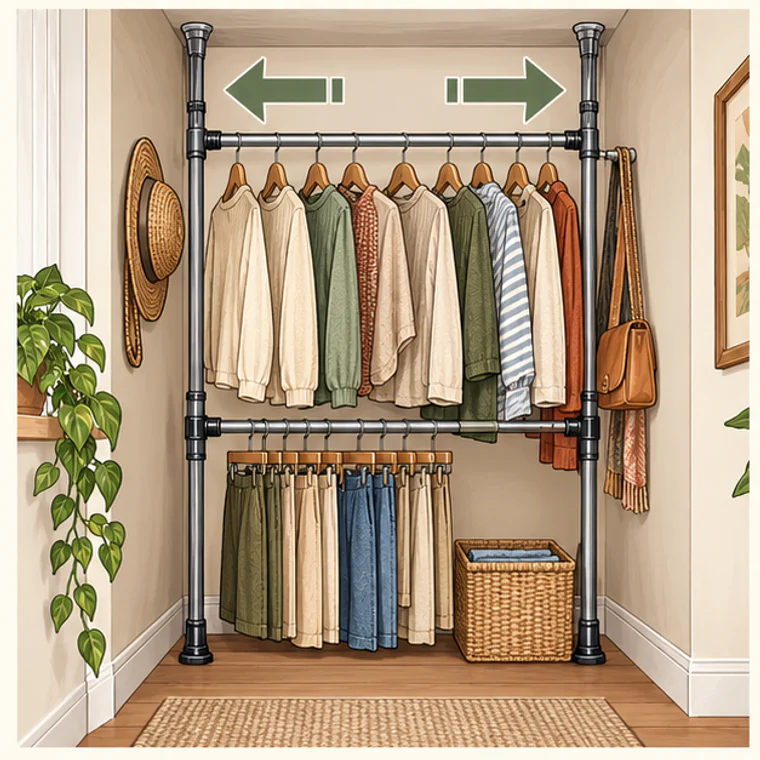
Adjustable width — reuse the frame without overfilling it
The faded outlines show changing span. This flexibility does not automatically add shelf zones or depth for bulky clothes.
Documented example — VIPEK X20: The X20 is the only finalist here with a manufacturer-documented 39–56-inch width range. That makes it easier to reuse across rooms or center within a narrow wall. Its two rods and two shelves are simpler than the larger frames, which can be an advantage when the goal is hanging rather than many small zones.
- Useful when
- The room width may change and a simple storage mix is enough.
- Reconsider when
- You need separate long-hang, short-hang, and folded bays.
VIPEK X20 — best for adjustable width
Trade-offs: less subdivision; the expanding members must be locked as instructed. VIPEK says the system can be assembled without wall anchoring and includes anti-tip devices. Follow the current manual for the exact variant.
Try it before choosing
- Try this
- Tape both intended widths and walk past with a loaded laundry basket.
- What it reveals
- The wider setting can fit the wall but narrow the daily route.
- What to change or look for
- Choose a locked span protecting both storage and passage; verify the extension mechanism.
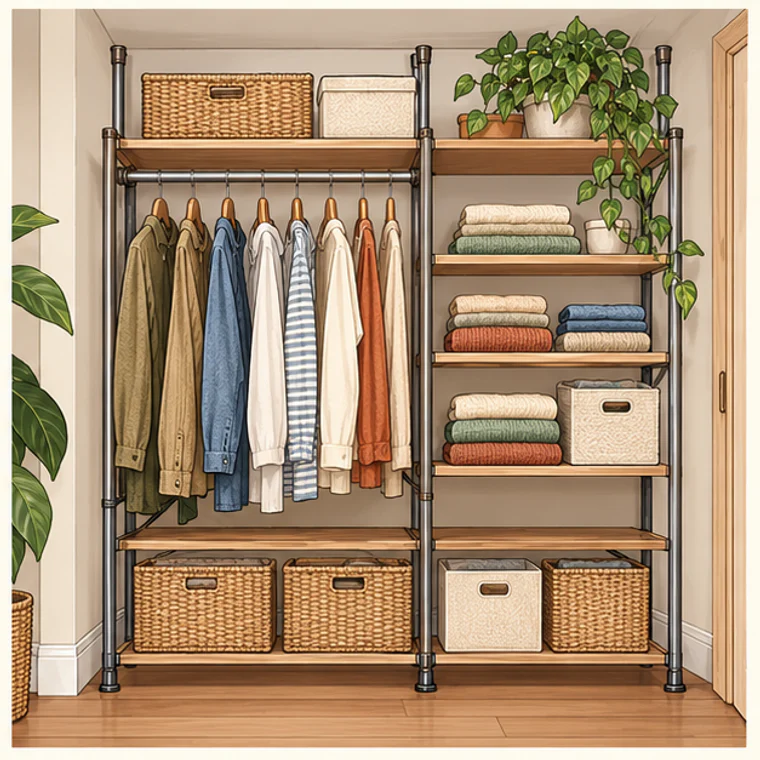
Balanced layout — separate long and short hanging
Different bays suit different garment lengths. Loaded clothes can project farther forward than the frame itself.
Documented example — VIPEK V5: At 68.9 inches wide, V5 is not compact, but its four rods and eight adjustable shelves distribute hanging and folded storage across a shallow 15.7-inch frame. It suits an open wall more naturally than a narrow reach-in opening.
- Useful when
- You need hanging and folded zones along a wide wall.
- Reconsider when
- A door or return blocks the outer bays.
VIPEK V5 — best balanced fixed layout
Trade-offs: wide fixed footprint and many components to assemble. The published 890-pound total is a manufacturer claim; use component limits and distribution instructions rather than treating it as a target.
Try it before choosing
- Try this
- Hang a bulky coat normally and place a basket at the planned lower shelf position.
- What it reveals
- A shallow bare-frame specification may still create a bulky loaded envelope.
- What to change or look for
- Compare garment projection and rod positions, not just frame depth.
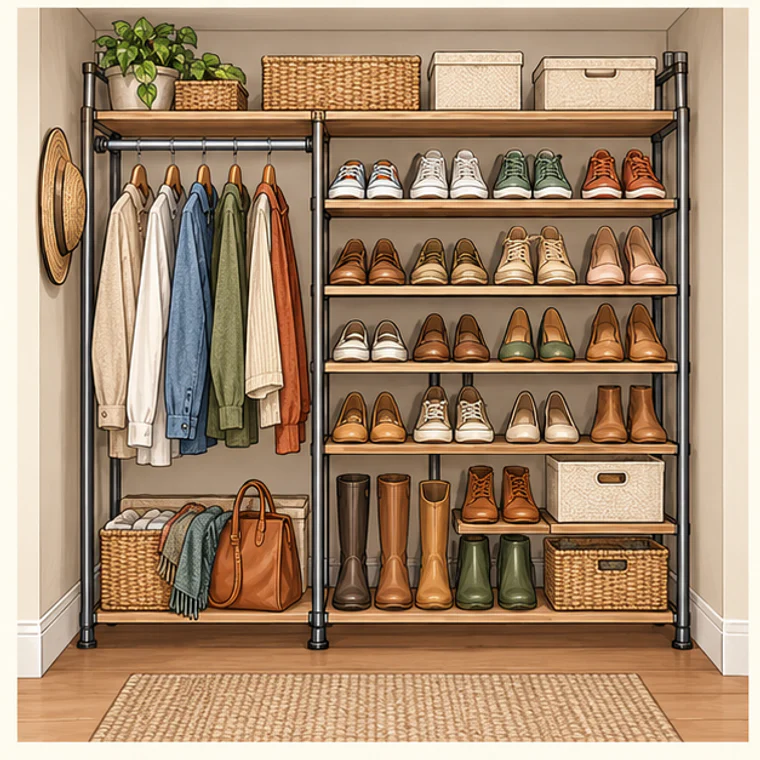
Shoe-focused layout — make pairs removable
A shoe bay recovers floor space, but tall boots can consume the height of several illustrated levels.
Documented example — VIPEK S3: S3 uses the same stated width and depth as V5, but changes the interior mix: three rods, six general wire shelves, and six shoe shelves. The manufacturer says a shoe section can be removed for boots.
- Useful when
- Footwear needs low-level storage alongside hanging clothes.
- Reconsider when
- Large or tall pairs need a different arrangement.
VIPEK S3 — best for shoes
Trade-offs: a specialized layout can become inefficient if shoe volume drops. Measure the largest footwear and do not convert “shelf count” into pairs without checking actual fit.
Try it before choosing
- Try this
- Try your largest shoes and boots at the proposed level spacing.
- What it reveals
- Removing levels for boots changes the display's apparent capacity.
- What to change or look for
- Look for adjustable levels and room to lift a pair without moving its neighbors.
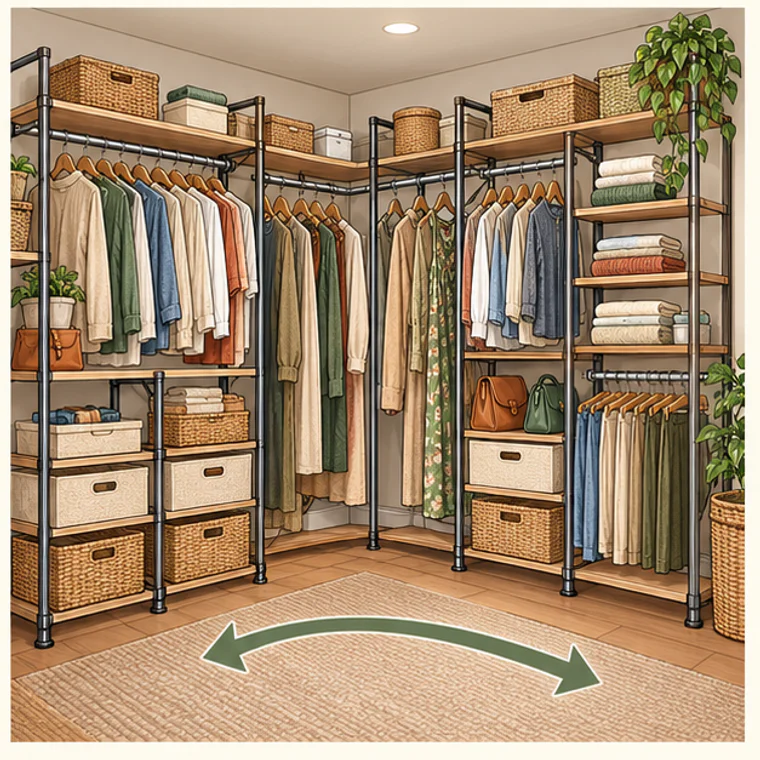
Multi-zone frame — plan the corner as well as the wall
More bays divide categories, but the corner is not free storage. The two legs can overlap in use.
Documented example — VIPEK V40: V40 spans 76 inches and can be assembled in straight or L-shaped configurations according to VIPEK. Four rods and six shelves favor a larger, multi-zone wardrobe.
- Useful when
- A generous wall or corner provides reachable bays.
- Reconsider when
- The inner corner hides daily contents or the frame blocks entry.
VIPEK V40 — best for a large wall or corner
Trade-offs: it requires the most uninterrupted footprint in this shortlist. An L layout changes the space calculation, so use the exact assembly diagram rather than the straight-line width alone.
Try it before choosing
- Try this
- Tape both legs of the layout and stand where you would reach the innermost item.
- What it reveals
- Moving another category first turns extra capacity into a bottleneck.
- What to change or look for
- Use the exact L-shaped assembly plan and assign the corner one reachable purpose.
Freestanding does not mean consequence-free
Check ceiling clearance, floor level, baseboards, door movement, and how loads will be distributed. The CPSC recommends securing furniture to address tip-over risks. The manufacturer’s restraint and assembly instructions determine what your exact unit requires.
If your wall and lease allow mounting, compare wall-mounted closet systems. If you have not mapped the space, start with measurement guide.
Frequently asked questions
These answers follow our documented comparison method and do not replace the current manual.
Does freestanding mean that the closet never needs anchoring?
No. Freestanding describes how the frame bears its load, not whether restraint is unnecessary. Follow the manufacturer instructions, especially for tall, narrow, heavily loaded, or child-accessible furniture.
Will an adjustable-width rack fit any opening inside its stated range?
Not automatically. The smallest usable width must account for baseboards, trim, returns, outlets, door hardware, and the space needed to assemble or expand the frame. Compare those constraints with the exact assembled dimensions.
Can I move the frame while it is loaded?
Do not assume so. Check the exact model's casters and movement procedure. Follow the manufacturer instructions when relocating it; portable does not necessarily mean a rolling wardrobe.