Best pantry turntables for deep shelves and corners
A turntable changes the direction you retrieve from: a bottle at the back can come forward without unloading a row. Its usefulness depends on the loaded sweep, visible labels, and enough room to remove each item. Here we separate four fit checks from four documented layouts, so bins, dividers, and a second level answer an actual need rather than just adding features. Start with the shelf and the widest intended bottle. Then compare the configuration that keeps your real categories stable and accessible, including the hand space needed to start and stop rotation.
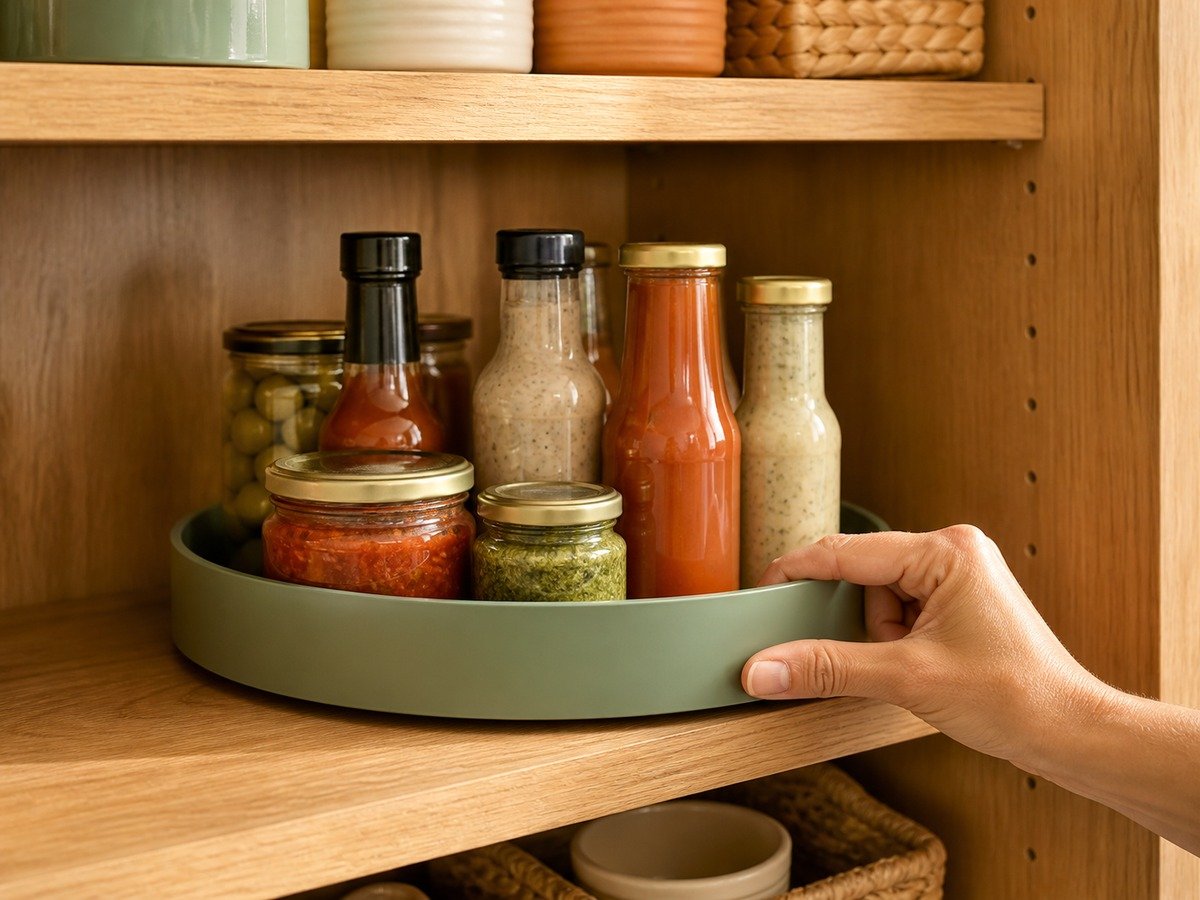
Compare the useful layouts
Start with the case that matches your routine. The checks explain what changes the choice; they are not installation approvals or a reason to buy every option.
These recommendations combine documented specifications with practical planning inferences. Casa Ordenada has not physically tested these organizers. Named models are documentary examples, not a market-wide ranking; decisive dimensions and instructions must be rechecked for the exact current variant. There are no active affiliate links, copied star ratings or static prices.
The illustrations explain typical layouts and movements. They are not exact product renderings, scaled installation drawings or proof of tested performance. Use the current appliance, fixture and organizer instructions for your own space.
Compare retrieval geometry before bins and dividers
A turntable is a circular retrieval tool inside a usually rectangular shelf. A 10-inch platform covers about 78.5 square inches, while a 10-by-10-inch square covers 100. The missing 21.5% is not automatically wasted: it buys the ability to rotate the back forward.
| Documented option | Dimensions | Configuration | Best category | Do not buy when |
|---|---|---|---|---|
| YouCopia MagicTrack | 12.6 W × 10.3 D × 3.9 H in | Rectangular turntable, four bins | Packets and grouped small items | The larger rectangle blocks adjacent storage |
| YouCopia Crazy Susan | 10.4 × 10.4 × 4.1 H in | Six removable bins | Small categories kept separate | Dividers consume needed open area |
| madesmart Basic 10 | 10 × 10 × 1.13 H in | Open round platform | Mixed bottles and jars | Items cannot stand stably |
| madesmart Twin 10 | 10 × 10 × 6 H in | Two levels | Short items in a tall gap | Tall bottles need the full height |
Fit checks and organizer layouts
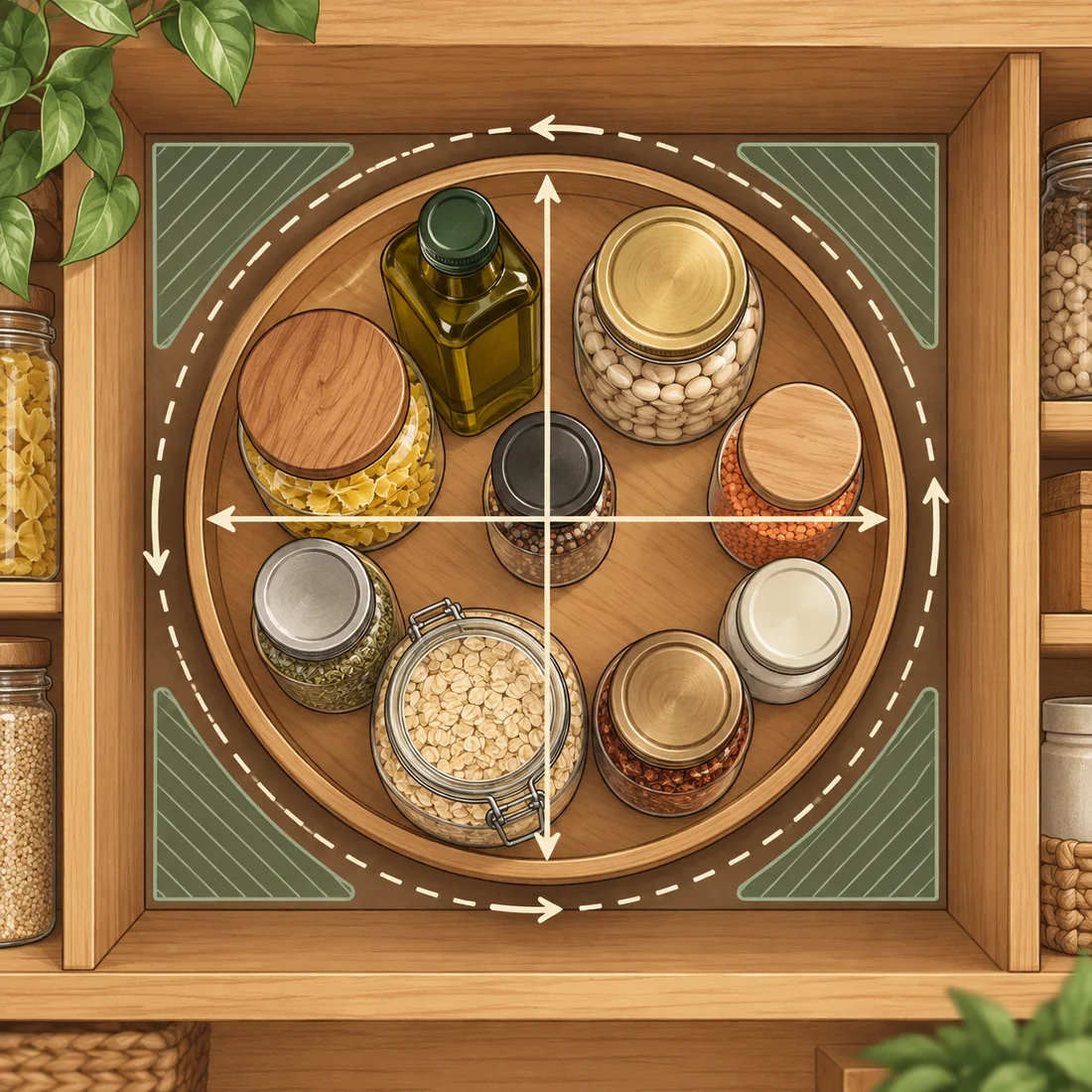
Diameter — Protect the full circle
A 10-inch round platform covers about 78.5 square inches inside a 100-square-inch 10-by-10 square. The corner area is exchanged for the ability to bring the back forward.
Read the scene: The shaded corners show the area exchanged for circular retrieval. That trade-off is worthwhile only if rotation improves access to the real category.
- Useful when
- Rotation replaces repeated reaching into a deep corner.
- Reconsider when
- A circle consumes an adjacent category's usable area.
Check the working layout
- Try this
- Place the documented outer shape on the shelf and mark where your fingers will turn it.
- What it reveals
- The geometric area exchanged for rotation may be worthwhile, but adjacent retrieval can still suffer.
- What to change or look for
- Choose by access gained rather than the largest possible diameter.
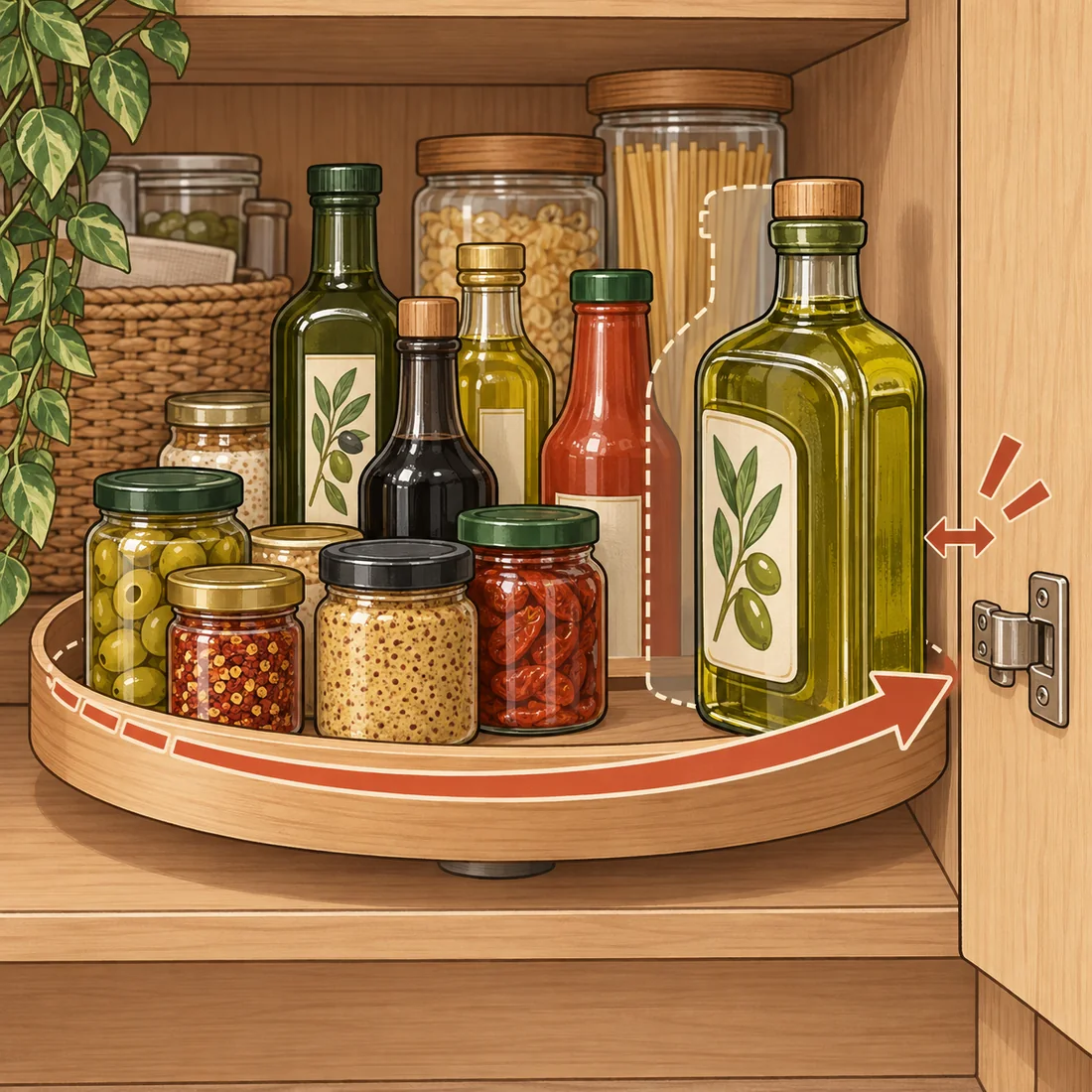
Edge items — Trace the actual moving outline
A wide bottle, pump or leaning packet can project beyond the platform and create a larger moving circle than the published diameter.
Read the scene: The edge bottle approaches the cabinet wall. Its projection can make the moving outline larger than the tray's stated diameter.
- Useful when
- Wide containers stay stable and clear obstacles while loaded.
- Reconsider when
- A pump or packet extends beyond the base into the wall or hinge.
Check the working layout
- Try this
- Trace a complete revolution with the widest item at the edge of a template.
- What it reveals
- The tray diameter is only the minimum sweep; the contents may define a larger one.
- What to change or look for
- Move wide items inward or compare a smaller platform with usable retained space.
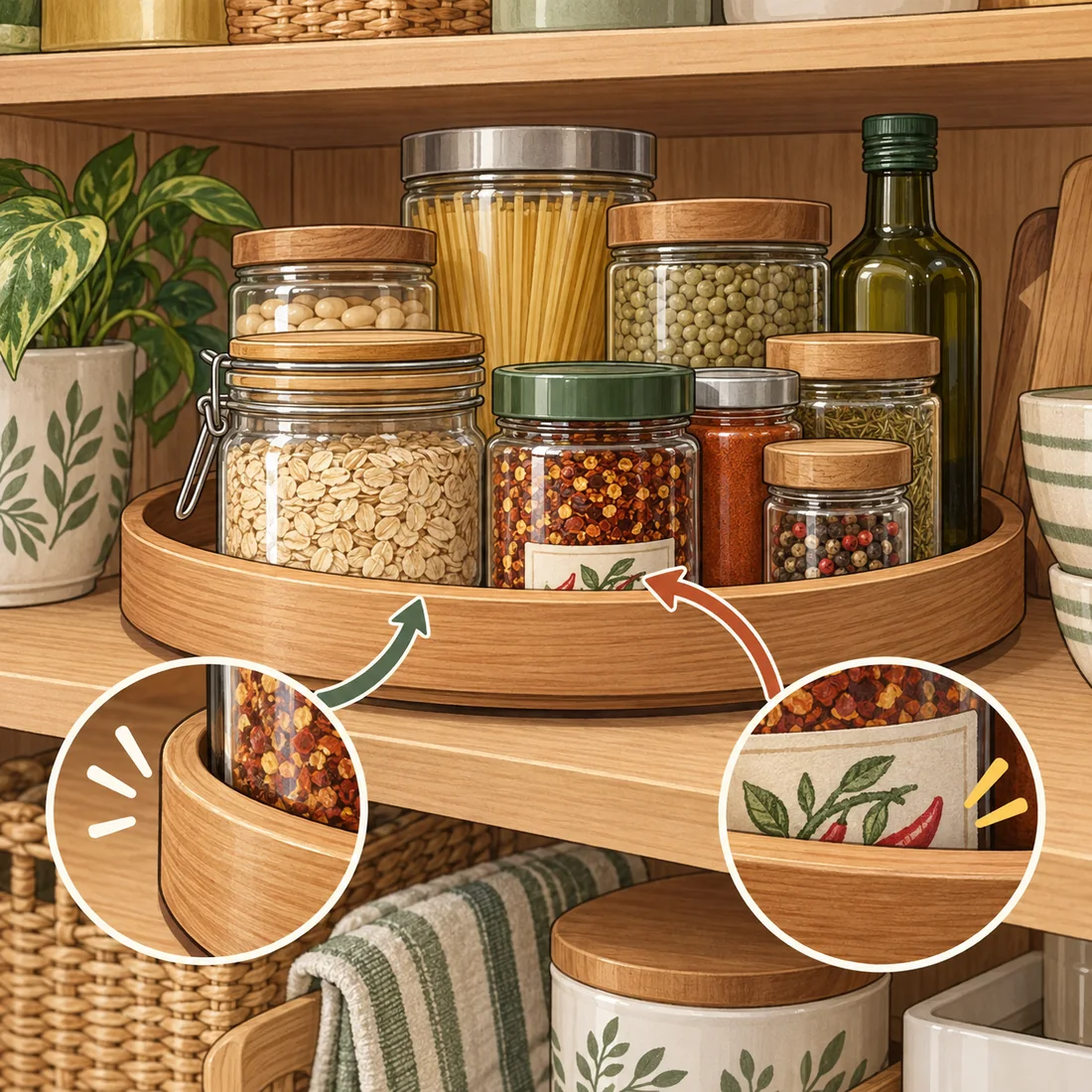
Rim — Balance retention and label visibility
A raised rim can keep jars from sliding outward, but a tall rim may hide labels on short containers and make small packets harder to identify.
Read the scene: The close-ups compare a retaining edge with a partly hidden label. More retention is not automatically better identification.
- Useful when
- A lip retains stable jars without hiding identification.
- Reconsider when
- Short labels disappear and small items cannot be gripped easily.
Check the working layout
- Try this
- Read the smallest container from your normal standing position and rehearse lifting it over the rim.
- What it reveals
- More retention can reduce visibility and make small packets harder to retrieve.
- What to change or look for
- Choose low walls for jars or removable bins for packets according to the real category.
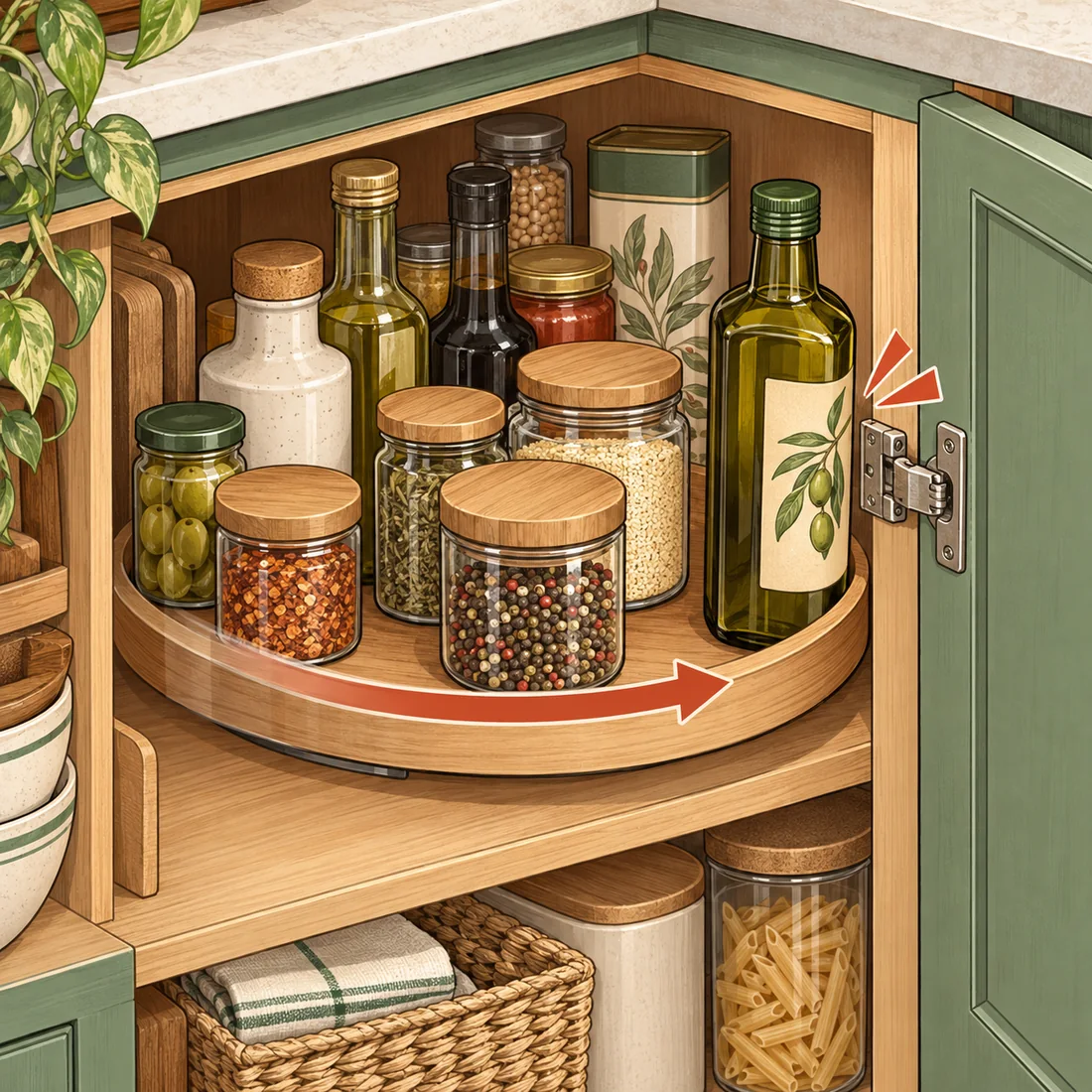
Hinges — Clear the loaded turn
A tray may fit the shelf while empty and collide only when a tall or wide item reaches the hinge side during rotation.
Read the scene: The bottle approaches a hinge as the tray turns. Test the load at the door angle the room normally permits.
- Useful when
- The tray and tallest edge item clear the normal door angle.
- Reconsider when
- The tray works only when the door is opened farther than the room allows.
Check the working layout
- Try this
- Trace the loaded outline near both hinges with the door at its normal usable angle.
- What it reveals
- An empty tray can fit while the load catches the door frame during rotation.
- What to change or look for
- Reposition or reduce the layout; never rely on manually lifting an edge past an obstacle.
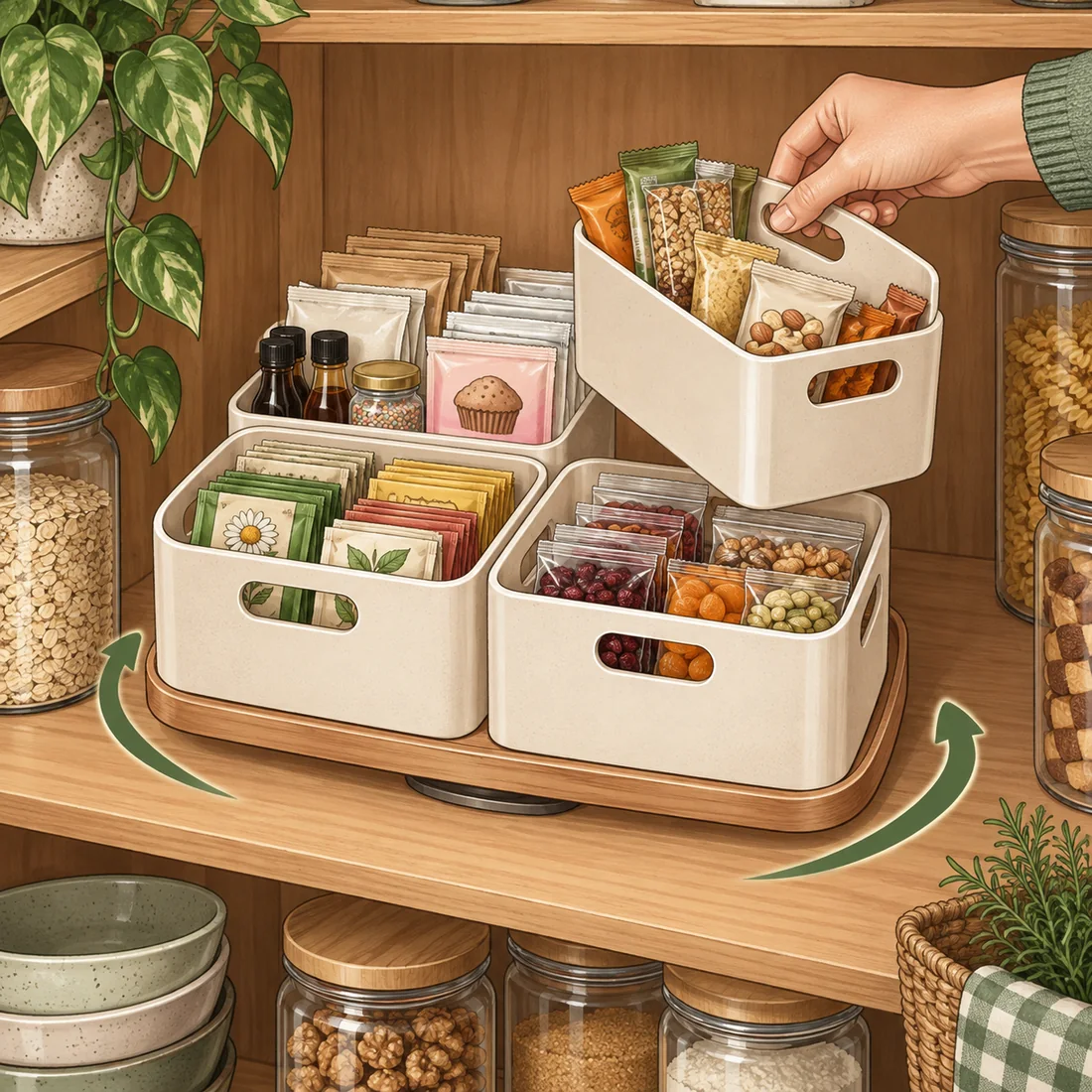
MagicTrack — Removable packet categories
Four removable bins can keep sachets, snacks, or baking packets separated while the complete base rotates. The 12.6-by-10.3-inch body is larger than the round 10-inch options and deserves a taped shelf test.
Choose it for category separation, not maximum open diameter.
- Measure adjacent products as part of the rotation zone.
- Check bin handles and labels at every angle.
- Skip if the shelf lip prevents easy removal.
Read the scene: The removable sections group packets while the whole base rotates. Each division needs a real category and an unobstructed lifting path.
- Useful when
- Several real categories need removable bins.
- Reconsider when
- Its rectangular body takes space needed by adjacent items.
Check the working layout
- Try this
- Assign a category to each bin and rehearse lifting the busiest one out.
- What it reveals
- Four bins help only when the divisions fit your habits and the handles clear the shelf lip.
- What to change or look for
- Compare the complete rotating outline and loaded bin access, not just the body rectangle.
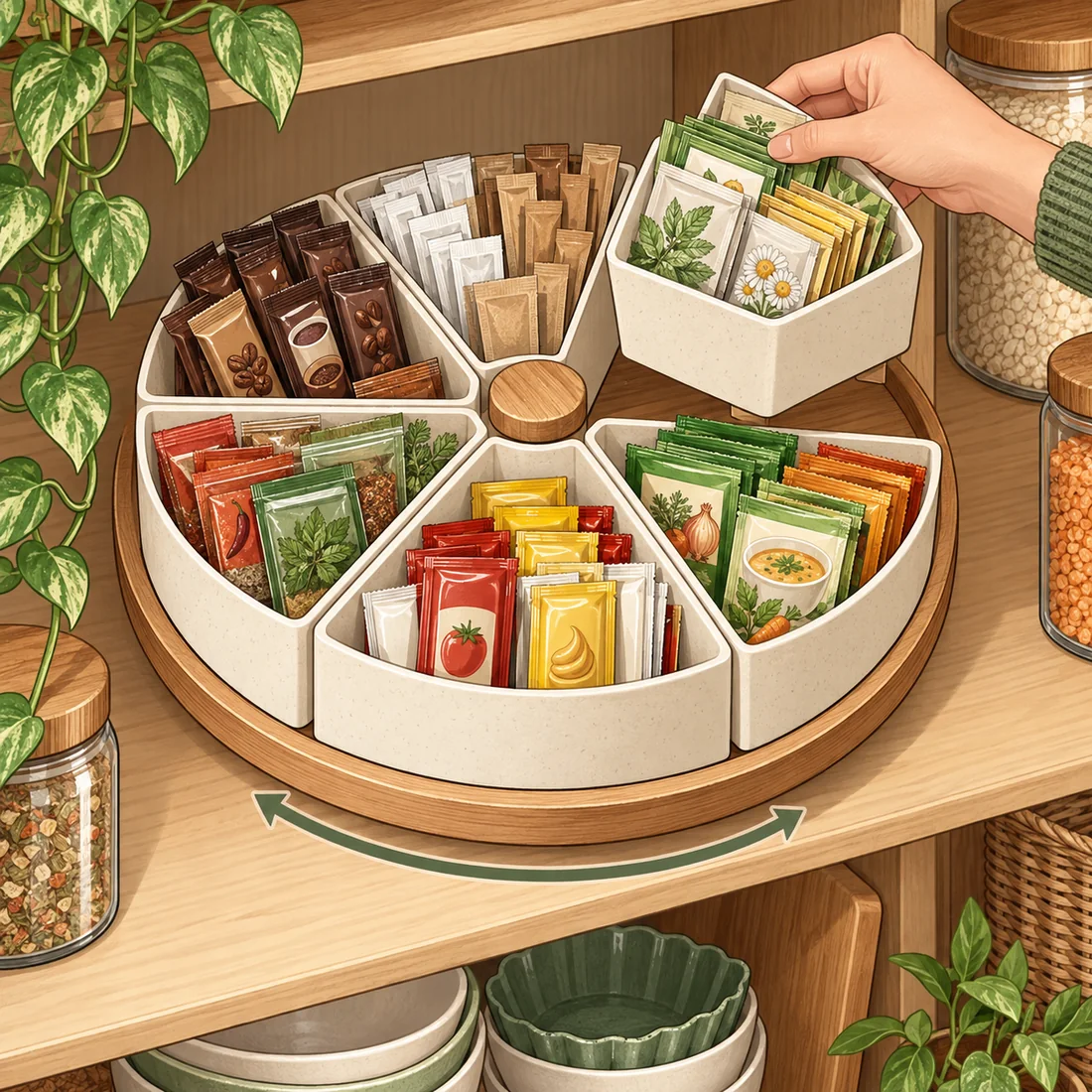
Crazy Susan — Several small categories
Six removable bins define categories without asking loose packets to stand upright. Dividers reduce open flexibility, which is useful only when separation is the actual problem.
Skip it for wide jars or bottles that would fit better on an uninterrupted platform.
- Assign a real category to every bin before buying.
- Keep tall unstable items off the edge.
- Confirm the loaded bin can be lifted vertically.
Read the scene: The hand removes one bin from a divided circle. Separation trades flexible open space for independent small categories.
- Useful when
- Small packets benefit from independent removable divisions.
- Reconsider when
- Wide bottles need an uninterrupted platform.
Check the working layout
- Try this
- Try the largest packet group within one proposed division and retrieve it without disturbing the others.
- What it reveals
- A divided layout exchanges flexible open area for separation.
- What to change or look for
- Choose divisions only when each has a clear purpose and can be lifted in place.
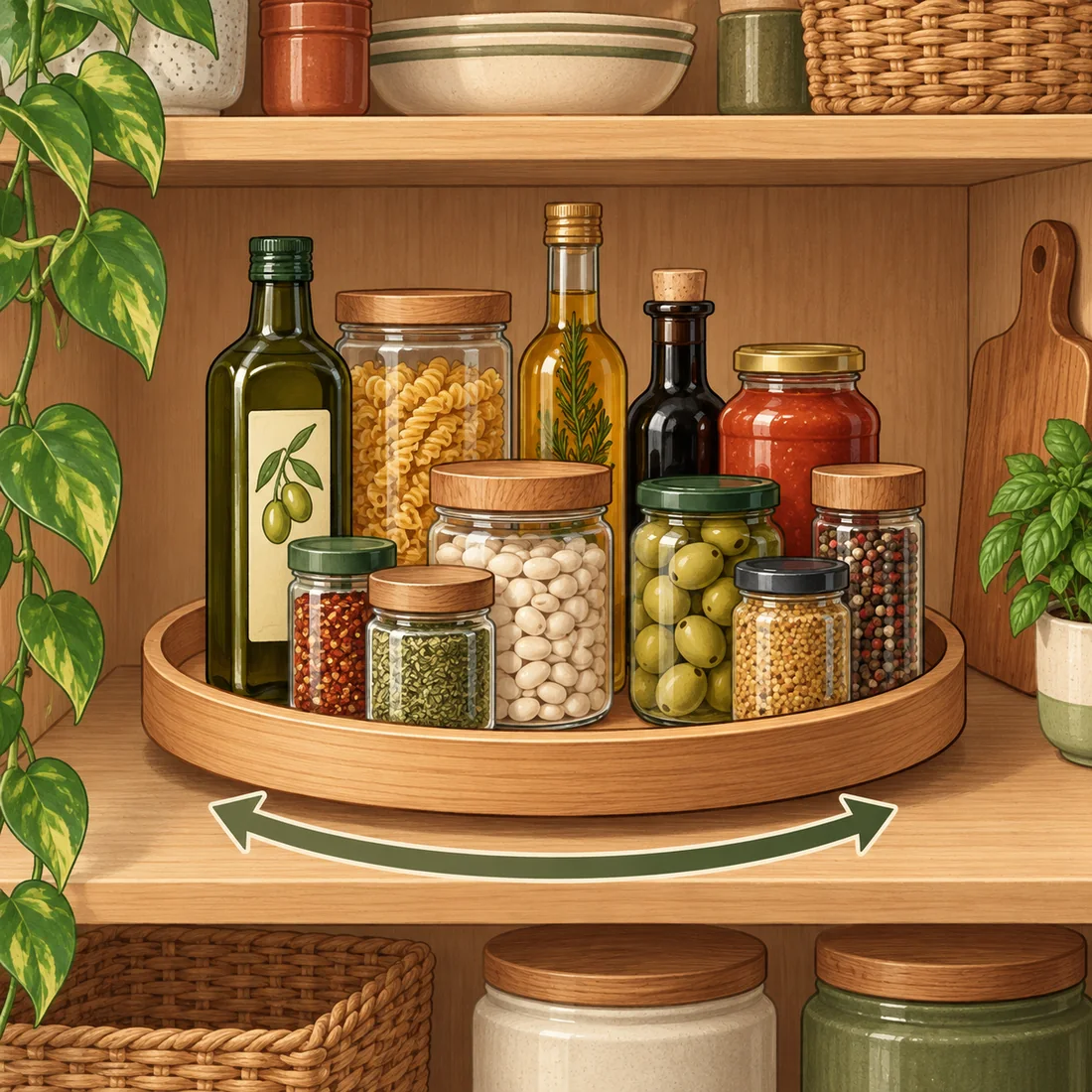
Madesmart Basic 10 — Flexible open platform
The low open platform accepts different jar and bottle widths. Its 10-inch diameter is the simplest geometry in the shortlist and the easiest to mock up with a paper circle.
It provides less retention and separation than bin-based options.
- Cut a 10-inch paper circle for the shelf test.
- Rotate the widest intended bottle at the edge.
- Use only stable containers and current load guidance.
Read the scene: The uninterrupted low platform accepts mixed jar widths. The curved arrow highlights retrieval; it does not establish stability or a permitted load.
- Useful when
- Mixed jar widths need an uncomplicated low platform.
- Reconsider when
- The load is tall, unstable or needs packet separation.
Check the working layout
- Try this
- Arrange the real jars on a 10-inch circle and leave enough grip space to turn them.
- What it reveals
- The simplest layout may be best when bins would reduce needed open area.
- What to change or look for
- Keep the load stable and follow current limits; use another family if rotation adds no access benefit.
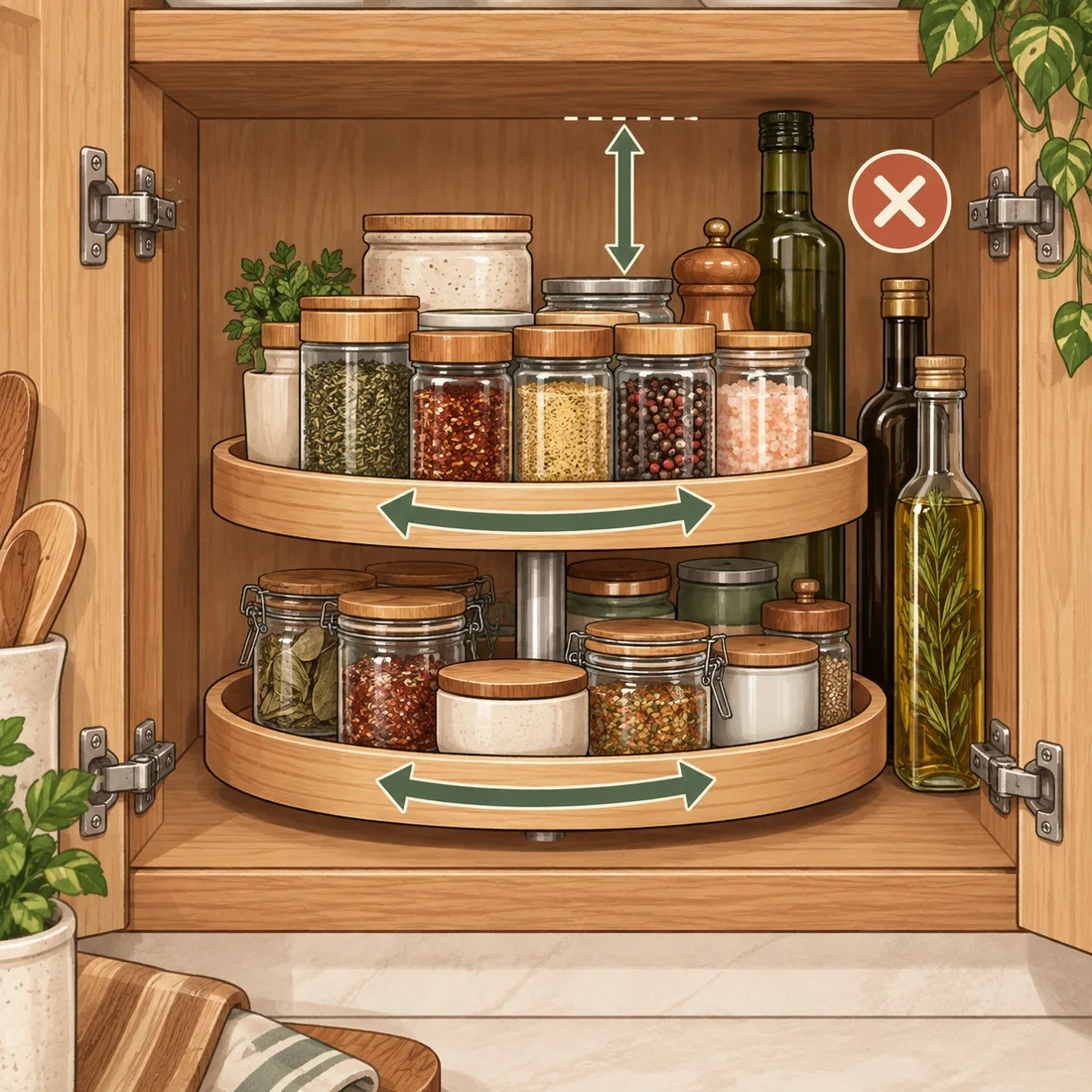
Madesmart Twin 10 — Short items at two levels
The 6-inch documented height divides one tall gap into two short retrieval levels. It works for spices, short jars, or low containers—not for tall oils or pump bottles.
The upper level must remain visible and removable without unloading the lower one.
- Measure the tallest item on both levels.
- Add hand clearance above the top item.
Read the scene: The two turns use separate short-item levels; the tall bottle shows the excluded height. Both tiers need their own removal and hand clearance.
- Useful when
- A tall gap contains short jars that can be reached independently.
- Reconsider when
- Tall oil or pump bottles need the full vertical clearance.
Check the working layout
- Try this
- Rehearse removing the tallest item from each level without unloading the other.
- What it reveals
- Two levels improve useful height only when both retain a visible label and hand path.
- What to change or look for
- Choose one level for taller contents; verify internal tier spacing rather than overall height alone.
Frequently asked questions
Is a larger turntable always better?
No. Larger diameters consume more shelf width and are more likely to collide with hinges or adjacent products.
What should not go on a pantry turntable?
Avoid unstable combinations of tall, heavy, or loosely packed items and follow the exact product guidance.
Are square turntables more efficient?
They can use rectangular shelf area differently, but rotation still creates a swept envelope. Test the complete moving outline.
How much finger clearance is needed?
Enough to start and stop rotation without pinching against a wall or adjacent product. Test with your hand and intended load rather than relying on a universal number.
Make the next decision
Plan the access and movement → Explore all pantry guides → How we review →