Best slim rolling carts for narrow gaps
A slim cart is useful when it brings supplies to the task and returns without making the room harder to use. The narrowest parked width is only one part of that decision: handles, swivel wheels, shelf lips, turns, and the filled load all change its behavior. Here we compare three documented layouts, then trace the journey from the gap to the working position. Choose the shelf arrangement around the bottles or tools you use together. If the contents never need to move, a fixed cabinet may be the simpler answer.
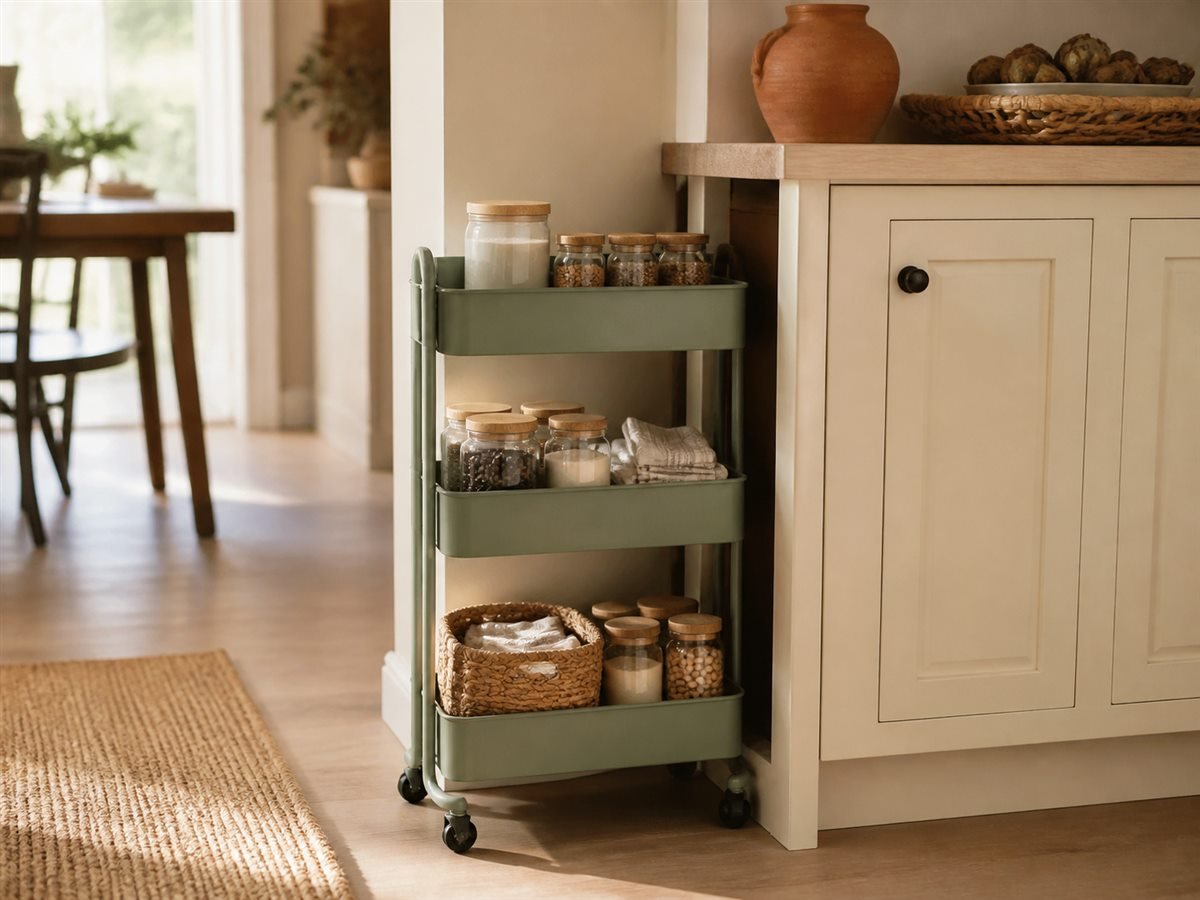
Compare the useful layouts
Start with the case that matches your routine. The checks explain what changes the choice; they are not installation approvals or a reason to buy every option.
These recommendations combine documented specifications with practical planning inferences. Casa Ordenada has not physically tested these organizers. Named models are documentary examples, not a market-wide ranking; decisive dimensions and instructions must be rechecked for the exact current variant. There are no active affiliate links, copied star ratings or static prices.
The illustrations explain typical layouts and movements. They are not exact product renderings, scaled installation drawings or proof of tested performance. Use the current appliance, fixture and organizer instructions for your own space.
| Option | Documented size | Material / layout | Best for | Main trade-off |
|---|---|---|---|---|
| Yamazaki Tower four-tier | 5.1 W × 18.9 D × 31.7 H in (converted) | Powder-coated steel; four tiers | Clearly documented narrow steel cart | Long, heavy body; current US availability varies |
| SPACEKEEPER SPKSC401 | 4.9 D × 15.3 W × 38.7 H in | Plastic; four tiers | Narrowest low-cost slot | Orientation and shelf load must be read carefully |
| IRIS USA narrow wood/metal cart | 8.66 W × 21.65 L × 25.98 H in | Wood top + metal shelf | Wider gap and usable top | Only two storage levels; 22-lb total stated capacity |
Compare the layouts in use
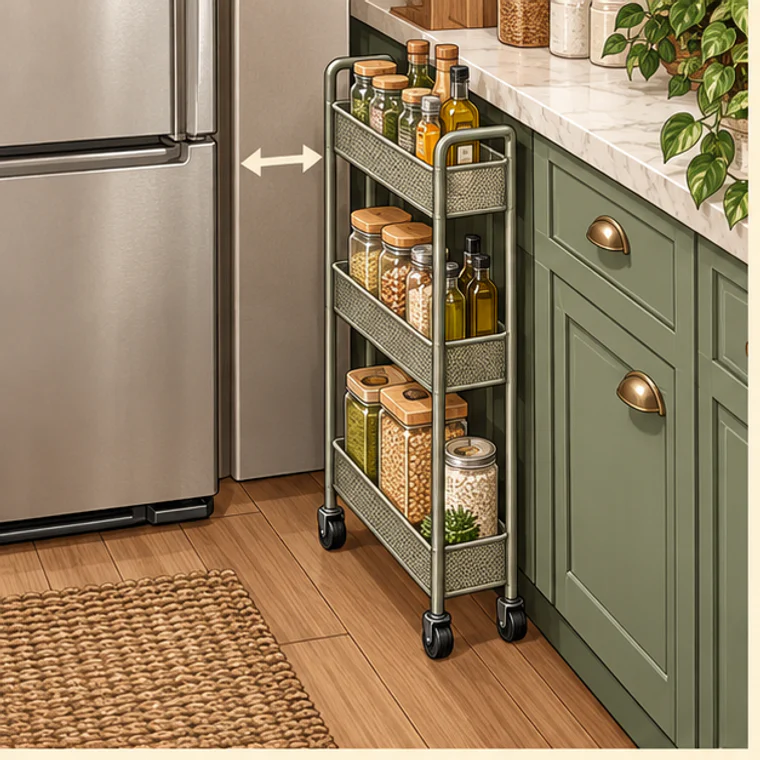
Yamazaki Tower — Narrow steel layout
Yamazaki lists a 13 × 48 × 80.5 cm body including casters—about 5.1 × 18.9 × 31.7 inches—with internal shelf measurements and a per-tier load breakdown. A handle and rotating casters support pull-out use.
Trade-offs: the cart is long and weighs 5.8 kg according to the manufacturer. Check the loaded turning path and current US-market availability before treating it as a candidate.
Read the scene: The cart sits between fixed surfaces, while the arrow highlights the gap. Judge the complete body and handle, not only the basket width.
- Useful when
- Several separated categories need a handle and four reachable tiers.
- Reconsider when
- The long body has no turning room or the loaded weight is awkward to move.
Check the working layout
- Try this
- Trace the 18.9-inch length through the tightest turn and reserve a place where the handle can be gripped.
- What it reveals
- A long cart can leave its gap straight but fail when turned toward the task.
- What to change or look for
- Choose a shorter body or a different parking direction if the route—not the width—is the bottleneck.
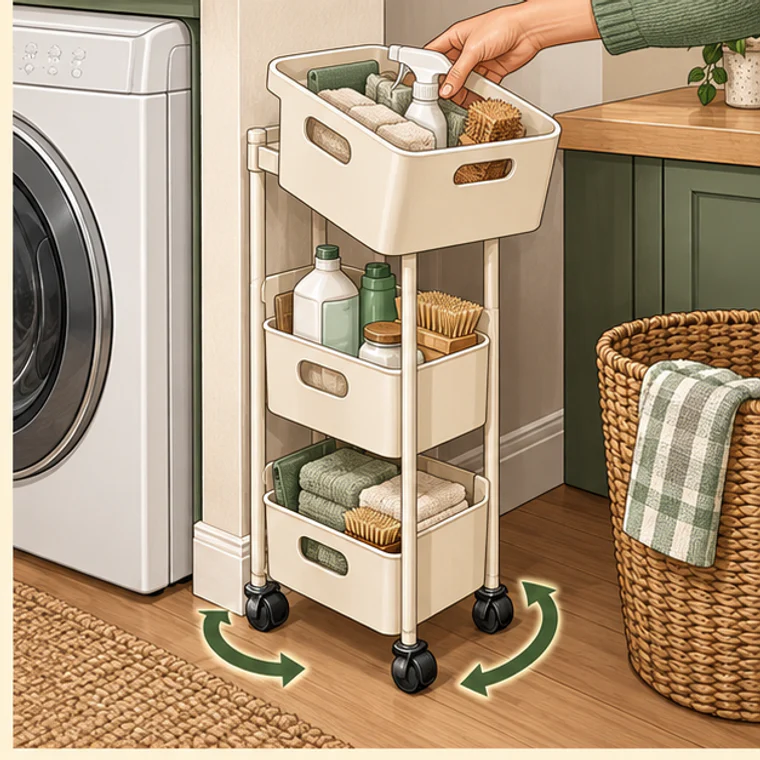
SPACEKEEPER — Light, narrow categories
The available manual lists a four-tier assembled size of 4.9 × 15.3 × 38.7 inches, 4.52-inch internal shelf depth, plastic construction, and a manufacturer-stated 20-pound maximum per shelf.
Trade-offs: plastic shelves and a tall, narrow body prioritize light supplies. The manual advises engaging wheel brakes when stationary; confirm that the exact current variant includes the same wheel setup.
Read the scene: The hand and curved arrows show retrieval and caster movement. The cart must be useful after it leaves the gap, not only while parked.
- Useful when
- Small supplies benefit from four separated plastic tiers.
- Reconsider when
- Tall or concentrated loads are expected, or the exact wheel/brake variant is unclear.
Check the working layout
- Try this
- Arrange the intended bottles inside the documented 4.52-inch internal shelf depth before allocating categories.
- What it reveals
- The outside dimension can fit a gap while the shelf is too narrow for the intended container.
- What to change or look for
- Check the current wheel setup and load guidance; prioritize light, retained contents rather than filling every tier.
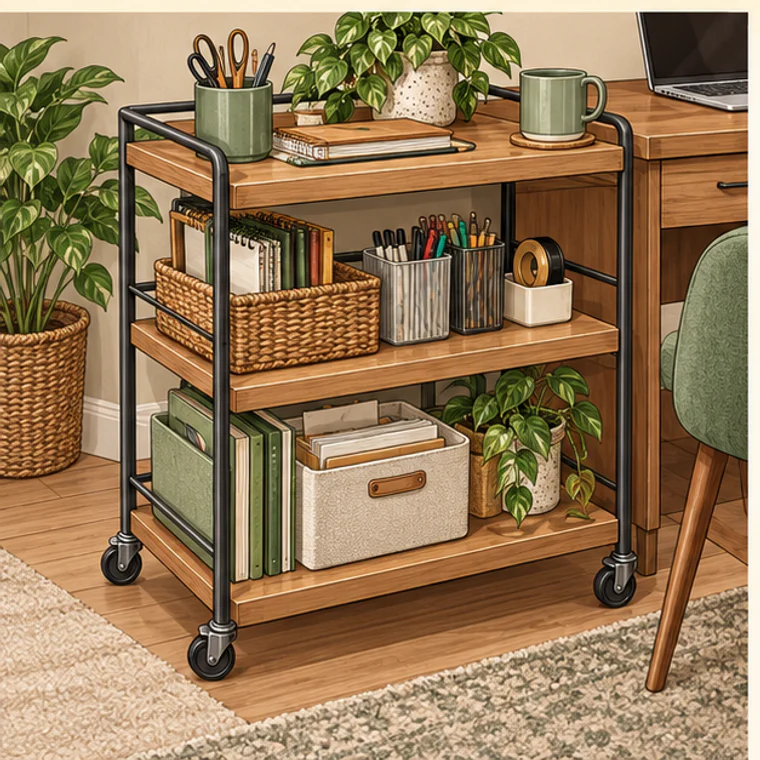
IRIS — Wider cart with a usable top
IRIS documents an 8.66-inch width, 21.65-inch length, 25.98-inch height, a wood top, metal lower shelf, and a 22-pound total stated capacity split across the two levels.
Trade-offs: it needs a wider and longer gap, and two levels provide less separation than a four-tier cart. Its advantage is a more usable top surface, not maximum density.
Read the scene: The top is a working surface above fewer storage levels. Its benefit is accessible double-duty use, not the largest number of tiers.
- Useful when
- One accessible top and a lower category are more useful than many tiers.
- Reconsider when
- Your gap needs a five-inch body or your categories require separate shelves.
Check the working layout
- Try this
- Place a template of the 8.66-by-21.65-inch body in its working position and simulate reaching the lower shelf.
- What it reveals
- A larger top helps only when you can approach it without blocking another cabinet or pathway.
- What to change or look for
- Choose this layout for its two-level access, not maximum tier count; follow the stated total and split loads.
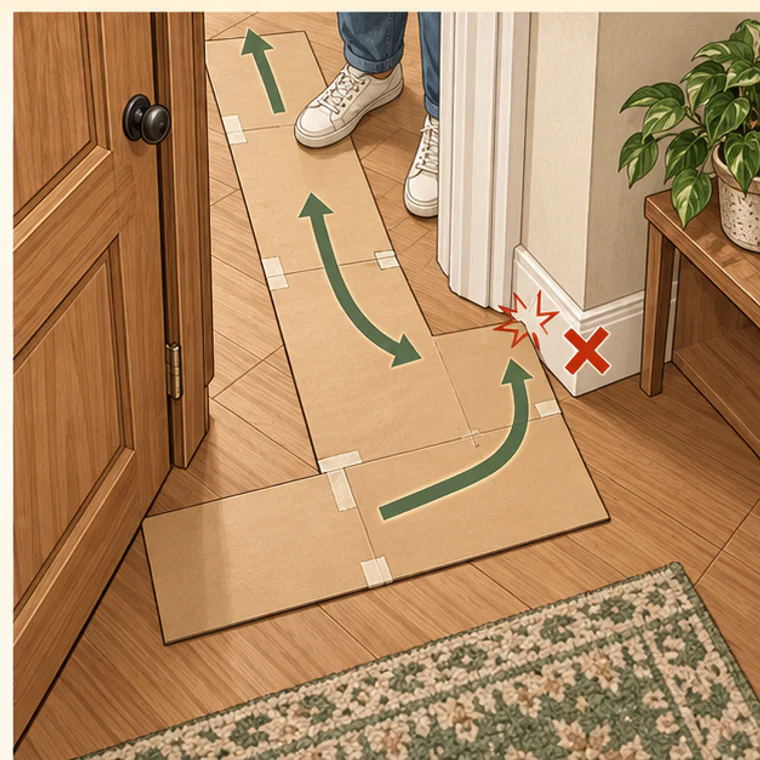
Follow the complete loaded route
When the furniture should stay fixed, see slim cabinets. For a bathroom-specific vertical zone, compare over-the-toilet storage.
Read the scene: The changing direction and marked collision show why the entire journey matters. A cart that leaves a straight gap may still fail at the turn.
- Useful when
- You need supplies in more than one working position.
- Reconsider when
- Rugs, thresholds or turns interrupt movement and wheel performance is undocumented.
Test the route with a cardboard footprint
- Cut or tape the exact footprint, including the handle.
- Move it from storage position to use position.
- Check thresholds, rugs, hoses, appliances, and tight turns.
- Measure the tallest bottle against clear shelf height.
- Prefer raised edges or drawers for objects that can fall.
- Keep heavy items low and within documented loads.
Check the working layout
- Try this
- Move a cardboard footprint along the route, including handle space, then identify each transition that needs a real loaded test.
- What it reveals
- Geometry can eliminate a candidate, but a paper test cannot prove caster grip, tipping resistance or rolling comfort.
- What to change or look for
- Seek a documented floor-compatible design and a suitable return policy; choose fixed storage when moving creates more work.
Frequently asked questions
Is the listed cart width enough to know that it will fit?
Not always. Confirm whether handles, wheel housings, fasteners, or shelf lips extend beyond the listed body width. Measure the gap at several heights and test the full route, not only the parked position.
Can a slim rolling cart move reliably on carpet?
That cannot be concluded from dimensions alone. Wheel diameter, load, floor transition, pile height, and caster design affect movement. Unless the manufacturer documents the surface, loaded rolling behavior requires hands-on testing.
Make the next decision
Plan the access and movement → Explore all small-space guides → How we review →