Best between-washer-and-dryer storage, chosen by the gap
A narrow gap can be useful storage, but only if it is genuinely free. A rolling cart brings the back tier forward, a fixed tower keeps light supplies visible, and handled bins let you carry a small kit to the task. They solve different access problems. Start with what you need to retrieve, not the smallest advertised width. This guide compares the daily compromises and explains when leaving the gap empty is the better choice.
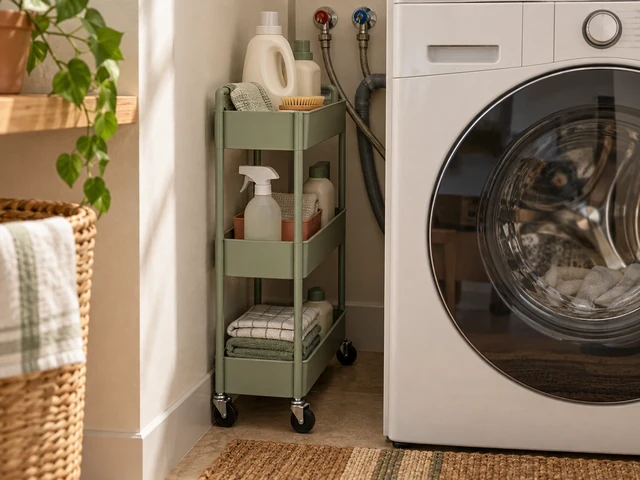
Choose the design that solves your problem
The first three sections compare organizer designs. The final section checks the working space or routine; it is not another product recommendation.
Compare the practical trade-offs
Swipe across the table to compare all four columns.
| Design | Useful when | Main compromise | Deciding feature |
|---|---|---|---|
| Rolling cart | Frequently used supplies in a genuinely free side gap | Needs a clear pull-out route | Outside width, tier openings, and route with supplies aboard |
| Fixed tower | Light items with direct front access | Upper and rear shelves may be awkward | Independent stability and comfortable retrieval |
| Handled bins | A small kit that travels to the task | The whole kit must lift out | Handle clearance and a manageable complete load |
We analyze layouts and product families, not personally tested models. There are no active affiliate links, copied ratings, or static prices. Compare any eventual product with its current instructions and your own appliance documentation.
Illustrations are conceptual layouts, not exact products, scale drawings, or installation instructions. Arrows highlight movements or areas to check, not specified clearances. Decorative containers are not recommendations to repackage laundry products.
See the differences in daily use
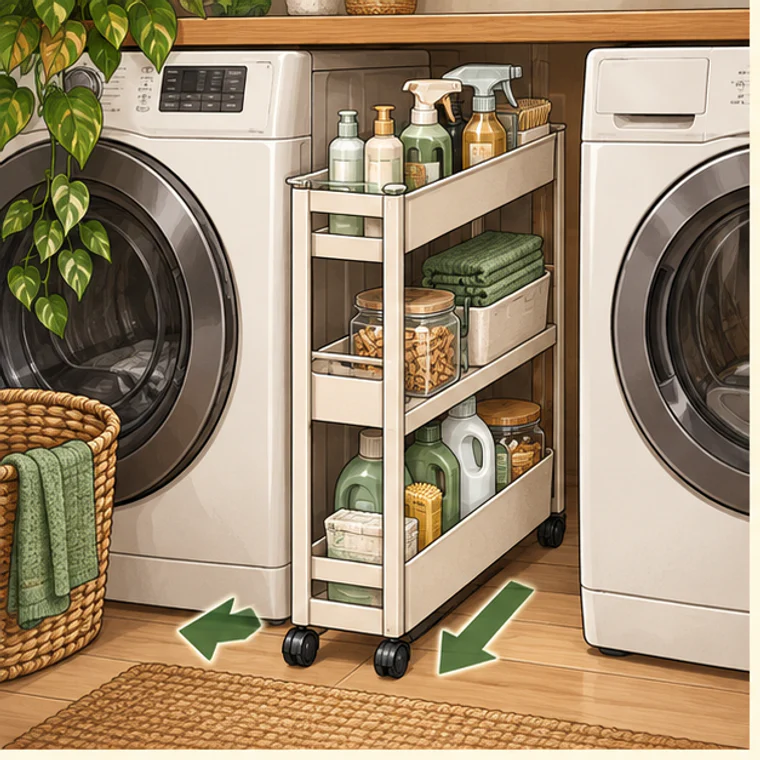
Ultra-slim rolling cart — bring the back tier forward
A cart suits a clear side gap when your supplies are easy to reach only after pulling the tiers into the room. It is less useful if you must move the washer, lift a basket, or steer around a door every time you need detergent.
Read the scene: The pulled-out cart is a reminder to judge its working route as well as its parked position.
- Choose it when
- One straight pull exposes the items you use most, and the loaded cart can return without catching a connection.
- Choose another route when
- Wheels, handles, or the pull-out turn take up space the room cannot spare.
Compare the complete cart, not the quoted shelf width
Outside dimensions should include projecting wheels and handles. Then compare the opening above each tier with your current bottles. A low shelf can look generous in a photograph yet make a tall bottle awkward to lift. A shallow top tray often helps with small, frequent-use tools; it does not replace secure storage for cleaning products.
Pull out a representative load
- Try this
- Walk the proposed route with a tray of your usual supplies, without moving an appliance.
- What the result reveals
- A blocked route or repeated lifting means rolling storage will not remove the access problem.
- What to change or look for
- Prioritize direct front access or a removable caddy instead of a deeper cart.
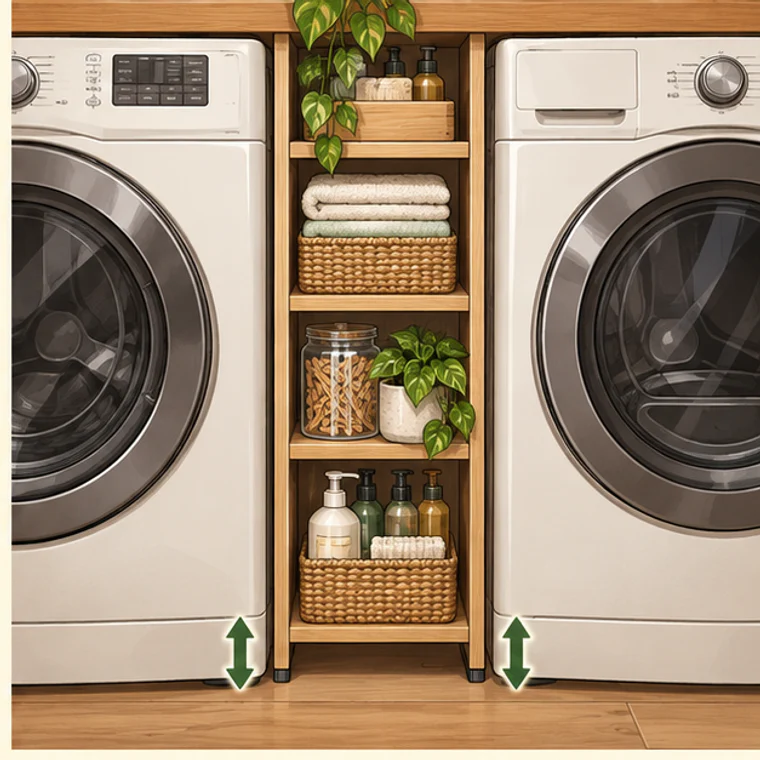
Fixed narrow shelf tower — trade movement for direct reach
A stationary tower removes the wheel route, but you still need to see and lift supplies from the front. It works best for a modest set of light items rather than a long row of bottles hidden behind one another. Height is useful only while the shelves remain comfortably reachable.
Read the scene: The upright arrangement shows the trade-off: more levels in the same floor area, but a longer reach to the top.
- Choose it when
- The front openings face the user and daily items do not disappear behind the machines.
- Choose another route when
- The rear of a shelf can only be reached by leaning over an appliance, or the frame cannot be restrained as required.
Access matters more than the number of tiers
Look at shelf spacing, the front opening, and the manufacturer's stability instructions. Do not assume a narrow tower is safe merely because two machines surround it. Leave required appliance clearances intact, and do not use the machine casing to support or brace the furniture.
Practice the hardest retrieval
- Try this
- Place a short and a tall item on a safe temporary surface at the proposed shelf height.
- What the result reveals
- If one blocks the other, another shelf level may add storage without improving access.
- What to change or look for
- Favor shallower shelves, fewer items per tier, or a lift-out container.
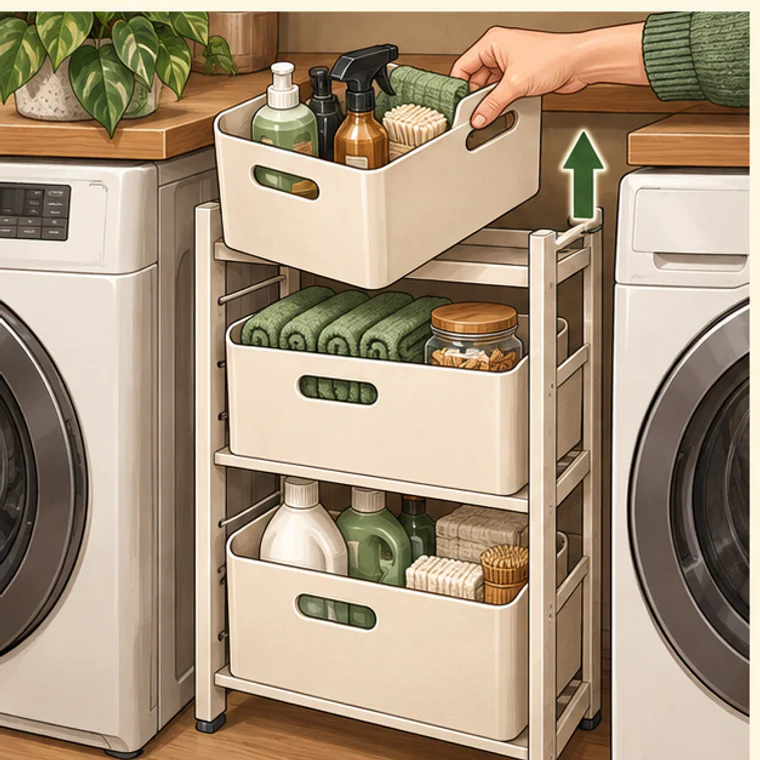
Removable handled bins — carry the kit instead of the furniture
A small bin can keep brushes, cloths, and other tools together without installing a full tower. It is especially useful when supplies serve more than one room. The compromise is that the whole bin must come out before you can comfortably inspect its contents; an overloaded kit becomes another chore.
Read the scene: The removable containers illustrate a portable group of tools, not a reason to fill every available gap.
- Choose it when
- A light kit can be lifted from a reachable position and carried to where you use it.
- Choose another route when
- The handle is trapped beneath a shelf or the container would have to scrape across hoses.
Separate a daily kit from reserve stock
Keep only the tools that travel together in the handled container. Refill stock can live elsewhere, which keeps the kit lighter and easier to put back. Cleaning products remain in their original labeled packaging and need storage appropriate to the household; a decorative open bin is not child-resistant storage.
Lift it as a complete kit
- Try this
- Group the items you actually carry together and try lifting that load from the proposed position.
- What the result reveals
- If the handle cannot clear the opening, fitting the bin's body is not sufficient.
- What to change or look for
- Look for a lower profile or a more accessible location, not simply a narrower container.
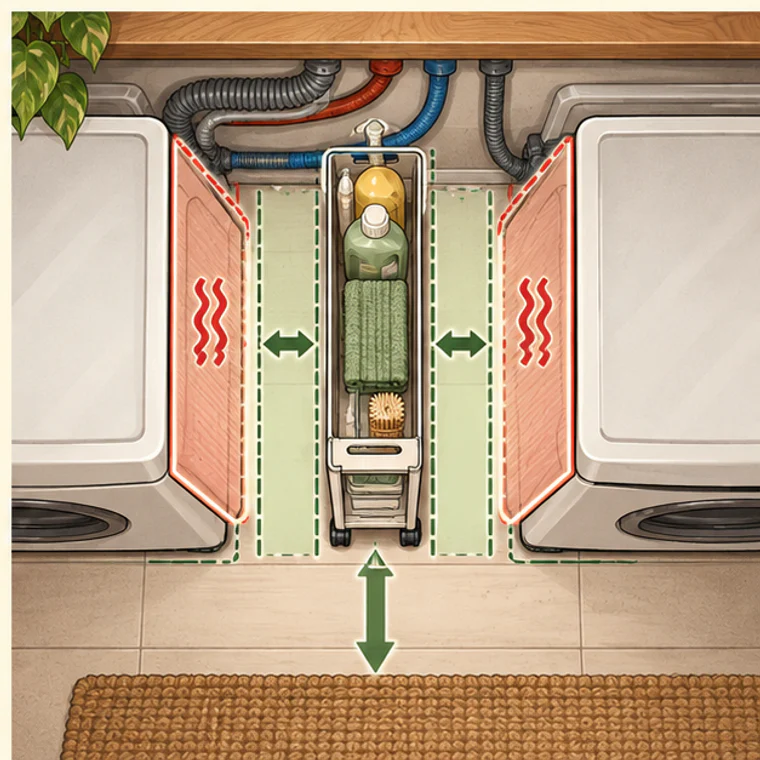
Service gap — sometimes the right choice is no organizer
A spare-looking strip beside a washer can contain shutoff valves, hoses, a dryer vent route, or clearances required by the appliance instructions. Those functions take priority over adding storage. An organizer should not hide a connection you need to inspect or make a routine task depend on shifting a heavy appliance.
Read the scene: The connections in this scene explain why an empty-looking gap is not necessarily available storage.
- Keep the gap free when
- The proposed furniture conflicts with the appliance instructions or with access to the connections.
- Reconsider storage elsewhere when
- You cannot confirm the installation conditions from the manual and accessible parts of the room.
Do not convert service space into a storage target
Check the installation instructions for your exact appliance, including any relevant stacking or venting configuration. There is no universal safe gap that applies to every washer and dryer. If confirming it would require moving an appliance or altering a connection, get suitable professional help rather than improvising.
Map what remains accessible
- Try this
- From an accessible position, locate the controls and connections you need to reach.
- What the result reveals
- If the proposed cart conceals them or presses against a hose, its narrow width is irrelevant.
- What to change or look for
- Use wall storage or another location that leaves the installation conditions unchanged.
Questions before your next step
Is the narrowest cart always the best choice?
No. A slightly narrower tier may still have projecting wheels, a handle, or a poor pull-out route. The useful choice exposes your supplies without moving an appliance.
Can I fill the entire gap between machines?
Not without checking your own installation instructions and connections. Empty space may serve ventilation, appliance movement, or maintenance; it is not automatically a furniture allowance.
What if I only need a few small tools?
Try a reachable handled kit before buying a multi-tier unit. It may solve the access problem while leaving more of the gap free.
References and the next decision
For equipment fit and installation, start with your exact model's manual. Whirlpool's dryer venting specifications explain why the equipment concerned needs its own installation and venting requirements; this document is not a universal clearance guide.
For laundry packets, the CPSC safety alert recommends original sealed packaging and locked storage out of children's sight and reach.
Shortlist one design and the feature that makes it easier to use: a clear pull-out route, direct front reach, or a removable kit. Then compare the complete outside dimensions and instructions of each candidate against that requirement. If the gap is reserved for equipment access, choose another location rather than a tighter fit.