Best laundry sorters for small spaces, chosen by workflow
A sorter is useful when it removes a repeated step, not simply when it offers more compartments. Think about the loads you already separate and how they reach the washer. A rolling frame helps on a clear, same-level route; lift-out bags matter more when you carry laundry upstairs; a vertical sorter trades width for reach. This guide compares those differences so you can choose an arrangement that simplifies laundry day without filling the floor with unused sections.
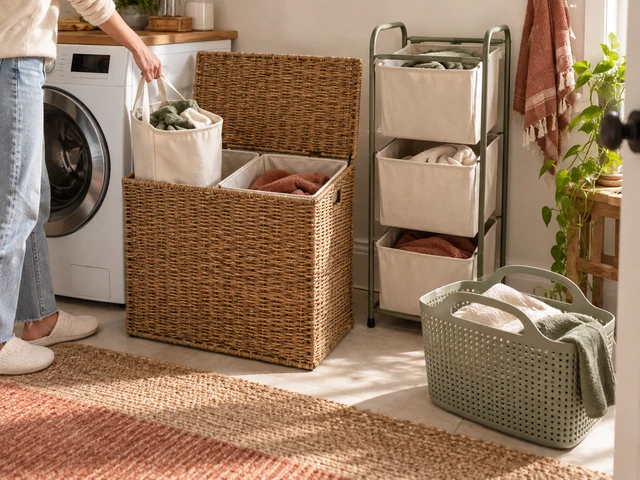
Choose the design that solves your problem
The first three sections compare organizer designs. The final section checks the working space or routine; it is not another product recommendation.
Compare the practical trade-offs
Swipe across the table to compare all four columns.
| Design | Useful when | Main compromise | Deciding feature |
|---|---|---|---|
| Three-bag rolling sorter | Several regular load groups on one floor | The frame uses a wider footprint | Full bags and the complete route to the washer |
| Vertical sorter | Several groups in a narrow wall position | Upper bag removal requires reach | Removal direction, top access, and restraint instructions |
| Two-compartment hamper | Two regular groups with independent carrying | Compartments can divide capacity unhelpfully | Each full liner can leave separately |
We analyze layouts and product families, not personally tested models. There are no active affiliate links, copied ratings, or static prices. Compare any eventual product with its current instructions and your own appliance documentation.
Illustrations are conceptual layouts, not exact products, scale drawings, or installation instructions. Arrows highlight movements or areas to check, not specified clearances. Decorative containers are not recommendations to repackage laundry products.
See the differences in daily use
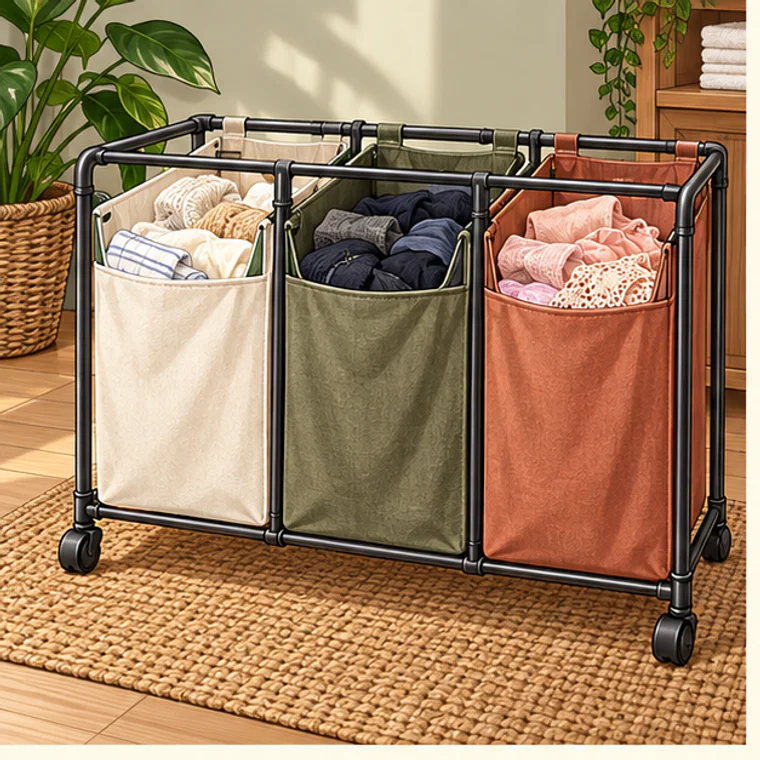
Three-bag rolling sorter — separate loads on a same-level route
A rolling sorter keeps several load groups together and lets you move the frame as one unit. It earns its footprint when those groups reflect your actual routine and the floor route is usable. Three sections are not inherently better than two if one stays empty while another regularly overflows.
Read the scene: The grouped bags and movable frame illustrate sorting and transport as two linked tasks.
- Choose it when
- You regularly separate several loads and can roll the loaded unit to the washer on the same level.
- Choose another route when
- Stairs, tight turns, or a doorway mean you will carry the bags regardless.
Compare bag removal as well as the wheels
Check whether each bag lifts out independently, how its handles are used, and whether the frame's wheels and brakes suit the manufacturer's intended use. A large frame may be convenient in one room but awkward between rooms. Compare overall footprint with all handles and projecting fittings included.
Walk a normal laundry route
- Try this
- Carry your existing full bag from the proposed sorting position to the washer and identify turns and obstacles.
- What the result reveals
- If the route includes stairs, rolling the frame will not remove the carrying step.
- What to change or look for
- Prioritize detachable, comfortable-to-carry bags; treat the rolling frame as optional.
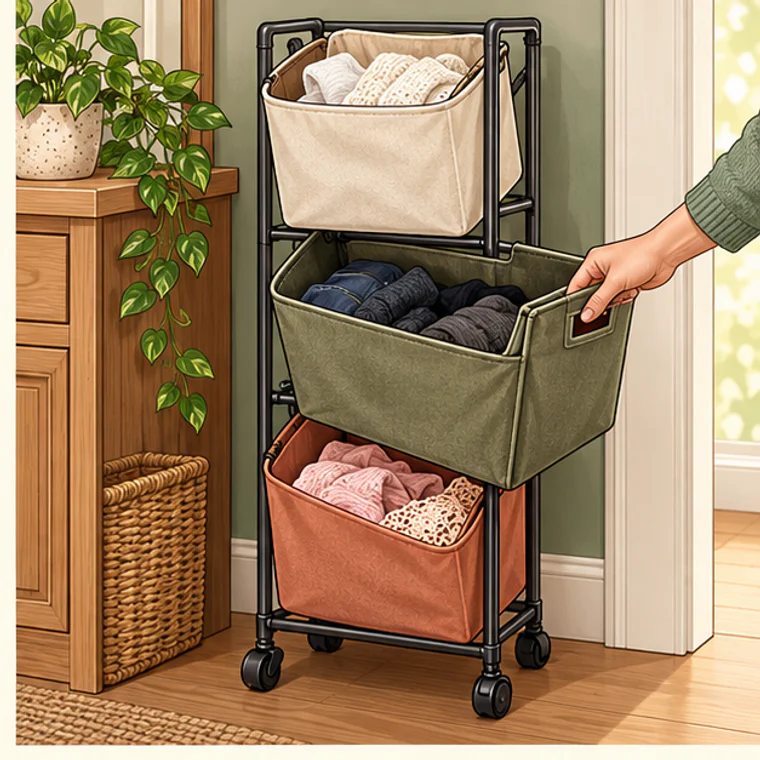
Vertical stacked sorter — save width without hiding the load
Stacked compartments can suit a narrow wall position where a wide frame will not work. The trade-off is reaching and removing bags at different heights. A high section that looks accessible when empty may be awkward when full, particularly if the bag has to lift upward before it comes forward.
Read the scene: The stacked layout shows the width-versus-reach compromise; the upper compartment still needs a removal route.
- Choose it when
- The upper and lower compartments can be reached and removed without leaning across the machines.
- Choose another route when
- A counter, shelf, or door traps the top bag, or required frame restraint cannot be provided.
Read the removal mechanism before comparing volume
Look for how bags attach, which direction they leave the frame, and whether any compartment blocks another. Check stability and restraint instructions for the exact model. Do not assume a tall frame is secure because it sits tightly in a corner; a narrow base and a full upper section deserve particular attention.
Practice the upper-bag movement
- Try this
- Use your present bag to judge the reach and lift involved from a safe, accessible position.
- What the result reveals
- If you would need to climb, overreach, or empty another compartment first, the vertical layout repeats the problem.
- What to change or look for
- Favor a lower frame or accessible lift-out hamper, even if it provides fewer sections.
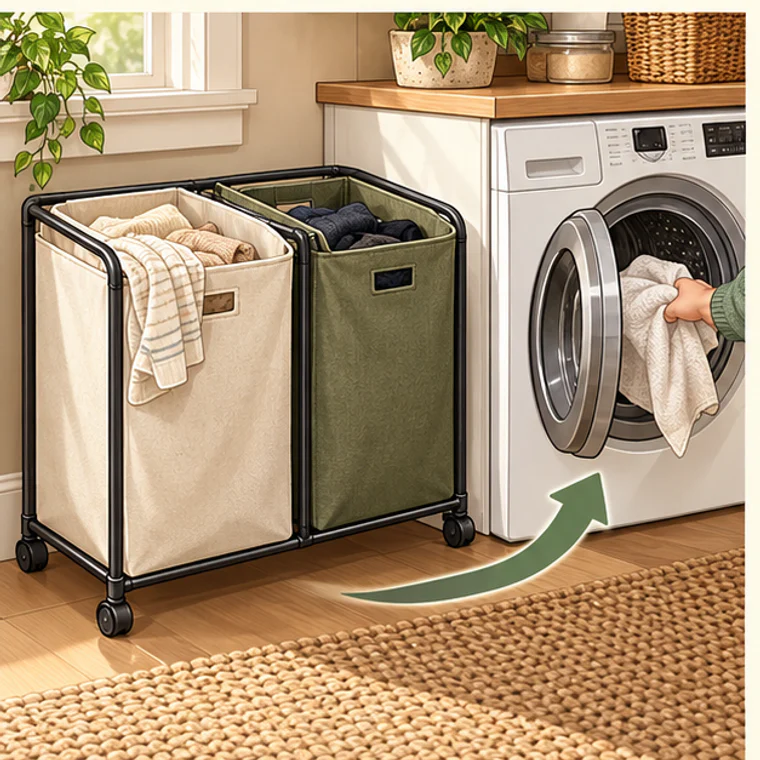
Lift-out two-compartment hamper — simple sorting, independent bags
A divided hamper works well when you repeatedly use two groups and want one contained sorting position. Removable liners can let each load travel separately, leaving the hamper in place. The benefit disappears if the liners have poor handles or can only be removed after opening an obstructed lid.
Read the scene: The separate compartments illustrate independent loads, not a rule that every household must sort the same way.
- Choose it when
- Two sections match your wash routine and each full liner can leave on its own.
- Choose another route when
- The division wastes capacity or the lid cannot open in the intended location.
Choose compartments around your routine
Use your actual load groups and fabric care requirements rather than adopting labels just because a hamper supplies them. Compare liner removal, opening width, handle design, and care instructions. A single hamper plus a separate temporary basket may be simpler if you sort only on wash day.
Use one full load as the example
- Try this
- Check how you would remove a liner and carry it while the other compartment remains occupied.
- What the result reveals
- If both liners must come out or the whole hamper must move, independent sorting is less convenient than it appears.
- What to change or look for
- Look for separately removable bags or keep a simpler basket-based system.
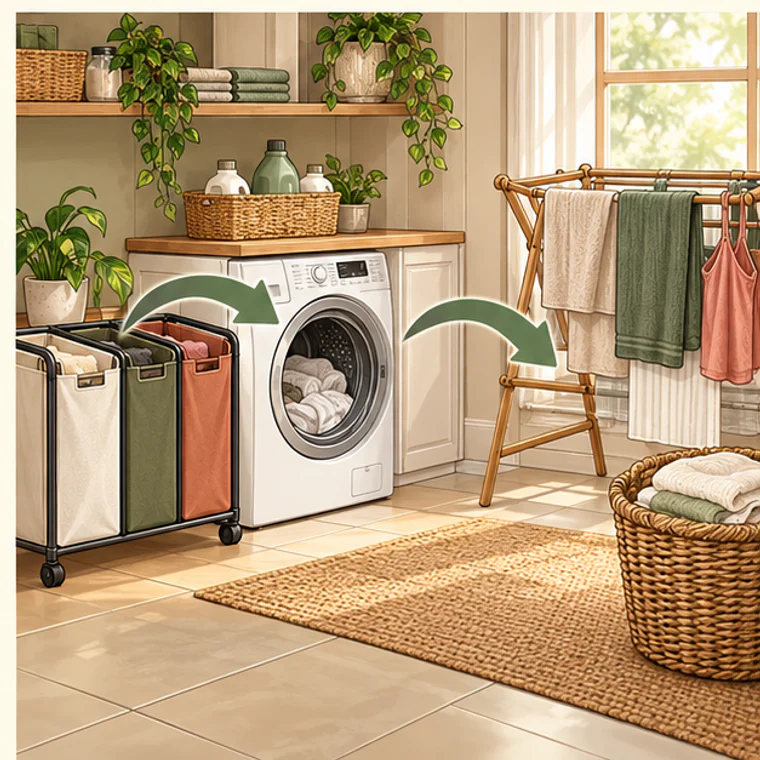
The transfer route — let the full bag decide the layout
The sorting position is only one part of the job. A full bag must reach the washer, be emptied, and return without crossing a pile of clean laundry. An attractive hamper in an unused corner can make that route longer rather than simpler.
Read the scene: The route scene connects the collection point with the washer; it is a planning check, not another sorter category.
- Keep your existing setup when
- One basket already collects and transfers your usual load without repeated re-sorting.
- Change the setup when
- You routinely empty one container into another just to get clothes through the route.
Do not buy compartments to solve a location problem
Move the collection point conceptually closer to the route before deciding that more bags are needed. In a home with a separate laundry room, individual carry bags may be more useful than a large rolling frame. Reserve a separate place for clean clothes so the return trip does not undo the sorting work.
Follow one load from start to finish
- Try this
- Note each transfer between containers, where the load is put down, and which door or turn causes difficulty.
- What the result reveals
- An unnecessary transfer suggests the container or location is wrong, not necessarily too small.
- What to change or look for
- Choose handles, independent removal, or a nearer collection point that removes that particular step.
Questions before your next step
How many compartments do I need?
Enough for the load groups you actually use. Extra sections can consume floor space and divide capacity unhelpfully; they are not automatically an upgrade.
Should I choose wheels or removable bags?
Wheels help with an unobstructed same-level route. Removable bags are more important when the frame will stay parked, or when stairs and narrow turns require carrying.
Can I compare hampers using liters alone?
Volume is useful but incomplete. Bag access, removal direction, handle design, and the way your usual load moves to the washer determine whether that capacity is convenient.
References and the next decision
For equipment fit and installation, start with your exact model's manual. Whirlpool's dryer venting specifications explain why the equipment concerned needs its own installation and venting requirements; this document is not a universal clearance guide.
Keep one deciding feature on your shortlist: same-level movement, independently removable bags, or comfortable access to stacked compartments. Compare the exact design's dimensions, removal mechanism, and care instructions before choosing capacity. If your existing basket already completes the route easily, keep it.