Best over-washer-and-dryer storage, chosen by installation
Storage above the machines can free the floor, but height alone does not make it useful. An open shelf gives quick visibility, a closed cabinet contains reserve stock, and a bridge rack changes the installation approach. Each still needs comfortable access and room for the appliance to open and be serviced. Start with the items you want to retrieve, then compare mounting, reach, door movement, and service access rather than treating the empty wall as unlimited storage.
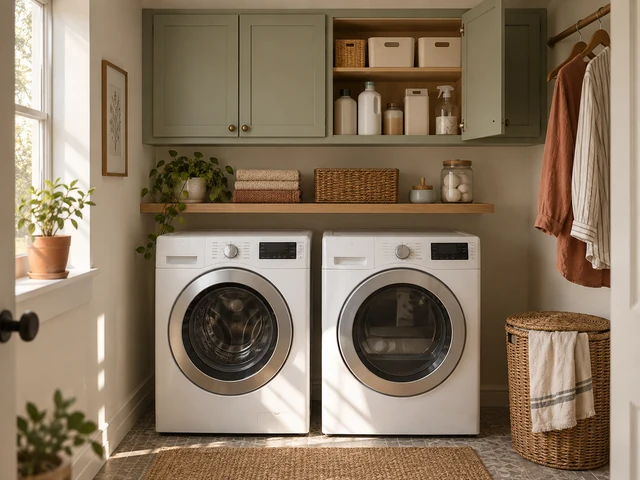
Choose the design that solves your problem
The first three sections compare organizer designs. The final section checks the working space or routine; it is not another product recommendation.
Compare the practical trade-offs
Swipe across the table to compare all four columns.
| Design | Useful when | Main compromise | Deciding feature |
|---|---|---|---|
| Open shelf | A small visible set of reachable supplies | Contents remain exposed | Shelf depth, item removal, mounting requirements |
| Closed wall cabinet | Less frequent backstock in a suitable wall position | Adds door movement and hides contents | Door path, retrieval, and exact installation instructions |
| Bridge rack | A compatible frame around the appliances | Legs, braces, and restraints add constraints | Frame-part positions and protected appliance access |
We analyze layouts and product families, not personally tested models. There are no active affiliate links, copied ratings, or static prices. Compare any eventual product with its current instructions and your own appliance documentation.
Illustrations are conceptual layouts, not exact products, scale drawings, or installation instructions. Arrows highlight movements or areas to check, not specified clearances. Decorative containers are not recommendations to repackage laundry products.
See the differences in daily use
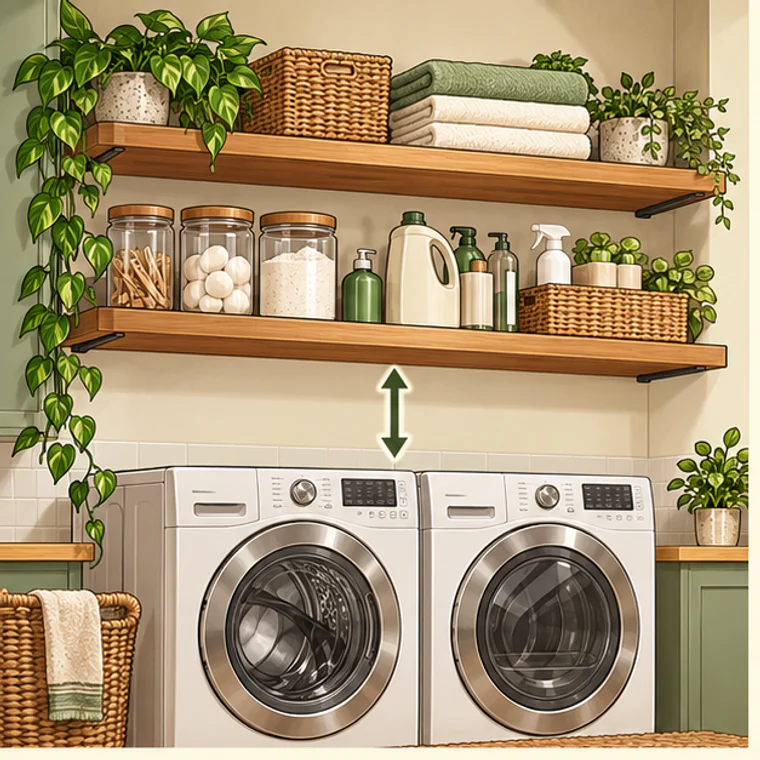
Open shelf — keep a small, visible set within reach
A shallow open shelf can keep a few regularly used supplies visible without occupying the floor. It is convenient only when the items can be reached from a normal standing position. A deep shelf over a deep appliance may push its most useful storage beyond that reach.
Read the scene: The open arrangement shows direct visibility, but it does not establish the correct mounting height for your room.
- Choose it when
- You can see, grasp, and replace daily items without leaning across the machine.
- Choose another route when
- The shelf would block a lid, controls, or the working space needed to lift an item.
Shelf depth changes the retrieval task
Compare both the shelf depth and the depth of what will sit on it. A tall bottle may need more removal space than a low tray. Check wall fixing, bracket spacing, and load instructions for the exact shelf system; this guide does not prescribe anchors or a universal weight allowance.
Rehearse the hardest item to retrieve
- Try this
- From a safe standing position, judge how you would grasp the tallest or heaviest daily item.
- What the result reveals
- If you would stretch over the appliance or pull another object forward first, the shelf is not convenient daily storage.
- What to change or look for
- Keep that item lower and use the shelf for lighter, less frequent supplies.
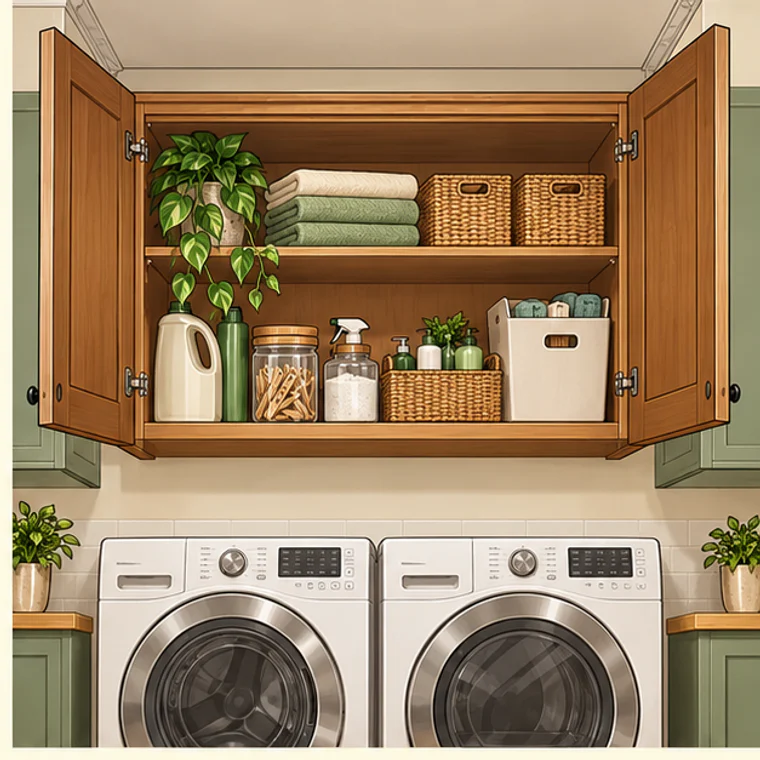
Closed wall cabinet — contain backstock, account for the doors
A cabinet can contain visual clutter and reserve supplies above the machines. That enclosure introduces a door movement and may make the contents harder to see. It is often better for less frequent stock than for the bottle you need on every load, especially when the machine sits between you and the cabinet.
Read the scene: The closed storage scene adds a second movement to consider: opening the cabinet before retrieving the contents.
- Choose it when
- The mounting conditions are suitable and you can open the door and reach the intended contents comfortably.
- Choose another route when
- The door enters another opening or the cabinet requires awkward access over the appliance.
Enclosed does not mean automatically secure
Compare cabinet depth, door direction, shelf adjustment, and the manufacturer's wall installation requirements. An ordinary closed door is not a child-resistant lock. Household cleaning products need appropriate secure storage and original packaging; do not rely on cabinet height alone as protection.
Consider the door with a load in progress
- Try this
- Plan the cabinet opening while the appliance door or lid is in its normal working position.
- What the result reveals
- If accessing a supply requires closing the appliance or shifting a basket every time, the cabinet location interrupts the routine.
- What to change or look for
- Choose shallower storage, a different door arrangement, or a separate backstock location.
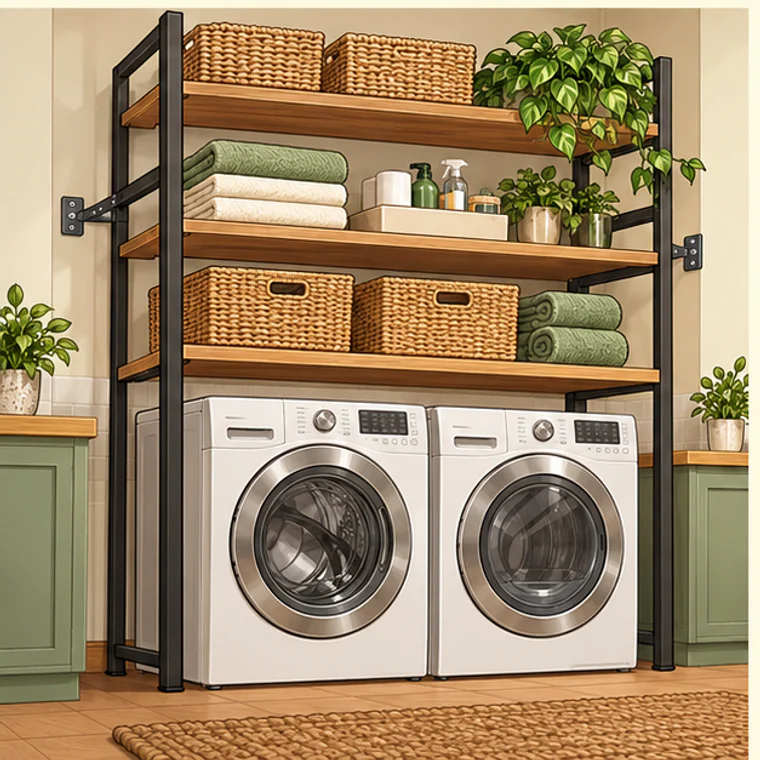
Freestanding bridge rack — compare the frame and its restraints
An over-appliance rack stands on a frame rather than using a shelf mounted directly to the wall. This can change the mounting problem, but it does not automatically mean no drilling or no restraint. Frame legs, crossbars, and shelves must all suit the appliance installation and the organizer's instructions.
Read the scene: The wall restraints visible in the scene are important: a freestanding frame is not automatically a no-fixing solution.
- Choose it when
- The complete frame fits the permitted installation space and any required restraint can be installed.
- Choose another route when
- A crossbar conflicts with hoses, controls, appliance opening, or maintenance access.
Look beyond the outside width
Check where the uprights and crossbars sit, not only the rack's overall dimensions. A frame that spans the machines can still collide with a rear connection or limit lid movement. Its shelves must support the intended items according to the organizer instructions; do not let the rack bear on the appliance casing.
Map the frame parts against the room
- Try this
- Compare the leg and crossbar positions with the visible appliance openings and connection routes.
- What the result reveals
- A clear central span is not enough if a side leg or rear brace occupies a protected area.
- What to change or look for
- Look for a compatible frame configuration or use storage elsewhere; do not remove structural parts.
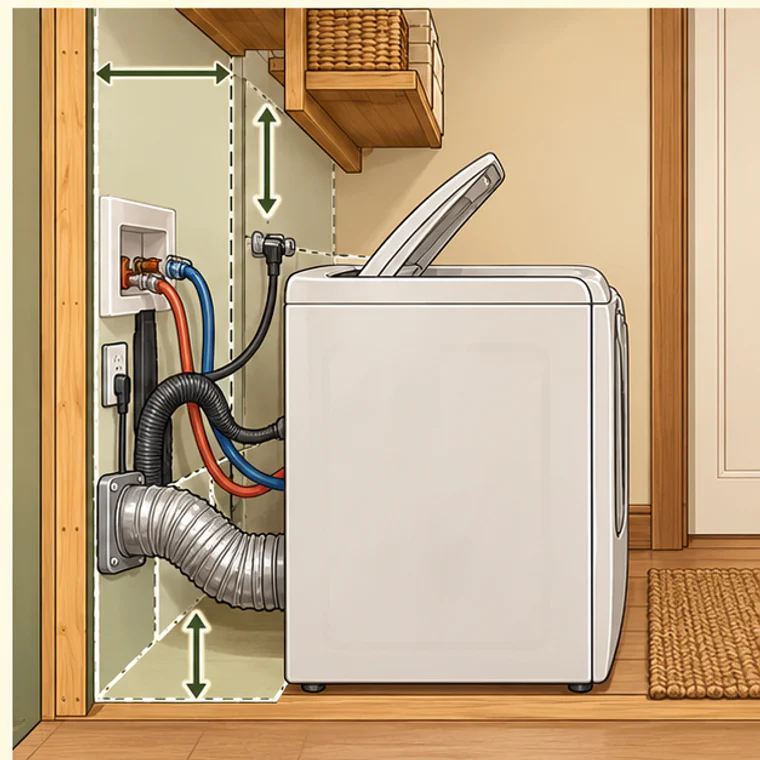
Service zone — preserve the openings before adding height
Appliance doors, top-loading lids, detergent drawers, controls, and service connections all need usable space. A photo with front-loading machines cannot demonstrate how a shelf will behave above a top loader. These constraints should shape the storage choice before you compare how many tiers it offers.
Read the scene: The service scene is a reminder to protect the appliance's working movements, not a fourth storage product.
- Proceed when
- You can establish the relevant conditions from your exact appliance and organizer instructions.
- Pause the purchase when
- The fit depends on guessed clearances or on altering a hose, vent, or appliance position.
Plan for access after installation
Storage should not make an ordinary inspection or service visit depend on dismantling an improvised layout. Consult the equipment instructions and use appropriate help if installation conditions are uncertain. Do not treat an illustration's gaps or arrows as numerical installation specifications.
Check the complete working position
- Try this
- With the appliance stopped, consider each normal opening from an accessible position and map the proposed storage around it.
- What the result reveals
- If the plan only fits when a lid is partly open or a connection is hidden, it is not ready for a shortlist.
- What to change or look for
- Resolve the installation constraint first, then compare the remaining shelf, cabinet, or rack options.
Questions before your next step
Is a freestanding rack a no-drill solution?
Not necessarily. Some designs require anti-tip restraint or other fixings. Read the exact organizer instructions before treating it as suitable for a rental.
Should detergent go on the highest shelf?
Choose a position that you can use comfortably and that meets your household's safety needs. Keep laundry products in their original packaging; laundry packets need secure storage away from children.
Can I use the same layout for front-loading and top-loading machines?
Do not assume so. The opening movements differ, and the relevant appliance instructions take priority over a generic storage photograph.
References and the next decision
For equipment fit and installation, start with your exact model's manual. Whirlpool's dryer venting specifications explain why the equipment concerned needs its own installation and venting requirements; this document is not a universal clearance guide.
For laundry packets, the CPSC safety alert recommends original sealed packaging and locked storage out of children's sight and reach.
Choose the installation approach only after protecting appliance openings and comfortable retrieval. Compare the exact shelf, cabinet, or frame instructions, including loading and any restraint requirements. Extra tiers are useful only when the stored items remain accessible without disrupting the laundry routine.